
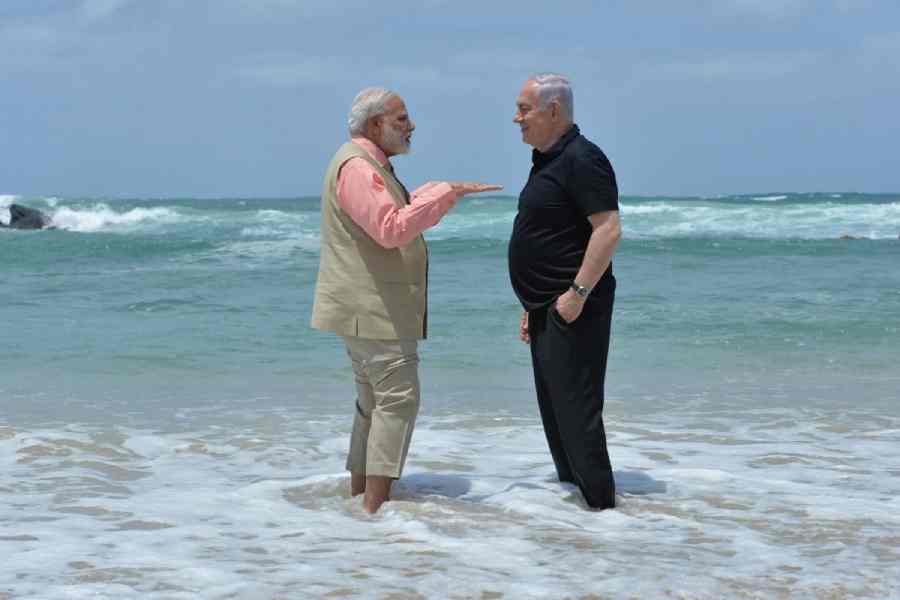
As Narendra Modi heads to Israel this week, his second trip to the country will involve avoiding a series of trip wires.
Modi’s first visit to Israel in July 2017 will stand out as a pathbreaking journey that elevated bilateral ties to new heights. But in many ways, this week’s visit is even more significant — the risks of a misstep are much higher for India.
In 2017, Israel and Netanyahu held a very different standing in the world compared to how they are viewed by most nations today. To be sure, Israel’s apartheid-like policies against Palestinians were in place then, and its creeping expansions into the occupied West Bank were a reality. But officially, Israel still subscribed to the Oslo Accords that committed it and the Palestinians to a two-state solution.
Israel was then on a dramatic diplomatic outreach mission in the Global South that appeared to be paying dividends. Netanyahu had visited Uganda, Kenya, Rwanda, Ethiopia and Muslim-majority Azerbaijan in 2016, China in March 2017 and Liberia in June. Soon after the Modi visit, he would travel to Mexico, Argentina, Paraguay and Colombia. And in January 2018, of course, he would visit India. In short, Israel was gaining greater diplomatic friendships than it had in several decades.
Nine years later, the global landscape is dramatically different. Israel’s war on Gaza, described as genocidal by many global rights groups and a United Nations panel, has turned the country into a pariah. The International Criminal Court has an arrest warrant out for Netanyahu over alleged war crimes in Gaza. He and his far-Right government have rejected the two-state solution that India holds as the cornerstone of its policy towards Israel and Palestine. And Israel is taking steps to formalise its annexation of the West Bank.
There is also the threat of a fresh war breaking out between the United States of America and Iran, with Donald Trump amassing military assets in the Middle East and issuing deadlines for Tehran to capitulate to his demands — or face attacks.
All of this means that Modi will need to navigate his way in Israel with far greater care than he needed to in 2017. Then, India needed to worry about offending Palestinians and New Delhi’s Arab friends. Now, no one any longer expects India to back Palestinian interests — but New Delhi risks tying itself in knots if it isn’t cautious.
Take, for instance, the events of last week. More than 80 countries and organisations, including most of Europe, jointly condemned Israel’s latest steps to exercise its control over the West Bank. India did not join them initially and, after facing criticism, belatedly signed on to the criticism of Israel’s actions. It’s possible this was a bureaucratic slip up, but the apparent hesitation in joining a statement in sync with India’s official position created the perception that the Modi government didn’t want anything to overshadow the optics of bonhomie with Netanyahu during the trip this week.
That sentiment will be strengthened if Modi does not directly raise India’s concerns over the steps towards the annexation of the West Bank with Netanyahu. But will such straight talk sit well with the public love the two leaders share?
Modi is also visiting Israel at a time when — unlike 2017 — the country is actively pursuing multiple wars or near-wars. It bombed Lebanon last week: Gaza knows too that ceasefires for Israel don’t mean that it actually ceases fire.
And have Israel and India secured a guarantee from Trump that he won’t kickstart a war with Iran while Modi is in Israel? How will India respond, diplomatically, if such a war were to break out? We don’t know the answers. But there will be a temptation to follow short-term ‘realism’ over long-standing policies. That would be a mistake: if you stop believing in anything, you eventually have nothing left to defend.
Charu Sudan Kasturi is a journalist who specialises in foreign policy and international relations