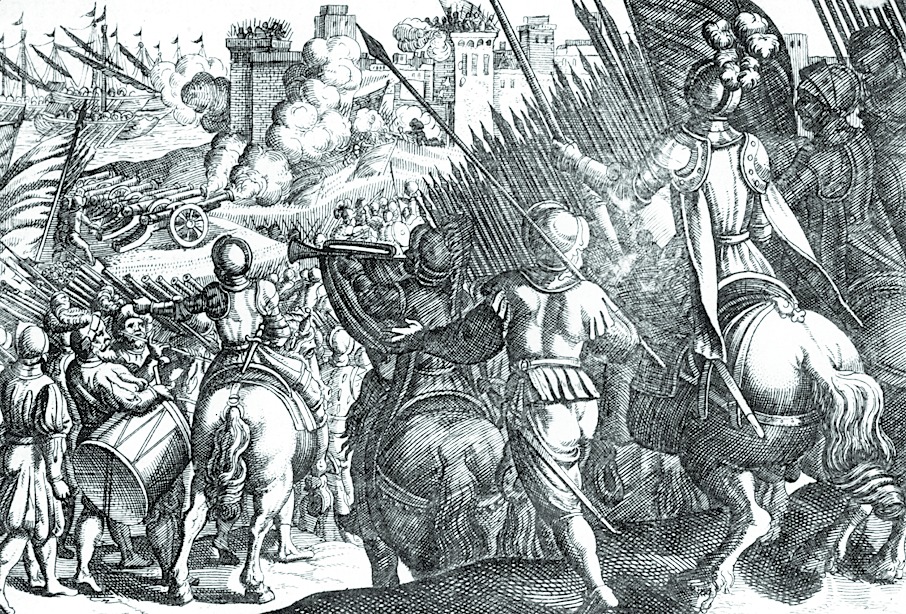

EMPIRE AND HOLY WAR IN THE MEDITERRANEAN: THE GALLEY AND MARITIME CONFLICT BETWEEN THE HABSBURGS AND OTTOMANS By Phillip Williams, I.B. Tauris, Rs 7,153
Phillip Williams explores the "campaigns fought between the Ottoman Empire and the Spanish Monarchy in the Mediterranean in the sixteenth and early seventeenth centuries". The Ottoman empire acted as the "standard-bearer for Islam" and the Habsburg dynasty of Spain stood as the "defender of Catholic Christendom". Interestingly, neither Spain nor Turkey served as the zone of the conflict. The wars were fought in North Africa and along the coasts of Italy and Greece.
The author narrates the events that took place in the period stretching from 1494 to 1620. This period can be further sub-divided into three phases: from 1494 to 1530, from 1530 to 1560, and from 1560 to 1620. During the first phase, the Ottoman Turks made major advances because the Christian States were engaged in bitter internecine quarrels among themselves for the control of territories in Italy and the Low Countries. In the second phase, the Ottoman Turks participated in the Christian civil wars. After 1560, however, the conflict reverted to a familiar and somewhat expected (direct) confrontation between Christians and Muslims.
The wars between the two contending powers were mostly fought on the seas. The salient feature of this protracted naval conflict, however, was the prominence of 'corsairs' or privateers. These were 'State-sponsored pirates' and could be considered as the predecessors of Pakistan-sponsored jihadis. They sailed from "Malta, Leghorn, Algiers, Tunis, Djerba and Tripoli" to "rob the shipping and trade" of their opponents. This highlights that the "holy war was also a business transaction".
Both the Habsburg kings of Spain and the Ottoman sultans used religion to justify "their rule over peoples in 'foreign' lands". However, the motive behind the conquests was quite different. The need to acquire alien land and resources was what drove them. The confrontation between the two powers can be compared to the Cold War rivalry between the United States of America and the Soviet Union. However, the clashes dating back to the 16th and the 17th centuries had their limitations. Unlike in the 20th century, those wars were mostly fought in the Mediterranean Sea.
The Habsburg monarchy was also embroiled in a conflict with the papacy. The 'Treaty of Barcelona', June 1529, between Charles V, the Habsburg ruler of Spain, and Pope Clement VII brought a degree of stability to the Italian peninsula. In 1530, the pope crowned Charles V as the "Holy Roman Emperor, King of the Romans and King of Lombardy". In lieu of the title, Charles V had to commit himself "to fight against all infidels... and pledged that he would never tolerate heretics, schismatics or usurpers of Church property as subjects but instead would persecute them with great alacrity,". The peak of this Christian-Muslim conflict in the Mediterranean, however, was reached during the 'Battle of Lepanto', October 1571. At Lepanto, the coalition of Christian powers, led by the Habsburgs of Spain, managed to inflict a decisive defeat on the Ottomans.
Many interpret the confrontation as a clash between the Western European civilization and the eastern Islamic powers. But the conflict, in reality, was between two dispensations, both of whom were wedded to religious bigotry. After this confrontation, there was a decisive shift in the centre of naval warfare from the Mediterranean Sea to the Atlantic Ocean.
Lepanto also exposed the inhuman treatment meted out to the sailors. 'If there is a hell in this world,' ran a 16th-century saying, 'it is in the galleys where rest is unknown.' A Frenchman, who was himself condemned to the galleys, provides a touching description: "six men chained to a bench naked... one foot on the stretcher, the other lifted and placed against the bench in front of him, supporting in their hands a vastly heavy oar... Sometimes the galley slaves row ten, twelve, even twenty hours at a stretch, without the slightest rest or break. On these occasions the officer will... put pieces of bread soaked in wine into the mouths of the wretched rowers, to prevent them from fainting... if one of the slaves falls exhausted... he is flogged until he appears to be dead and is thrown overboard without ceremony."
Williams concludes that "the dictates of political sovereignty, rather than considerations of military purpose, were the determining features of war between Christian and Islamic states in the Mediterranean in the sixteenth and early seventeenth centuries". This book is extremely well-written and makes a number of pertinent observations.