When asked if he believed in ghosts, Ruskin Bond, the master of ghost stories, replied, “I do not believe in ghosts but I see them all the time.” I am no Bond, let alone Ruskin, and am master of no genre of stories, ghostly or sainted. But, if I were asked, “Are you superstitious?”, I would invoke the great denizen of the Himalaya and say, “Er… no… not super but I do feel ‘stitious ever so often.” That would make me an old weed tangled on a bike wheel, but that would be the truth.
The month of March does that to me. It makes me ‘stitious. Every year, as I turn the calendar and diary page on the first of March, I do so remembering “Beware the Ides of March.” The ides in Latin refers to the middle-day of the month, that is, the 15th, which divides the month into two halves. So, when in his Julius Caesar (Act I Scene 2), Shakespeare makes a soothsayer administer the grim warning, “Beware the Ides of March,” to Julius Caesar, he is not relating history but giving through literature, and high literature too, a set of truths about human nature, the nature of ambition, of politics, of war. He is telling us that the most powerful man imaginable, intoxicated by victory (in this case Caesar’s triumph over his once-colleague and now rival, Pompey), celebrating it, can yet be checked by an ordinary mortal with an insight of his own, and can spurn the warning only to meet doom.
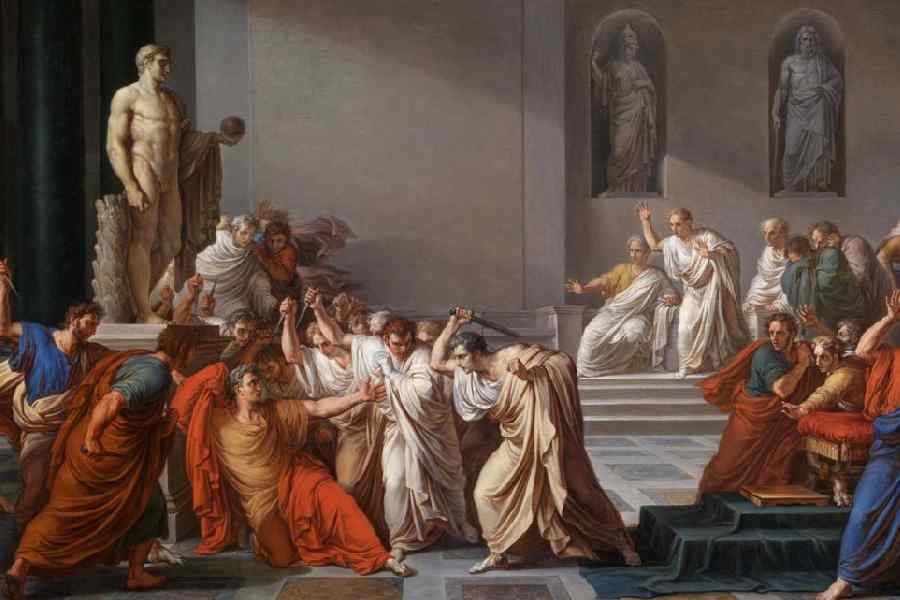
The soothsayer is almost certainly fictitious and never lived, except in Shakespeare’s sense of life’s dramatic richness. But so what? The truth of the Ides of March lives. Caesar, who did live and, on the high summits of victorious power, ignored the prophecy and went to his death, stabbed on the Ides of March, 44 BCE, in Rome’s Senate House by senator-executionists. They dug their knives into Caesar twenty-three times, it is said, to ensure his end. The dagger-wielding Marcus Brutus, immortalised in the dying Caesar’s words, “Et tu, Brute?” (“You too, Brutus?”), went too, at the point of his own dagger, by his own hand, two years later to avoid being captured by the eloquent Marcus Antonius and Caesar’s grand-nephew, Octavian. And Marcus Antonius, too, not long after Caesar, again by his own hand, in the arms of his lover, Egypt’s queen, Cleopatra. That bewitching figure herself also went, self-willed, assisted, says prurient belief, by the fangs of a deadly asp held to her breast.
Over the corpses of all these dead and dying, following the assassination on March 15, 44 BCE, Shakespeare’s line on the Ides of March lives, throbs, when March starts, year after year. With it throbs the vein of ‘stition’ in mortals like me. It is not my intention to remind the reader of wars and conflicts that began in some March or the other, like the First Anglo-Maratha War (March 15, 1775), First Anglo-Burmese War (March 5, 1824), the Battle of the Bismarck Sea (March 2, 1943), Iraq War (March 20, 2003), and Syrian Civil War (March 15, 2011). That would be giving what is mere coincidence a higher plinth than it deserves.
But the Ides of March does say to us that when we talk of March 44 BCE, we are talking of today, of this March, our March of the bombings of Iran by Israel backed by the United States of America, leading to desperate strikes by Iran on targets near it.
And the theatre is eerily the same. Consider this:
Caesar’s republic controlled most of the Mediterranean coast, now rimming the European Union. His conquests took in Gaul (modern France/Belgium) and extended its northern frontier to the Rhine river and the Alps, in what we now know as Germany and Switzerland. Most significantly, his sway extended to the North African coast, including Cleopatra’s Egypt. And to its east lay Greece, the Balkans, and parts of Asia Minor (modern Turkey). But most tellingly, in Caesar’s time, Persia, or Iran as we know it today, came under the Parthian Empire (or Arsacid Empire), rivalling Rome and tempting its expansion in the east. Nine years before Caesar’s assassination, Parthian forces had defeated and killed Caesar’s general, Crassus, in the Battle of Carrhae, modern Harran in Turkey. Flush with his victory in his civil war, Caesar was planning a massive invasion of Parthia in 44 BCE to avenge Crassus, thereby expanding Roman territory into the Middle East and Central Asia. But the Ides of March that year ended that dream.
Revenge is an old emotion. And from all that one can make of it, is deathless.
Modern Israel, Benjamin Netanyahu’s nation-state, was in Caesar’s time under Roman hegemony, Jerusalem and the region of Palestine (then known as Judea) were in a state of political transition, having recently been conquered by the Roman Republic. Following Pompey’s conquest of Jerusalem in 63 BCE, that entire area was under Roman hegemony. But this column is not a class in Roman history. It is about
the Ides of March 44 BCE and the Ides of March 2026 CE being staggeringly similar.
Ali Hosseini Khamenei, who died in Tehran this March as bombs fell on his palace, had ruled Iran as an ultra, the Latin for extreme or extremely. His rule was ultra male. Ask the women of Iran and they will tell you what living in an ultra male state meant. Was he about to become another ultra and do the ultra unthinkable, make a nuclear bomb? Only God and the laboratories of death in Iran know how strong Tehran’s plans for making that ultra nuclear bomb were. But the bombings that killed, along with the Ayatollah, his daughter and grandchildren, and several, several others, innocent as well as belligerent — what were they? They, too, were an ultra. They were ultra vires.
And they have spelt disaster for much more than the areas now under direct fire — originating and retaliating fire. Beginning this March, they have caused, are causing, and will continue to cause disaster across the world.
‘March’ and the ‘Ides of March’ need not evoke superstitious fears. But they can and should alert us to the horrid antics of our — human beings’ — ultra male impulse that lives and plots and works in the minds of the ‘world conquering’ human type. That type is for real. He simply does not go away.
We need to be aware of the Ides of March not superstitiously but super-intelligently to see the fatal folly of transborder, trans-vires, ultra vires ambitions. As India joins other nations and agencies working for de-escalation, we need to see the imperative need for this folly to end not just because killings must end, the suffering of innocents in the theatres of war must end, the serial extension of deaths of perpetrators, in the manner of the consuls and the senators of 44 BCE must not repeat, but because this war can do — and has already begun to do — more than what missile attacks can, through direct incineration. It can give the globe its worst-ever oil shock, its liquefied natural gas crunch and put all of us humans into a near-death experience of energy thirst. Worse, this war can swell into the ultimate of war-scorchings — a nuclear war. Believe me, I write this with fingers crossed, that dire drama may well take place before this column is printed. Israel, possessed of that vile technology, may well deploy it. And if it does, will other nuclear powers just watch saying tut-tut? They will not.
And we need to be aware of yet another horror of a truth: no war in 2026 is going to desist from using the unknown nightmares of Artificial Intelligence. Either way. Let us be sure that there is not just the nuclear bomb which may or may not have existed but the AI ‘bomb’ that can be unleashed and not necessarily from where the fire rages now and not over so-called enemy targets alone.
The Ides of March is not a soothsayer’s prophecy. It is a hard truth. As hard as a dry petrol bunk and a gas cylinder that has only air in it. And as hard as the nuclear knock with AI at its back, which no one has so far felt.
Give it to Shakespeare. He has warned us, this March as never before.