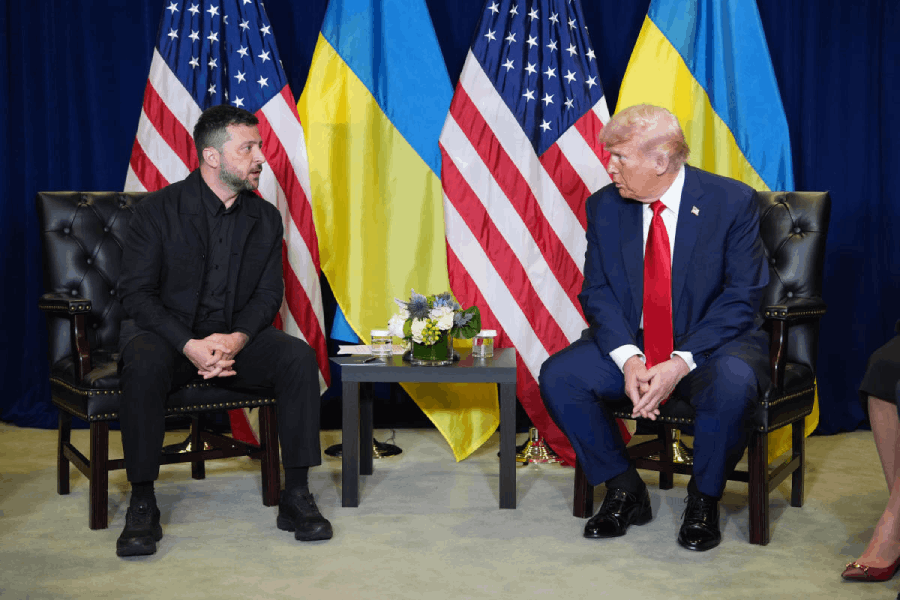
“This is going to be great television,” Donald Trump, the president of the United States of America, had quipped at the end of a White House meeting with his Ukrainian counterpart, Volodomyr Zelensky, in which the former had come across as discourteous towards the visiting dignitary. The remark, delivered casually, captured more than a moment of typical Trumpian bravado. It revealed an innate instinct that has defined Mr Trump’s presidency with unusual clarity. Mr Trump’s mercurial behaviour and his tumultuous presidential stints have often been described as symptomatic of a real estate tycoon who treats politics as a profitable enterprise, examining alliances through the rubric of transactions and reducing policy to negotiation. This description is tidy, but not entirely correct. Mr Trump’s formative public career was forged on television sets apart from boardrooms. For 14 seasons, he was the central figure of The Apprentice and, later, The Celebrity Apprentice. Those programmes offered a telling clue of Mr Trump’s understanding of the idea of leadership — the contestants competed under artificial pressure, conflict was encouraged, decisions were rendered publicly and theatrically. Mr Trump’s role was not to manage complexity but to personify judgment, delivering verdicts designed for maximum effect. A cursory look at the world will reveal that this is how the American president conducts affairs of the State as well.
Mr Trump’s foreign policy perhaps signifies his Reality TV doctrine most effectively. Diplomatic engagements that once took place behind closed doors are conducted as public performances. Visiting leaders — Mr Zelensky is a case in point — are placed in settings where cameras are present and tension is encouraged. The interaction is consistent with a classic Reality TV trope: a controlled confrontation designed to establish dominance — that of Mr Trump. The outcome of the exchange matters less than the image it produces. This style departs from traditional deal-making, negotiations that prize discretion, incremental progress and private compromise. Mr Trump’s preference is the opposite. Announcements precede agreements. Threats are aired publicly — think of the recent warning of 500% tariffs on India. Praise and reproach are delivered to generate polarised reactions. The same sensibility shapes Mr Trump’s domestic governance. Executive actions are unveiled with ceremony while personnel decisions are framed on the basis of loyalty and performance of peers.
Reality TV thrives on surprise and reversal, and a feud is more valuable than a resolution. Mr Trump’s political behaviour follows that rhythm, producing a steady stream of moments that command attention even as underlying issues remain unresolved. This pattern helps explain why Mr Trump’s presidency appears erratic when measured by policy coherence, yet consistent when measured by narrative effect. The consequences are illuminating. Governing through spectacle alters public expectations. Citizens are encouraged to watch politics rather than weigh it and complex problems are reframed as personal contests even as the line between performance and responsibility grows thin. The belief that Mr Trump is, at heart, a businessman risks misunderstanding the nature of his presidency. Business, however ruthless, depends on results. Reality TV, on the other hand, depends on attention:
Mr Trump has made sure that he has got the world’s attention.