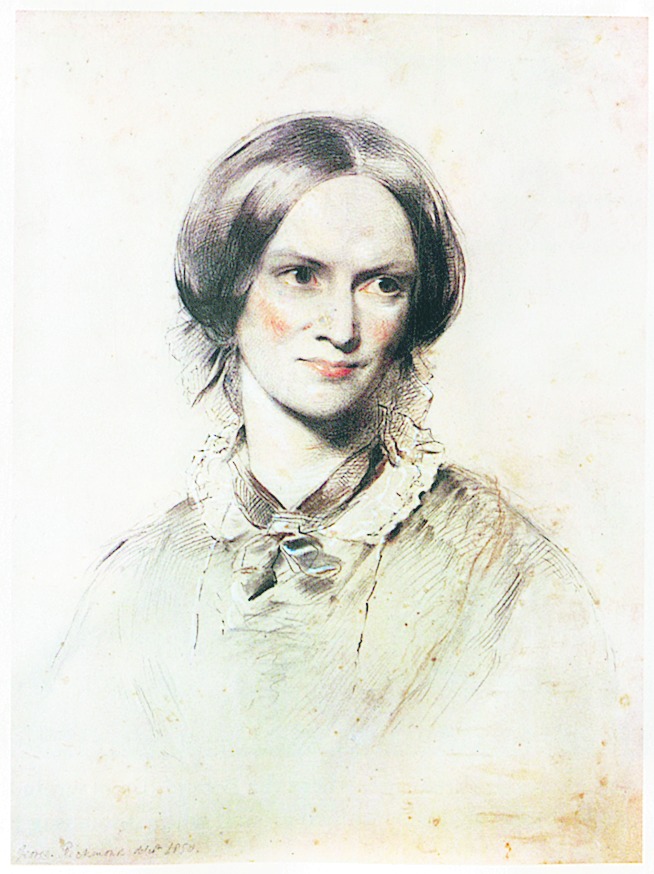

CHARLOTTE BRONTË: A FIERY HEART By Claire Harman, Knopf, $30
Last year, somebody who had bought a photograph of three grumpy-looking, middle-aged women on eBay sought to convince the world that this was the only surviving photograph of the three Brontë sisters, Charlotte, Emily and Anne. Charlotte was 39 when she died, Emily 30, Anne 29. All the three women in the photograph look forty-ish - unless it is assumed that the three sisters had lived beyond the grave, this photograph could not be theirs. Yet the photograph had created quite a stir, and newspapers carried articles defiantly refuting the claims of the excited buyer. This is just one instance of the kind of interest that the Brontë sisters still evoke, more than a century after their deaths. There's the Brontë Blog, which meticulously records every vicissitude in the Brontës' posthumous lives; the Brontë Parsonage Museum in Haworth that has continued to be a place of pilgrimage for the Brontës' admirers right from the time of Charlotte's death in 1855 (Virginia Woolf had visited the Brontës' home in 1904); and Brontëana, which periodically throws up books like the recent Jane Eyre Laid Bare: The Classic Novel with an Erotic Twist, which, the title page announces, is written by "Charlotte Brontë & Eve Sinclair". Now that we are in the 200th year of Charlotte's birth, we can expect yet another surge of Brontëmania, centred on the eldest sister, whose life and works lend themselves especially to prurient imaginings.
Claire Harman's biography of Charlotte Brontë appears to be part of the bi-centenary celebrations. The "fiery" in the book's title and the bright red cover seem designed to give credence to the stereotypes about Charlotte that inspire books such as Jane Eyre Laid Bare. To her credit, Harman steers clear of hysteria and lets Charlotte do most of the talking through her letters and books. Elizabeth Gaskell, Charlotte's fellow novelist and friend, had followed a similar method in writing The Life of Charlotte Brontë, which came out two years after Charlotte's death. In writing their biographies of Charlotte, both Gaskell and Harman seem to have been guided by the wish to see through the popular conceptions about the author of Jane Eyre as a woman who incarnadined Victorian England by loving with passion, losing with vehemence and dying an early, befittingly tragic, death. But in her effort to make a 'normal' woman out of Charlotte, Gaskell had made the Brontës into household goddesses - Charlotte is seen sewing, Emily baking bread and Anne earning that bread by working as a governess in a hostile household. Their piety is proved by their constant devotion to their difficult father, Reverend Patrick Brontë, who had once burnt a dress of his young wife because he considered it to be too fashionable for a village curate's helpmate.
The Brontë sisters in Harman's biography sew and bake all the same, but are less exemplary in their behaviour. Their prerogative is that of authors, who want not just to write but also to be recognized for their works. So the three sisters are found feverishly pacing the dining room of the Haworth parsonage in the evenings, discussing, arguing and composing their poetry and fiction. Fascinatingly, Mr Rochester's mad wife in Jane Eyre, Bertha Mason, habitually paces and runs around her cell, and proves her skill as a pyrotechnician by burning down Thornfield Hall. She could have been a worthy daughter of Patrick Brontë.
Harman does not spend too much time reading Charlotte's unconscious into her novels. She sticks to the conscious: Harman looks for the undocumented history of real objects - such as a lock of Charlotte's hair found among the memorabilia later given away by the Brontës' tutor, Constantin Héger - in incidents described in Charlotte's novels. The connections she makes are too literal at times, but are worth pondering.
Harman begins the biography in Brussels, where a lonely, homesick and lovelorn Charlotte seeks the "relief of communication" by confessing to a priest in the church of Ste-Gudule. This was an uncharacteristic act on the part of the Anglican clergyman's daughter and, as such, is indicative of the intensity of Charlotte's crisis. Harman writes, "Her experience in Ste-Gudule gave her an idea not just of how to survive or override her most powerful feelings, but of how to transmute them into art." Charlotte's novels would become her secular confessionals. Unlike Emily's Wuthering Heights, which has a chaotic array of points of view, all of Charlotte's novels are written in the first person. The illusion of authenticity is almost unbroken: the weird happenings in a novel like Jane Eyre gain credibility by being filtered through the consciousness of the practical, reasonable Jane, who confides in her reader as she would confide in her diary. The 19th-century reader would have found it easy to absolve Jane for falling in love with Mr Rochester although he is a married man. The first-person narration ensures that Jane and the reader get to know the hushed-up secret of Mr Rochester's marriage to mad Bertha at exactly the same moment - by that point in the narrative Jane is already smitten with Mr Rochester.
The events in Charlotte's real life had followed a very different course. She had allowed herself to fall for her Belgian tutor, Constantin Héger, in the presence of his wife and their ever-increasing brood of children. While Héger rebuffed her with the righteousness of a prude, she went on writing him pleading letters: "Why cannot I have for you exactly as much friendship as you have for me - neither more nor less?" Amazingly, Charlotte was livid when she found out that her brother, Branwell, was having an affair with a married woman. Harman writes, "[Charlotte] was not just appalled by his behaviour but secretly furious at the ease with which he had been able to indulge his passions, while she was almost killing herself with the suppression of her own." The object of Branwell's affection was a certain Mrs Lydia Robinson. In 1858, three years after Charlotte's death, a scandal would break out in England over the journals of another Mrs Robinson - Isabella Robinson - who had not only dared to fall in love with a married, younger man, but had also written about that affair with evident relish in her diary, which was duly discovered by her cuckolded husband. Isabella Robinson's 'confessions' in her diary did not help her gain the sympathies of those who read it - unlike a fictional rebel like Jane, Isabella was not the heroine of her own novel - but they did earn her a divorce, which was perhaps what she wanted more than the readers' absolution.
When Gaskell talked of Branwell's Lydia Robinson in her Life, her tone was predictably censorious. Lydia, who had remarried after her husband's death to become Lady Scott, sued Gaskell, and Life had to be revised for subsequent editions. Gaskell also edited out the letters to Héger, publishing only insipid compositions in French that Charlotte had written as his pupil in Brussels. Harman reproduces most of the letters to bring out the possible reason behind Charlotte's overwhelming need to depend on her tutor: he had once valued her for what she was - an intelligent, capable woman with the power of independent thought and with exceptional writing skills. It is easy to see why Charlotte would continue to crave for his approval, if not love. Victorian men were not used to treating women as equals. Even the poet laureate of the time, Robert Southey, while tacitly recognizing the merit of Charlotte's poems, had written to her in a letter: "Literature cannot be the business of a woman's life: & it ought not to be."
If Gaskell stops short at the line of respectability in dealing with Charlotte's personal affairs, she makes Charlotte's sympathies for the Yorkshire working class a matter of paternalistic concern. This is not entirely incorrect: Charlotte, like her father, was a lifelong Tory. But as the daughter of a poor parson who had to find employment as a governess to support the household, Charlotte had also joined the oppressed classes. Harman shows how the "comparable predicaments of workers and women are linked all through [Shirley] in a very interesting meld of the personal with the political". Caroline says in Shirley, "[O]ld maids, like the houseless and the unemployed poor, should not ask for a place and an occupation in the world: the demand disturbs the happy and rich: it disturbs parents."
Harman's biography is best read as a dialogue with Gaskell's Life. She carries forward Gaskell's work, as it were, taking up unfinished issues, filling in gaps, analysing Charlotte's writings to arrive at conclusions which Gaskell's notion of morality would have precluded, and, above all, looking at Charlotte with a more critical eye. Gaskell paints Patrick Brontë in a rather unfriendly light - he is something of a tyrant who makes constant demands on his daughters' attention, retreats into stubborn silence when displeased (which he often is) and lets off steam by "firing pistols out of the back-door in rapid succession" (The Life of Charlotte Brontë). In his selfishness and petulance, Patrick Brontë would be a real-life counterpart to Mr Woodhouse, Emma's father in Jane Austen's novel. His dictatorial ways, which impede his daughters' freedom, would also make him akin to Leslie Stephen as portrayed by his daughter, Virginia Woolf. Harman does not dismiss Gaskell's impressions of Patrick Brontë. But she adds that much of it may have been shaped by what Charlotte had told Gaskell about her father. Charlotte had blurted out to Gaskell, in a manner which Harman finds "disloyal": "At 19 I should have been thankful for an allowance of 1d a week. I asked my father, but he said What did women want with money."