
At the beginning of the 19th century, when the British first conquered the maritime provinces of Ceylon, the indigenous population of the island was estimated at only 8,00,000. Over a century later, as the empire came to an end, the population stood at more than seven million. The colonizers left behind cities with anglicized homes and street names, an abundant hinterland of coconut, tea, coffee and rubber plantations and a network of roads and railways, a postal system, educational institutions and hospitals. By the 1850s, there was a growing number of photographers and photographic establishments too. In other words, things were not very different from India, except of course, the scale.
In fact, one is tempted to say that it is the compactness of the island that lends itself to broad interpretations of its totality: the recent exhibition at the National Museum, Imaging the Isle across - Vintage Photography from Ceylon by the Alkazi Collection of Photography, being a case in point. Different sections dealt with the various aspects of a colonial archive - cityscapes, buildings, portraiture, plantations and plantation workers, and the ubiquitous corpus of 'views' and the picturesque. By the middle of the 19th century, visual representation as a source of information became an important component for the rulers; relating to an alien land meant balancing the quest for similarities with the principle of difference needed to govern, and photography was an important aid in this laborious process.
The camera was extensively used by the rulers to record, document and analyse physiognomic aspects of the native population and the country's architectural and natural wealth. Commercial studios developed the genre of the family portrait, while a small band of photographic adventurers re-created notions of the picturesque through landscape. Although Ceylon did not have a Lord Canning to initiate something as far-reaching as The People of India project, the colonizers could hardly rein in their fascination with ethnic differences. The exhibition had images of men and women in different occupations and from various communities - and there was even one of "a dwarf" standing next to a 'normal' man.
As in other colonial metropolitan centres, there were a few significant women photographers as well, writes Ismeth Raheem in an article in the accompanying catalogue. Included in the exhibition was an interesting example of on-site photography by Madame Del Tufo, whose work through her Colombo studio at the historic Galle Face Hotel spanned both world wars. She was obviously commissioned by the well-placed Frederick Dornhorst to photograph his historic home, Calverly House, and its members, who are seated along the seemingly endless broad verandah. It is an interesting take on family photography, drawing equal attention to the space as well as to the people. Although Samuel Bourne did visit Ceylon, it was the studios of W.L.H. Skeen and Company and Charles Scowen and Company that dominated the photographic scene.
British fascination with the railway and its role in helping them entrench themselves in the country is well-documented through cleverly taken photographs. Building railway lines, tunnels and bridges could be quite treacherous and scary as is evident from a photograph of an engine at the Kadaganawa pass or chugging into view at Sensation Rock: possibly taken from a point where the terrain broadens out a bit, the second image highlights well looming rock faces and the sheer drop into infinity. Clearly, one of the aims of such photographs was surely to convey to viewers back home the dangers of working for the empire. On display was an interesting deep shot of gnarled roots of old rubber trees in the Royal Botanic Gardens, Peradeniya. Here, to show scale and size of the main object of the photograph, Scowen and Company had used the technique popular at the time of positioning human figures in the frame; self-conscious, bare-chested turbaned workers seated on various roots were able to convey the sense of how large the trees could be to a viewing population who had perhaps little idea of tropical flora and of appropriate clothing for the colony's fetid heat.
Those of us who have grown up in the aftermath of colonialism and continue to live in post-colonial India might have the occasional fleeting thought of the raj as we pass the Writers' Buildings or Rashtrapati Bhavan - or even think of the ultimate historical irony of Hastings Road being re-named Krishna Menon Marg. In present-day Sri Lanka, however, road names are apparently not being changed with the same alacrity and it is still possible to find Chatham Street - though how very different it is today from the image in the exhibition in which a worthy bullock cart waited under a tree while a few lungi-clad men were visible here and there. Traditional conveyance on a pot-holed road could not have been further from the legacy of William Pitt, the first earl of Chatham - yet a nostalgic ruling elite named it thus. Memories linger on in Rosmead Place, Mackenzie Road, Guildford Crescent... or in the neo-baroque old Parliament Building, the grand cupola and gardens of Government House - now the President's House.
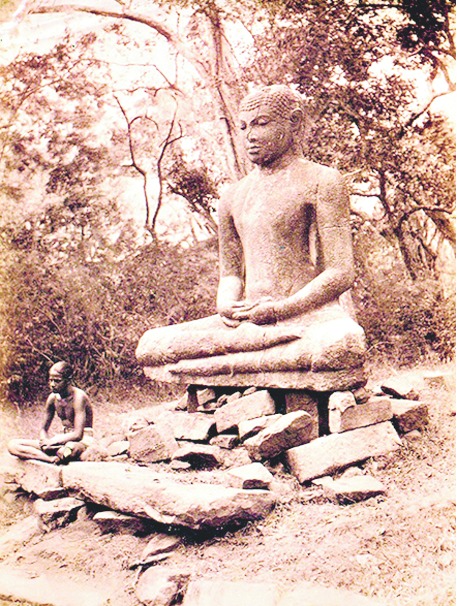
The perahara, an annual Buddhist procession, Kandy's lake as well as the many statues of Buddha and ruined temples as well as formal studio portraiture of elite men and women were well represented in the exhibition. This photograph by Skeen and Company of a huge seated statue of the Buddha in a half-padmasana pose, his hands in dhyana mudra with a man sitting at the side is particularly interesting [picture]. The figure which is used to emphasize the relative size of the statue, ends up being an annoying distraction for the purist keen on appreciating the magnificent carving without having to also view a slouching figure; with hands placed casually in his lap, his body language is indicative of resistance at being possibly bulldozed into the image. The colonized masses rarely had the option of choice - nor could they influence the rulers' "harsh and clinical pre-conceptions" (Rahaab Allana in "Island and Connected"). Sometimes, the image confirmed stereotypes; at other times it exoticized, particularly when 'native' women were the subjects.
Thus it was not unexpected that photographic 'models' would be wary and even apprehensive, and these responses are palpable in the subjects of many photographs taken to record physiognomic types in the subcontinent; interestingly, they are largely absent in the gay abandon of young, lower-caste Ceylonese women and male toddy and rubber tappers. The colonies encouraged a range of emotions and feelings in the colonizers as well -desire and fear being the dominant ones. And of course, the subtext of such emotions was the need for surveillance and control - Foucauldian panopticon structures were not unknown and were photographed, even as places of worship were converted into 'spying' towers without a thought to local sentiments. Taking further the notion that colonial photography was rarely innocent, in her article, Annamaria Motrescu-Mayes reminds us of underlying ideologies: there was, she writes, "a romantic urge to 'hunt' [not 'hunt for'] picturesque images" as there was the need to embed bodies in exotic landscapes.
Photographers soon found that the camera could be readily manipulated - though in ways very different from the present day where everyone with a cellphone is an image-maker. As Jennifer Chowdhry Biswas points out in her article, "A Landscape of Desire", the strategic location of the island lent itself to visualizations of a gentle landscape, although strife and unrest were never far away. Postcards soon joined the visual gallery as Ceylon was promoted as the gorgeous emerald pendant at the tip of the British Indian empire. At the individual level, sartorial styles in the colonies were hybridized in most interesting if not amusing ways, such as in the photograph by Skeen and Company of a Ceylonese man wearing trousers under his lungi; called the sarayamata mahattaya or 'the trouser under the cloth', Ayesha Matthan informs us that such innovations were often caused by a move to salaried white-collar urban occupations - as was also the case with the jacketed bhadralok who nevertheless did not abandon the dhuti in favour of trousers - hidden or otherwise. In a fast-changing society, to be photographed thus legitimized the role of innovative dress codes in the process of mobility. If the colonials used the camera for their own ends, so did emergent indigenous elites. Photographs were useful tangible additions to the props needed to support an imagined world view as a hierarchical society became overlain with racial divides.
karlekars@gmail.com