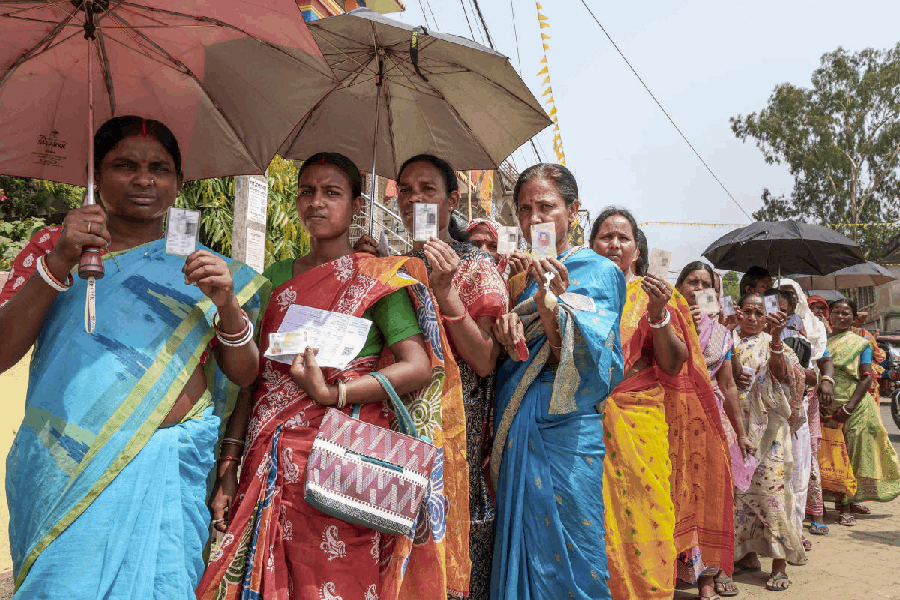
Data released by the Election Commission of India on Saturday suggest that the voter turnout in the first phase of Bengal’s assembly election was a little over 93%. This, undoubtedly, is an unprecedented, impressive development. Earlier, on Friday, a bench of the Supreme Court, commenting on the record voter turnout, expressed satisfaction and remarked that this testified to a robust democratic process. There is, however, a different way of interpreting the rise in voters’ numbers. Firstly, there is the arithmetic. The Special Intensive Revision of Bengal’s electoral rolls, a contentious exercise, had led to a dip in the total number of voters — by an estimated 12%. So a rise in the voting percentage was not surprising. There is a second, even more telling, causal factor behind the high electoral participation. The SIR’s nature was both peculiar and exclusionary in this state. In Bengal, the EC introduced parameters for ineligibility — the mysterious ‘logical discrepancy’ criterion — that were not applied in the case of other states undergoing the SIR. There have been innumerable incidents of bona fide voters alleging that they were stripped of their electoral rights: the voluminous number of applicants for adjudication at the appellate tribunals is a case in point. This random, exclusionary edge of the SIR generated fear of mass disenfranchisement, forcing migrant constituencies as well as white-collar workers to return to their home state to vote in large numbers. The EC’s data also reveal that women, another constituency that bore the brunt of the SIR, had turned out to vote en masse in the first phase. Public participation was, indeed, high; but a subterranean element of anxiety and unease may have been the principal factor.
This leads to a set of questions that merit scrutiny. Can voters’ turnout that is the consequence of the dread of disenfranchisement be a testament to the potency of a democracy? The query is all the more pertinent given the fact that an august institution, one of democracy’s minders, stands accused of stoking this collective sense of exclusion by conducting a routine bureaucratic exercise in an allegedly arbitrary, insensitive manner. Another relevant query cannot be dismissed either. Should an election, with the attendant clause of voters’ turnout, be the only yardstick for judging the strength of a democracy? Should not the unbiased nature of institutions count as well in this context? These are deliberations that the republic must engage with urgently.