|
|

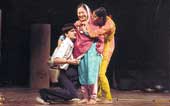
Rangakarmee’s tribute to Manto terminates with Manto aur Manto (picture). The conceptualizer and director, Usha Ganguli, trisected her trilogy as follows: Badnam Manto on women, Sarhad Par Manto on Partition, and this one on “the human being”. The overlaps among these themes are so obvious that one cannot take the distinctions too seriously. Episodes from the first two can easily fit in here; likewise, some from here suit the earlier collages better. Equally, if we agree on “obscenity” and censorship as the connecting thread in Manto aur Manto, a few of the previous stories can claim space here.
Ganguli does write the author in as a character for this edition, which differentiates it somewhat, but even Vinay Sharma’s ironic portrayal of Manto, and the reading of his open letters to the US president, cannot prevent us from thinking of them as secondary to the force of his fiction. And as we have seen in the past, Ganguli’s own matter-of-fact storytelling (here, of Bu) as a sutradhar decisively undercuts the theatricality of the rest of the production.
Leaving aside Bu, she dramatizes three stories. Dhuyan depicts the sexual awakening of a schoolboy and his sister, mingling in his mind with images of a goat’s carcass. Tetwal ka Kutta, about Indian and Pakistani soldiers claiming a dog as their own, is a canine equivalent of Manto’s famous Toba Tek Singh, therefore far more appropriate for Sarhad Par Manto. My pick is Thanda Gosht, the horrific tale of the ironically-named Ishwar Singh, who kills and attempts to rape during a riot, and how his wife gets the truth out of him. Dilip Bharti and, particularly, Srabani Bhadury act with frenzied violence, metaphorically mirroring the narrative.
Ganguli’s newest project, Khela Gadi, evolved from her social work among underprivileged Muslim women in Khardah, who related their life histories to her. One of them, Zohra Bibi, joins Rangakarmee as the protagonist of this play. Riding her van-rickshaw around the stage, she looks like a latter-day Mother Courage, except that she actually drives one for a living. She also narrates her experiences as a circus acrobat and daily labourer. The script, by Subir Mukherjee, roughly puts together incidents from the Khardah women’s lives, retold by Rangakarmee’s regulars. One was raped by her father-in-law, then excommunicated; one escaped as an 11-year-old from preparations for an arranged marriage; one was assaulted periodically by her husband. They unite to exhort all women to fight oppression, become self-sufficient and cooperate in collectives. Khela Gadi must travel to villages and perform in the open to convey its strong message. Its loose structure is not meant for the proscenium.