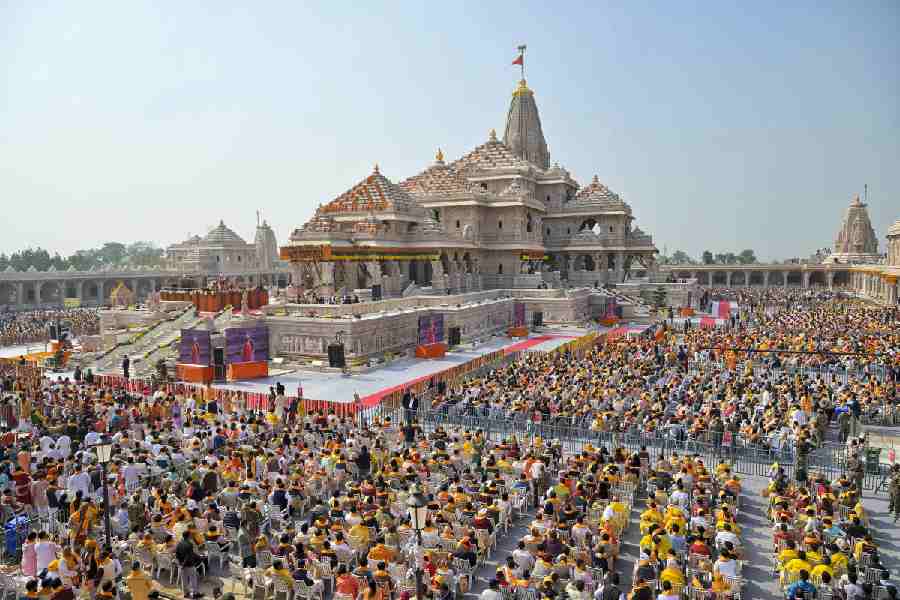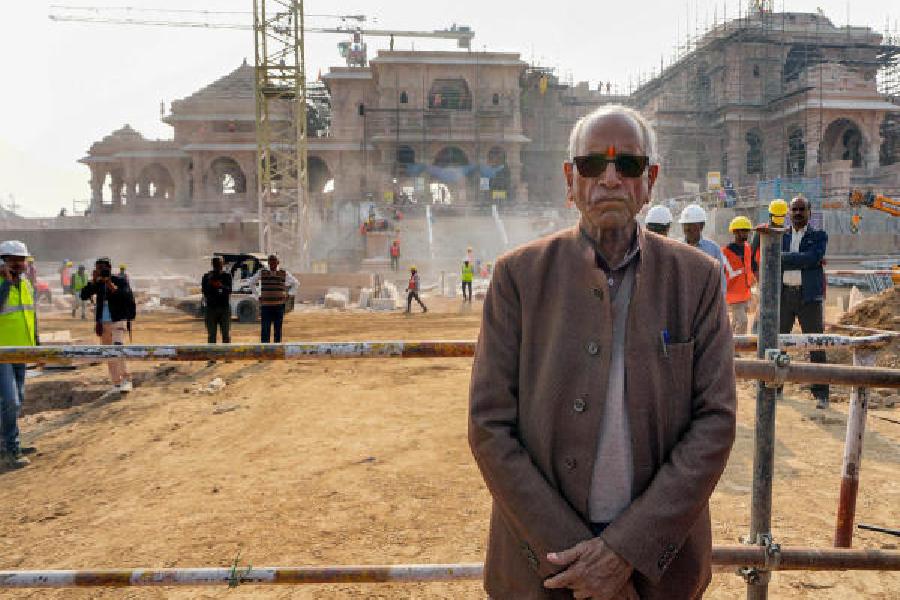
Judging by the latest, officially-released information on the Ram Mandir theft, we may have jumped from the frying pan into the fire in discarding Trinamool Congress for the Bharatiya Janata Party. It appears that the ‘cut money raj’ that Narendra Modi boasted of having ended kept his Shri Ram Janmbhoomi Teerth Kshetra Trust, which manages the Ram temple in Ayodhya, going. No fewer than 125 temple employees were recruited only after paying commissions.
Nor was Asaduddin Owaisi’s explosion over the blame for the thefts too surprising. Never in the story of man can so many flaws have been laid at the doors of one organisation as the crimes attributed to Mamata Banerjee and her followers. But
why go so far? I was 11 when Mahatma Gandhi was killed and well remember my grandmother’s Muslim
driver from Simultala in Bihar,
where we had family links, worrying that Muslims would be blamed
for it.
Gandhi’s murder was, of course, a fundamental tragedy with national and regional overtones. It could have had a permanent bearing on basic linkages between the two communities. M.S. Golwalkar, arch champion and strident spokesman for the Hindutva cause, paid fulsome tribute to “the greatness of Hindu culture”. But as the All India Majlis-e-Ittehadul Muslimeen chief warned, citing Golwalkar, “The non-Hindu peoples in Hindusthan… must not only give up their attitude of intolerance and ungratefulness towards this land… but must… stay in the country wholly subordinated to the Hindu Nation, claiming nothing, deserving no privileges, far less any preferential treatment — not even citizen’s rights.”
Owaisi’s half-jocular advice was that “They should have kept a Muslim in the trust and closed the case with his encounter (death) and by bulldozing his house.” He added to that, “Champat is having fun!”, meaning Champat Rai, one of the people being interrogated for the temple theft but whose decision to quit as the Trust’s general-secretary poses intriguing questions to which no replies have been given.
One can hear echoes of Nazi Germany’s anti-Jewish propaganda in Owaisi’s declamation on Muslims. If the echoes are distant, it’s because both sides in India know when to stop. Taking a more literal view of the Biblical injunction, “Give to Caesar the things that are Caesar’s, and to God the things that are God’s,” Owaisi had asked the Uttar Pradesh government a few days earlier whether a bullet would despatch the accused or a bulldozer crush his house, both being (according to him) the usual fate of Muslims in the state. Uttar Pradesh is India’s most populous state. Its approximately 38.5 million Muslims are heavily concentrated in towns and make up 19.26% of the population.
Natural justice as well as legal logic demands that punishment should match the crime. The 2004 theft, from a glass showcase at the Rabindra Bhavana museum in Santiniketan, of the original 23-karat gold medal that was awarded to Rabindranath Tagore when he won the Nobel Prize in 1913 certainly merited the strongest possible punishment that civilised law and humanity can prescribe. Although eccentric billionaire collectors of the unique are a stock figure in fiction, no one will pretend that Tagore’s medal was stolen by — or for — someone who held him in reverence. It was very likely taken for that most base of reasons — greed — and was probably long ago melted down for the gold. Criminal though the act was, neither the bullet nor the bulldozer that Owaisi mentioned would have been appropriate punishment for the offence.
In fact, this is where the law falls short of reality: it isn’t able to offer an appropriately severe form of retribution. That also applies to some of the objects (and certainly the pile of cash) that are said to have disappeared. Also to the seemingly sudden increase in the disposable money in the hands of some not particularly well-paid functionaries of the Trust. Little is known precisely because the authorities have chosen to respond in a manner that cannot but invite scepticism. Initially, they pretended that nothing had been lost. Then the official investigation reported that approximately Rs 7 crore to Rs 7.5 crore were embezzled. Raids and searches are said to have yielded Rs 79.85 lakhs; but Opposition political groups say that the stolen sum could exceed Rs 200 crore. Arvind Kejriwal, the former revenue officer who was awarded the Ramon Magsaysay Award for his involvement in the movement against government corruption, and who is now a major Opposition figure, calls it a “maha dacoity”.
Others hint at supernatural intervention. Speaking at a public rally in Uttar Pradesh, a prominent member of Modi’s BJP, Anil Singh, who is also the local member of the state legislature, announced dramatically, “Those who have stolen from Lord Ram’s temple will directly get cancer. It will be a death sentence from God.” For his predecessor, Pawan Pandey, the godly Ram himself is the divine whistleblower who is directing the former Uttar Pradesh chief minister, Akhilesh Yadav, in tracking down the thieves.
Thundering oratory notwithstanding, there is no hint as yet of these exchanges presaging a Hindu Götterdämmerung. On the contrary, a government that has more than a finger in every pie is probably making a deliberate effort to keep everything especially low-key. It cannot but recall from experience and example, especially after the Gujarat killings of 2002, that however serious Muslim outrage might be, the rage of a roused billion Hindus could have a very different outcome. Owaisi’s taunts and sneers are an irritant but not yet major provocation. But while variety is the soul of democracy, a little less aggressive posturing might make for more harmonious interaction.
I mentioned our driver. Childhood memories of his Simultala community included no in-your-face religious posturing. Beards and burqas may not have been totally absent but none stand out in memory. Lifestyles were not markedly different. When I was alarmed one day by a small green and yellow snake in the bathroom, the Muslim bearer was dismissive. It was harmless, he said. “We call it Shiv-ka-jatha!” Folk culture was much the same across the religious divide at that simple level.
It’s different as you climb society’s rungs. Kejriwal’s bewilderment at Amit Shah’s refusal to visit the Ram temple at Ayodhya (although “he considers Ramchandraji to be God”) even more than two years after it was consecrated is therefore either feigned or a calculated piece of ingenuousness designed to embarrass the home minister. Power is the only deity that people at the top of the political ladder are wedded to; and power is a jealous spouse. As for Modi’s enthusiastic participation in all the elaborate consecration rituals, power is also polyandrous when it suits the purpose.
Whichever way the wind blows, three obviously inescapable lessons deserve to be noted.
For all the government’s boasting about efficient management, the Ram temple scandal exposes its utter inability to discipline employees and hold them to a strict accounting of their duties. Second, if the devotional aspect hadn’t been bogus, supposedly practising Hindus in lay ecclesiastical positions would never have thought of abusing their trust and exploiting the faith in order to make money. Finally, there is little to choose between Hindus and Muslims when it comes to shirking responsibility.
There’s a fourth lesson that one hesitates to consider. That is the rumour that the eight arrested men are only small fry, and that the real culprits have gone scot-free. No one knows where the finger of suspicion might point without information that only the government can provide. When will it break its silence and come clean?