In June last year, India was gripped by the discovery of the dead body of a young businessman in Meghalaya, near one of the state’s iconic landmarks — the township of Sohra, better known to the world as Cherrapunji, fabled for torrential rain and its stunning waterfalls leaping over cliffs. The incident — the killing of the Indore-based businessman, Raja Raghuvanshi, allegedly by his wife, her lover, and his accomplices — was not the kind of publicity that local residents, hugely dependent on tourism, wanted.
However, a robust local response to the crisis, despite an adverse media and truculent family members of the victim and his spouse, helped the police crack the case, brought confidence back among tour operators and visitors. The media stationed some television crews and correspondents in Shillong: for a few days, the Raghuvanshi case, little more than a tawdry murder mess, became one of the biggest breaking stories in India with the usual hysteria and drama that are typical of the noisy media. Yet the owners of those channels or the media editors did not think it worth their while to send their teams to Manipur to report on a far worse tragedy.
The Raghuvanshi case has faded into distant memory and Meghalaya seems to be on a boom as far as tourism is concerned. The influx may have been boosted by the publicity generated by ubiquitous YouTubers, many of whom exaggerate the virtues of places they know nothing about in depth, and also by visuals of vast traffic jams ruining holidays in places like Dehradun and Shimla.
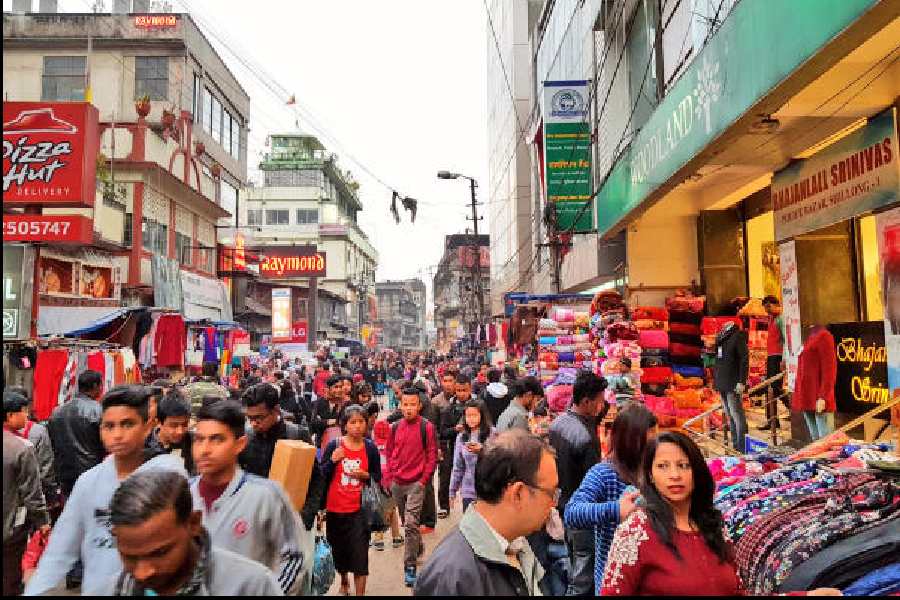
In fact, this large inflow may also have been caused by a desperate wish to beat the heat that is roasting many parts of India. The cafes are packed, streets are full, markets are busy and traffic is bad. The latter has been frustratingly slow for at least a decade with a soaring, unregulated growth of people, vehicles and cemented buildings. Consequently, groves of trees and green hills have been denuded.
The tourist pressure has been so extensive that the hamlet of Mawlynnong, with the moniker of the ‘cleanest village of Asia’ (bestowed by the magazine, Discover India, with no reference to villages in Japan, South Korea or Southeast Asia!), decided to ban tourists on Sundays, saying that while people welcomed visitors, they needed time to catch their breath and spend time with their families and at church. They’ve successfully implemented that decision; it seems to be the kind of social distancing that is necessary if pristine spaces of the state and other parts of the Northeast are not to be overwhelmed by a flood of largely middle-class, noisy, and insensitive travellers, some of whom think nothing of jumping into a limpid pool in shorts, singing tunelessly, and dancing to a noisy Bollywood number. Other places in the region would do well to follow Mawlynnong’s example because such incidents are becoming a public nuisance.
Thus, a few days back, videos emerged of Indian tourists cavorting at the foot of one of the great waterfalls in Sohra. In another, in a nearby area, people could be seen doing pull-ups while passing under a living root-bridge, which has received a UNESCO world heritage tag (one of its preservers was rightfully awarded the Padma Shri the other day). Such visitors need to be penalised by law as do those who litter by tossing plastic wrappers and trash as they casually go by.
Tourism is growing because it’s also part of an official campaign by the Meghalaya government which is incentivising tourism, home stays, and announcing plans for more five-star hotels in Shillong and Tura, the family home and political stronghold of Chief Minister Conrad Sangma. The flow of travellers could become a veritable deluge as there are few rules and regulations to make it sustainable.
Taking advantage of the influx and the business opportunities, almost every other house in Shillong appears to be announcing itself as a home stay, a B&B or a hostel for students, or a café, some doing better business than others. It’s a pattern seen in other large towns of the region.
Meghalaya has some robust traditional local governing institutions: they ensure that streets are swept clean every morning in Shillong’s neighbourhoods. These Dorbars or Shhnongs (as they are known in the Khasi hills) need to invoke their hereditary powers using a mix of traditional rules and new ones, including, possibly, fencing off key areas and a ban on loud music and other activities that disturb peace. The police also need to keep an eye.
Don’t get me wrong. I’m all for people having fun and enjoying the sights of this country, either backpacking or in comfort. But this has to be done in a way that doesn’t offend local communities and intrude into spaces that nature created over millions of years. Local communities are inheritors and preservers, while many of us are first-time visitors.
There is a darker side to all this. In the Jaintia hills, silently and without fuss, large cement factories have been set up, clearing forest land, obviously with local and official connivance, to feed the gargantuan appetite of a construction boom, thereby adversely impacting water bodies. Illegal and dangerous coal rathole mining continues despite a ban, despite regular deaths and disasters, with a sly official nod and protection bypassing dozens of stinging official reports pointing to collusion and corruption stretching high into the system. Coal loads disappear from depots and roadsides. In the face of this environmental degradation, one student pressure group announced its support for the demand by the coal mining lobby to resume mining! Student organisations here, ubiquitously called NGOs, have long demanded the introduction of Inner Line Permits to control migration and settlement by outsiders, saying these would change the state’s demographic profile. Yet, one has not yet heard of the activist groups raising the issue of the unsustainable flood of tourists — last year, 17 lakh visitors came to Meghalaya. That is the equivalent of about half the state’s population.
Despite this hype, Meghalaya lies at the bottom of India’s education ladder, below Bihar, Uttar Pradesh and neighbouring Assam, according to a Central government assessment. It scores poorly in such indicators as education infrastructure, teaching skills, dropout rates and has witnessed the extraordinary spectacle of having over 2,000 ghost schools — schools with paid teachers but no students. Closing these schools, the chief minister said recently, presents a complex political problem.
So it’s a Catch-22 situation: a small state with limited funds of its own is trying to innovate and overcome the tyranny of distance and long-time dependence on the Centre, by winning international funding, pushing tourism and soft skills and local talent in music and sports. Yet, it needs to invest as much funds and give as much priority to bridging the chasm in primary and secondary education as it is giving to tourism. No state can grow without the basics of education.
Sanjoy Hazarika is a writer who specialises on the Northeast and travels extensively in the region