 |
| A complex man |
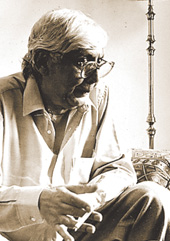
Dom Moraes died over three years ago on June 2, 2004. He was buried in the Sewri Christian Cemetery in Mumbai. He had never been a practising Christian. Although he was born in Mumbai and died of cancer there, and was as dark as a Goan, he considered himself English, spoke no Indian language, and wished to be buried in the churchyard of Odcombe, a tiny village in Somerset. The reason was that one Thomas Coryate, who hailed from Odcombe, had walked all the way from England to India in the 17th century and died in Surat where he is buried. Dom and Sarayu Srivatsa, his lady companion during the last 13 years of his life, went to Odcombe to collect material on Coryate’s background for a biography.
Dom published ten collections of his poems and 23 books in prose on his travels to different parts of India and the world. He was rated the first among Indian poets writing in English. His poetry is beyond my comprehension but I read all his other books, since I found his prose good, if not better, than any written by his contemporaries. Somehow, I had missed his last book, written jointly with Sarayu, Out of God’s Oven: Travels in a Fractured Land. It was published in hardback five years ago. I read its paperback edition published recently. That is my excuse for writing a second requiem for Dom (or Domsky, as he was known to his friends). I know his father Frank Moraes as well. Father and son were very close as Dom’s mother became violently insane and died in a lunatic asylum. Dom was my friend from his years at Jesus College, Oxford; he often visited me in London. I stayed with him and his then wife, the actress Leela Naidu, in Hong Kong while they both visited me frequently in Delhi.
Dom was a complex character. He disliked everything about India, particularly Indians. The only exceptions he made were the good-looking women he took to bed. Yet his description of the Indian countryside, of the heat and dust storms of summer and of the monsoons are lyrically beautiful. His characters, too, come alive. Despite his ignorance of the Indian languages he was able to comprehend what they said in their dialects and in Indian-English. He was not choosy about his women: if any of them was willing, he was always ready to oblige. He is said to have married thrice; and his second wife, Judy, bore him a son. But I don’t think Dom paid for his education. And I am not sure whether he had civil or church weddings and court divorces. In any event, he certainly did not pay any alimony to his former wives. He never earned enough to do so. It appeared that the only real love in his life was Sarayu. She was visibly shaken by his death. Sarayu is a Tamil Brahmin married to a Punjabi, and is a mother of two children.
Like his father, Dom was a heavy drinker. At the best of times he spoke in a low mumble, hard to understand. I had asked Indira Gandhi, whom he interviewed many times to write her biography, if she understood what Dom said. She had beamed and replied, “No, Leela Naidu translated it for me.” After reading Dom, she had snubbed him for a few critical words.
Because of his love for the bottle, Dom could not be depended on for meeting deadlines or sticking to the subject he was commissioned to write on. Ram Nath Goenka of The Indian Express had sacked Dom for spending his time in a Calcutta hotel, drinking and consorting with a lady, instead of going on his assignment to the Northeast. His friend, R.V. Pandit, fired him for drinking in his office in Hong Kong. The Times of India appointed him editor of a magazine they intended to bring out. But they fired him before the first issue came out. He vent his anger on poor Prem Shankar Jha, who was appointed in his place, by grabbing his tie and asking him, “Fatty boy! What do you know about journalism?”
I had got him an assignment from the Dempos — shipping magnates and mine-owners of Goa. Dom produced a very readable book on Goa without mentioning the Dempos. I had to add four pages on the family. He was commissioned by the Madhya Pradesh tourism department to do a book on the state’s historical sites. He did a memorable job on the beauty of the landscape and its full-bosomed tribal women without bothering about historical sites. Dom never allowed facts or truths to stand in the way of his lyrical prose. He did not write reference books; instead he painted pictures in vivid colours to the songs of flutes.
Out of God’s Oven is an excellent sample of Dom’s writing in partnership with Sarayu. His contempt for everything Indian finds easy targets in what he hated most — the resurgence of Hindu fundamentalism in Bajrang Dal, Shiv Sena, Hindu Vishwa Parishad, the Bharatiya Janata Party and its progenitor, the Rashtriya Swayamsevak Sangh. He exposes their vandalism, their penchant for violence and pathological hatred of Muslims. Sarayu is gentler with her characters and tends to caricature rather than castigate them. Between them, they traverse the length and breadth of India, interviewing poets, writers, editors, film-producers, Naxalites, Ranbir Sena leaders, dacoits, and politicians. Once you start, you cannot put the book down.
Black buck, bad luck
First it was Sanjay Dutt
Imprisoned for burning a rifle butt
Now its Salman’s bad luck
Imprisoned for killing a black buck
Killers and terrorists with rifles are
loose
So are poachers of tigers, rhinos and
smugglers of booze
What got these stars trapped in the
first place?
May be it was the height of their
blaze
Pity they were put behind bars for
public gaze
T’would have been better instead
To make them pay a crore from their
wealth
For the homeless in need
Or to enable the black buck to breed.
(Contributed by Sami Rafiq, Aligarh)