
Theories on criminal justice can often operate in an ambiguous realm where the legislature is in a constant endeavour to strike a balance between deterring criminals and upholding their basic human rights. The lines often get blurred when the issue relates to drug abuse. To create an effective criminal justice system, institutions need to not only prevent and deter but also reform the deviant.
Reform and rehabilitation of offenders forms the core of a restorative justice system — where the focus lies on the victims and offenders and the communities at large rather than a restricted focus on punishment to the offender. These elements are required to be infused in the reality of pragmatic functioning in our fight against drug abuse.
While most countries shudder at the thought of scheduled drugs like heroin and cocaine slithering into their homes, we as a country face a situation where most lethal drugs can be bought over the counter, especially in the border states of north India.
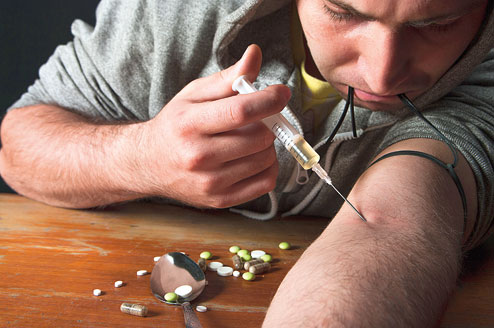
The drug menace in India is a pressing reality today and it is only if the idea of rehabilitation of addicts is explored within or outside the parameters of our legislation that the issue can be tackled. With 70 per cent of addicts between the ages of 17 and 35 and 50 per cent of the drug-related cases being registered only in Punjab, the loss to posterity is already incalculable.
In an attempt to cater to the problem, the ministry of social justice and empowerment lately sanctioned 28 new rehabilitation centres in Punjab in order to pay special attention to the issue.
The surging nature of the problem is evident from the fact that in Punjab the need for rehabilitation facilities are equated to a bare necessity of a dispensary — there now exists a demand of having one in each district.
The stigma attached to the label of an addict and the societal taboo inherent in getting treatment for de-addiction does not help either. Addicts are mostly tried under our penal laws and eventually imprisoned without any hope for a healthy and a stable future.
In 1985, the legislature consolidated the then existing legislations on narcotics into a single act and named it the Narcotic Drugs and Psychotropic Substances Act, 1985, (NDPS Act). If one was to strictly compartmentalise the provisions of this act into a conventional criminal justice theory, then most provisions would fall in the category of retributive justice — a system based on punishment of offenders rather than rehabilitation.
Section 27 of the act is an example. It prescribes a punishment of six months to one year for possession of a small quantity of narcotics. Having ratified the Single Convention on Narcotics, 1961, about 40 years ago, it was time for us to institutionalise a change, reformative in nature, consistent with the legislations across the globe.
The Narcotic Drugs and Psychotropic Substances (Amendment) Act, 2001, introduced Section 64A to the act, a provision that allowed an addict immunity from prosecution in case he or she volunteers to undergo medical treatment for de-addiction.
Although, this insertion can be seen as a paradigm shift in the attitude of the legislature towards the plight of drug addicts, Section 64A is the least used provision in the NDPS Act. The fact that only a single landmark judgment is available on this issue shows that the provision is nothing more than an embellishment for the restorative theory of justice in an otherwise retributive statute.
The Bombay High Court, in Fardeen Feroz Khan vs Union of India, refused to grant the petitioner immunity under Section 64A for the reason that nine grams of cocaine did not constitute as small quantity and at the same time, a mere statement of the petitioner to the effect that he was an “addict” was not enough to qualify him for immunity.
This brings us to the issue at hand — two areas that require considerable scrutiny for the effective implementation of this provision are the terms, “addict” and “volunteer” as both entail a very subjective approach, (sometimes scientific). Section 2(i) of the act defines the term addict as a person who has dependence on any narcotic drug or psychotropic substance.
As noticed in the Fardeen Khan case, it was not possible for courts to evaluate the criminal as an addict unless a nuanced approach in terms of psychology and science are taken into consideration.
Thereafter, it must be established that the consent of the addict to undergo medical treatment is in fact voluntary, without any external pressures. The courts must not hesitate to take the assistance of psychotherapists and medical experts in order to decide the fate of an addict under Section 64A.
The problem may, however, not end here due to the yawning gap between the policy and its implementation by the executive. The provision might with the most laudable intention grant access to rehabilitation but it still remains to be seen whether the governmental institutions are sufficiently equipped to take on the challenge of rehabilitation. The executive and the judiciary need to work together to strengthen this provision and fortify it into an exemplary model of our criminal justice system.
It must be realised that drug abuse and dependence on narcotics is an issue that is more of a psychological disorder and less of a motivated crime, where the actus (act) remains but the mens (intention) is absent. The addict remains a prisoner to a justice model that leads to one of the three least warranted outcomes, i.e. relapse, incarceration or death, none of which addresses the core issue of addiction.
It is important to use the NDPS Act as a prism which helps filter out the negative dimensions of the addicts and enables us to foster a drug-free environment. Instead of adopting a hyper-sensitive outlook bordering on denial to the insidious narco-plight, there is an urgent need for institutions to come together and create a society where addicts can be rehabilitated into the mainstream with cleansed systems and quenched cravings.
Palli and Grover are advocates