 |
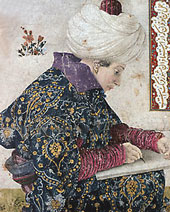
| Gentile Bellini, Seated Scribe |
Other colours: Essays and a story,
By Orhan Pamuk,
Faber, Rs 495
In the early Twenties, Franz Kafka, with his boundless self-deprecation, dismissed The Metamorphosis as “an indiscretion”. His friend, Gustav Janouch, who was deeply moved by the work, protested. “Is it perhaps delicate and discreet to talk about the bedbugs in one’s own family?” Kafka asked him with a smile, adding, “You see what bad manners I have.” Evidently, this was a sample of K’s characteristic bleak humour. An overbearing patriarch, a whimpering mother, a thousand mundane interruptions — nothing could stop him from writing, nor did he stop from writing anything. Writing was the curse of his life, and also its cure.
It is impossible not to recall K, the “implacable graphomaniac” from Prague, while reading Orhan Pamuk’s Other Colours. Although Pamuk does not write here about Kafka directly, the similarities between them are quite conspicuous. Just as K, Pamuk, too, cannot live without his “pen-and-ink cure” — he is “a creature who can never write enough, who is forever setting life in words”, he hates interruptions (“life is full of things that conspire to keep a person from literature”), and prefers a hermitic existence (“the starting point of true literature is the man who shuts himself up in his room with his book”). Pamuk’s position within his family is as unenviable as K’s dealings with his own parents: “Istanbul destroyed my relationship with my mother — we don’t see each other anymore. And of course I hardly ever see my brother.” The Turkish nationalist press considers him politically suspect for his allegedly controversial remarks on the 1915 genocide of Armenians in the country. Hounded by the state, Pamuk has lived, like Ka, the hero of Snow, in a Kafkaesque nightmare.
This edition of Other Colours draws substantially from the eponymous collection, published in 1999. Pamuk claims that the present volume is structurally more organic: “this book is shaped as a sequence of autobiographical fragments, moments, and thoughts.” The first, and the best, part, called “Living and Worrying”, comes closest to fulfilling this promise. The rest of the sections comprise of his occasional speeches, book reviews, lectures and memoirs.
The brevity of the opening pieces, their intimate tone and lyrical allure, recall Bacon and Montaigne. Even the titles are delightfully quirky, personal, whimsical: “When the Furniture is Talking, How Can You Sleep?”, “Seagull in the Rain”, “A Seagull Lies Dying on the Shore”, “My Wristwatches”, “What I Know About Dogs”. Some of these compositions come with beautiful pen-and-ink illustrations by Pamuk, dedicated to his beloved daughter, Rüya.
There are richly nostalgic pieces on the barbers in Istanbul, the devastating fires, Bosphorus ferries and the recurring, calamitous earthquakes that have traumatized Turkey for years (“I even heard of some so worried about being caught with their pants down that they rushed whenever they were in the toilet or taking a bath, and that some couples, afflicted by a similar worry, lost interest in making love”). These “moments of being” (Pamuk borrows the phrase from Virginia Woolf) record a young boy’s exploration of his hometown in his adolescence, as he grows into adulthood. The literary parallel is Stephen Dedalus’s familiarity, and later disenchantment, with Dublin in James Joyce’s A Portrait of the Artist as a Young Man. Pamuk, however, never outgrows the charms of Istanbul. He goes away provisionally — to some foreign country or to one of the neighbouring Mediterranean islands. But mostly, he travels metaphysical rather than geographical distances: indulging in the sinful pleasure of street food becomes, for him, a measure of “the sadness and guilt of eating food made far from your mother’s kitchen.”
Pamuk returns to the questions of travel in the section, “Politics, Europe and the Problems of Being Oneself”. These are questions that are at once pragmatic (should Turkey be made a part of the European Union?) and political (could Westernized Turks claim themselves as Europeans?). Pamuk explores the dichotomy of being Turkish — of being geographically close to but culturally distant from Europe — in “My Passport and Other European Journeys”. The account of his brief stay in Switzerland as a child, and the recollection of the experience of meeting American neighbours in Ankara, reveal the essentially truncated character of internationalism: “Our passports, which are all alike, should never blind us to the fact that each individual has his own troubles with identity, his own desires, and his own sorrows.”
The burden of identity, for Pamuk, is thus related as much to citizenry as to the evolution of individual self-consciousness, how the life of the mind, not just the life of the republic, shapes one’s destiny. For a self-aware “Westernizer” like Pamuk, “being oneself” also means not being allowed to be the Other. This limitation becomes, for the hero of Dostoyevsky’s Notes from Underground, a deeply shameful and frustrating experience. Writing on Mario Vargas Llosa, Pamuk compares his own exclusion from the West with the intellectual displacement of Third World writers: “If there is anything that distinguishes Third World literature, it is…the writer’s awareness that his work is somehow remote from the centers where the history of his art — the art of the novel — is described, and he reflects this distance in his work.”
Unlike Third World countries, Turkey was never colonized, so “the romanticizing of Turkey was never a problem for Turks.” In “Pictures and Texts”, Pamuk writes on the coming together of Western and Oriental iconographic traditions in the history of Turkish art. He shows how Islamic miniature painting evolved through a highly sophisticated exchange with literary texts. The legend of the courtship of Širin and Hüsrev reveals this process of intertwining strikingly. The European influences came through travellers like Gentile Bellini, whose exquisite portrait of Sultan Mehmet II continues to be a nationally familiar icon in Turkey. This cultural fluidity survived from the Renaissance into the Seventies, albeit through a different medium, the cinema: “When Goldfinger, surrounded by all the latest technological gadgets and weaponry, offered James Bond Turkish tobacco, saying it was the best in the world, many filmgoers went so far as to applaud the villain.” Other Colours is an elegy for this vanished cosmopolitan past.