|
|
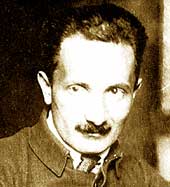
| Heidegger: lure of Syracuse |

The Reckless Mind: Intellectuals in Politics
By Mark Lilla,
NYRB, £5.00
Ever since Plato mooted the idea of philosopher-kings, a relationship, albeit a tenuous one, was established between intellectuals and political power. Plato himself attempted in vain to educate the ruler of Syracuse, Dionysus, in philosophy. The 20th century is especially rich in examples of intellectuals? attempts to flirt with politics. Mark Lilla in this collection of essays looks at a number of significant examples. Very aptly, he describes the intellectuals? penchant for political influence as ?the lure of Syracuse?.
Many of the eminent philosophers and intellectuals of the 20th century ended up as supporters of totalitarian regimes ? fascist or communist. The most notorious example of this was Martin Heidegger, according to many 20th century?s most profound thinker, who was a supporter of the Nazis. (The story goes that when in 1934 Heidegger returned to teaching after his shameful tenure as Nazi rector of Freiburg University, a colleague quipped, ?Back from Syracuse???)
The other equally notorious example ? though not cited as often as Heidegger?s advocacy of Nazism ? is the shameless support given to the Stalinist regime in Soviet Union by Jean Paul Sartre. In 1952, he dismissed reports of the gulag, and after a trip to the Soviet Union in 1954, declared that ?the freedom to criticize is total in the USSR?. But Sartre was not alone in this kind toadyism and deceit. From the Thirties, some of the best minds of the world deliberately and shamelessly turned a blind eye to atrocities and genocide carried out by Stalin, Mao Zedong and other communist leaders in the name of Marxism. What is even more appalling is that even after the full exposure of the horrors perpetrated by communists, men like Eric Hobsbawm, who should know better, continue their defence of Lenin, Stalin and the USSR.
Lilla is concerned with the strange attraction that philosophers, especially those belonging to the Continental philosophic tradition, have for tyrannical regimes. He explores two possible explanations that have been advanced. One links this attraction to the Enlightenment, the fountainhead of modern European philosophy. The Enlightenment was imbued with an absolutism of knowledge. It believed that through the rigorous application of Reason it was possible to arrive at Truth. The Enlightenment tradition was thus against a pluralist view of the world. It was essentially intolerant. This explanation is associated with the name of Isaiah Berlin.
Jacob Talmon argued contra Berlin that the emergence of modern political ideas became infused in the course of the 18th and 19th centuries with religious and messianic fervour. Political ideas thus got deflected from rationalist moorings and this explains the support that philosophers provided to totalitarianism.
Lilla, through his studies of Heidegger, Kojieve, Carl Schmitt, Walter Benjamin, Foucault and Derrida, finds both these explanations somewhat inadequate. According to him, the lure of Syracuse is an urge within all humans, the urge, in the words of Plato, to contribute to ?the right ordering of households and cities??. There is no disengaged philosopher. Marx?s cry in the eleventh thesis on Feuerbach constantly beckons the philosopher/intellectual. Given this inevitable and unavoidable urge in humans, Lilla calls for more self-consciousness to master the tyrant within.