The year is not 1914, nor 1939, but for many across the world the air feels just as heavy.
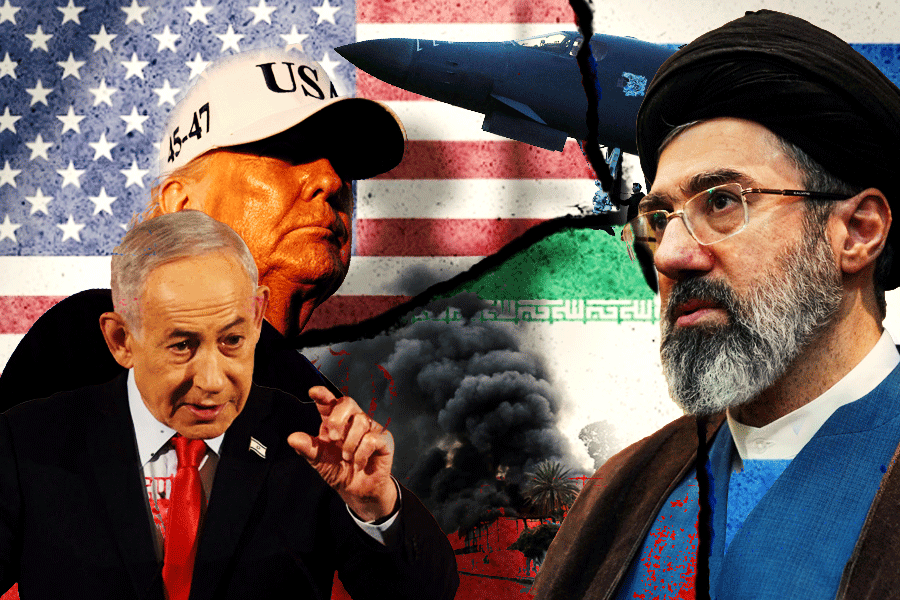
Not a bullet in Sarajevo. But a targeted algorithmic strike 3,500 km away at Tehran. The strike killed Ayatollah Khamenei, the Supreme Leader of Iran. To his followers, he was the moral compass. His enemies, the US and Israel, think that the strike was a biblical thunder clap that turned the citadel of Satan into rubble.
The conflict has spread to the entire Middle East, West Asia, and even the Indian Ocean.
Add the Ukraine-Russia clash, Israel-Gaza, African conflicts, India-Pakistan, and the simmering China-Taiwan problem, then the past few years may be surreally reminiscent of the first half of the twentieth century.
Are we already in World War III?
“The world is at war. But this is not World War,” Ramin Jahanbegloo, Iranian political philosopher, tells The Telegraph Online. “Despite the conflicts, I don’t think this is a World War. This fear of a global war is coming from the general public of America and Europe.”
Ramin, executive director of the Mahatma Gandhi Centre for Nonviolence and Peace Studies and vice-dean of the School of Law at Jindal Global University, Delhi, elaborates on why it is not a world war: “There is war in Ukraine. But Europe didn’t get involved.”
The Iran-US conflict has global ramifications given its effects on the international energy markets. But the number of states engaged in active military confrontation has remained limited.
World War I
World War I, also known as the Great War, started in 1914 after the assassination of Archduke Franz Ferdinand of Austria. It escalated into a war across Europe that lasted until 1918.
Germany, Austria-Hungary, Bulgaria and the Ottoman Empire (the Central Powers) fought against Great Britain, France, Russia, Italy, Romania, Canada, Japan and the United States (the Allied Powers). The Allied Powers won.
Over 16 million people (soldiers plus civilians) were killed in the war.
The man who coined the term World War I was Times military correspondent Charles à Court Repington.
Repington was one of the UK’s leading military correspondents. On September 10, 1918, he met with a Harvard professor to decide on a name for the global conflict.
The book The First World War 1914-1918: Personal experiences of Lieut.-Col. C. à Court Repington shows his diary entry of that day.
“We discussed the right name of the war. I said that we called it now The War, but that this could not last... I suggested The World War as a shade better title, and finally we mutually agreed to call it The First World War in order to prevent the millennium folk from forgetting that the history of the world was the history of war.”
On June 28, 1919, the Allied and associated powers and Germany signed the Treaty of Versailles, a peace document signed in the Hall of Mirrors in the Palace of Versailles, France. It took force on January 10, 1920. Two decades later, this peace treaty was counted as one of the causes of World War II.
Jump cut to 2016. On January 16, the International Atomic Energy Agency (IAEA) verified that Iran had completed the necessary steps under a deal with the US that was supposed to ensure Tehran's nuclear programme remained peaceful. Then US President Barack Obama announced the deal, which was supposed to bring “peace” between the two historically warring nations.
The Obama deal now seems like the Treaty of Versailles.
Today both nations are at war, which the current US President Trump seems to be giving the colour of a crusade.
The death toll in Iran has crossed 2,000. At least 397 people have died in Lebanon. And most of the Gulf is under fire from Tehran.
Israel, another party in the Iran conflict, was in another devastating war in the region till last month. The Israeli onslaught on Gaza continued for over two years, killing over 72,000 Palestinians, according to local health authorities, and leaving much of the enclave in ruins, Reuters reported.
The contest over the Gaza strip, between Israel and Palestine, started from a secret agreement made during World War I. The Sykes-Picot agreement, signed in May 1916, was a secret convention made between Great Britain and France, with the assent of Russia, for the dismemberment of the Ottoman Empire.
The agreement led to the division of Turkish-held Syria, Iraq, Lebanon and Palestine into various French and British-administered areas. The agreement took its name from the chief negotiators from Britain and France, Mark Sykes and François Georges-Picot.
The borders split up Arab lands and led to the modern borders of Iraq, Israel and the Palestinian territories, Jordan, Lebanon, and Syria. The outcome? Israeli-Palestinian conflict and frequent wars between Tel Aviv and its Arab neighbours.
Cut to the present, and there are shouts and murmurs of Iran getting help from China – such as via Beijing’s Beidou global navigation system, attributed in Al Jazeera to Tehran’s missiles becoming more accurate – and Russia (satellite data, per unconfirmed reports).
“We cannot afford a prolonged proxy conflict in the region,” Ramin cautions. “This tension could take that shape. This would mean Arab refugees rushing to Europe.”
The battle of narratives
World War II (1939–45) involved most parts of the world and a continuation of unresolved tensions from World War I, with an ideological hue.
On one side were the Axis powers—Germany, Italy and Japan—and on the other were the Allies—France, Great Britain, the United States, and the Soviet Union.
Author H.G. Wells is often credited with predicting World War II. In his 1933 novel, The Shape of Things to Come, he predicted a Second World War beginning in January 1940, sparked by a Polish-German conflict in Danzig, closely matching the actual outbreak of Nazi Germany’s occupation of Poland.
But the term was entrenched in the narrative by Time Magazine, the same place where Repington worked.
The total death toll from World War II was 40 million to 50 million.
While the Nazi regime exterminated Jews, Slavs, and other people considered “inferior” by Hitler’s ideology, Stalinist Russia unleashed terror against Ukrainians to the conquered Poles.
“Today there is no grand narrative. During the Second World War, we had narratives of fascism,” Ramin says, explaining why the last few years cannot be understood in the praxis of a global war.
But on March 5, evangelical leaders gathered around Trump in the Oval Office and prayed over him and for US success in the war against Iran.
They prayed for God’s protection over Trump.
“And Father, we just pray you continue to give our president the strength that he needs to lead our nation as we come back to one nation under God,” one of them said.
Trump and any far right supporters may look at this conflict through the prism of Christian versus Muslim binary, some can look at it as through the idea that it is a clash of civilisation (historical east versus west or a conflict of culture and religion).
The immediate outcome of World War II was that the globe was divided into two blocs. One under capitalist US and the other under communist Soviet Russia. The Cold War between the two blocs ended with the disintegration of the USSR.
“During the Cold War the world was bipolar. Now it is multipolar, marked by geopolitical and economic conflict,” Ramin underlines.
Rewind to 2014. Russia had emerged from political disarray and former KGB man Vladimir Putin was at the helm as President. He decided to annexe Crimea, Ukraine after a military operation that followed political turmoil in Kyiv.
Russia argued that the new government in Kyiv was illegitimate and that Russian-speaking populations in Crimea were under threat. In late February 2014, armed troops took control of key locations across Crimea, including airports and government buildings.
On March 16, Crimea held a referendum on joining Russia and two days later, Putin signed a treaty incorporating Crimea into Russia. Ukraine and most of the international community said the vote was illegal and conducted under military occupation.
Western countries imposed sanctions on Russia. Social media joked saying it was time for ‘Soviet Reunion.’ The annexation triggered a broader conflict between Russia and Ukraine, which kicked off in 2022 and has been continuing till today.
In the past three years, about 0.5 to 0.6 million have died in the conflict.
The total deaths from the conflicts in the past three years may not be comparable to the two world wars. But war in the 21st century has evolved. These wars are not fought in the trenches, but through data, drones and AI.
The criticality of tech in modern day warfare can be understood by AI company Anthropic’s decision to sue Pentagon after being labelled a “supply-chain risk,” a designation that could bar its technology from US military use.
The dispute stems from Anthropic’s refusal to allow its AI system, Claude, to be used for autonomous weapons – killer robots – or domestic mass surveillance.
There are three possible directions the US-Iran conflict can take now, Ramin says. One could be US boots on the ground, the other could be coercive diplomacy over Iran. “Gulf countries approaching the UN for truce could be another option given Hormuz will remain a problem,” he adds.
“After Covid can we afford a global energy crisis? The lower and middle class will suffer,” Ramin warns.
Yes, despite the Pope’s “peace on Earth” wish, the world has been at war for the past few years. We have not decided to give it a name, yet.