Munch on that
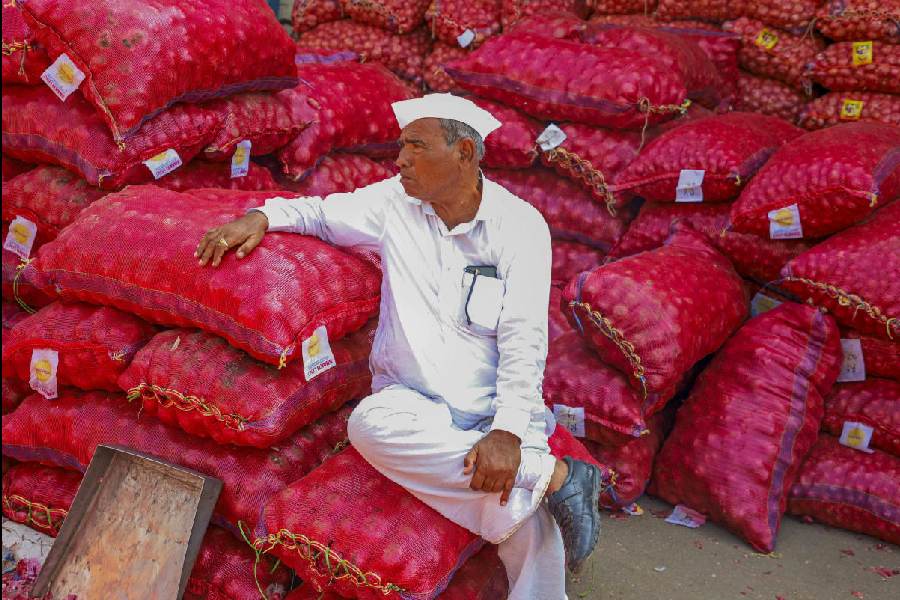
Sir — While taking a jhaalmuri break on the campaign trail in Bengal recently, the prime minister, Narendra Modi, said that he eats onions. Perhaps onion farmers in the country — at Lasalgaon, Asia’s largest onion market, prices recently crashed to Rs 775 per quintal, the lowest in a year — should turn to the prime minister with their plight since the Union finance minister had famously said that she does not know anything about the price of onions as she comes from a family where this staple is not consumed. Farmers in Bengal or anywhere else in the country are not interested in ministerial diets. They want a stable export policy, proper procurement and prices above the cost of cultivation. Perhaps the prime minister should munch on that.
Rai Banerjee,
Calcutta
Blatant bribe
Sir — The Bharatiya Janata Party’s promise of giving Rs 5,000 a month for accredited journalists in West Bengal should it come to power deserves strong criticism. Journalism is a public duty, not a profession waiting for political allowances. The announcement by the Bengal BJP chief, Samik Bhattacharya, creates the impression that reporters can be rewarded by parties seeking power. That weakens public trust in every newspaper and channel. Media owners, editors and press bodies should reject this proposal openly. Silence will look like consent and damage journalism further.
Fakhrul Alam,
Calcutta
Sir — A political party offering monthly payments to journalists during an election campaign raises serious ethical concerns. The BJP may call it financial support, but many citizens should rightly see it as an attempt to influence the press. Journalists are expected to question governments, not depend on them for personal allowances. Such schemes make independence look doubtful. The dignity of the profession depends on maintaining clear distance from political patronage.
Chitra Ghosh,
Calcutta
Sir — The BJP’s proposed Rs 5,000 allowance for journalists is only the most visible example of political influence over the media. Governments already use public advertising budgets to reward friendly newspapers and channels while critical voices lose revenue. This creates quiet pressure without open censorship. Readers deserve to know how editorial lines are shaped. Media owners and editors must resist such open attempts to offer bribes. Journalism cannot claim independence while relying on governments for financial comfort and selective favour.
Rajat Kanti Das,
Calcutta
Sir — Political control of the media often works through access rather than direct payment. Reporters who praise those in power receive interviews, leaks and invitations, while critical journalists are kept outside the room. This weakens honest reporting because access becomes more valuable than truth. The Bengal BJP’s allowance promise simply makes this culture more obvious. Press freedom requires equal distance from all parties, not special treatment for those willing to stay agreeable and silent.
Chaitali Ghosh,
Calcutta
Steep fall
Sir — The steady fall of the rupee is a warning that cannot be ignored. External shocks such as wars and oil price spikes explain only part of the problem. The deeper concern is the loss of investor confidence and continuing capital outflows. A country growing above 7% should inspire confidence; yet investors are moving funds abroad. When even a weakening dollar does not help the rupee recover, the issue is clearly domestic as well. Policymakers must stop celebrating growth figures alone and address the reasons investors are quietly looking elsewhere. The Reserve Bank of India can arrest the fall for some time, but confidence cannot be created through such interventions alone.
Kiranmala Saikia,
Jorhat, Assam
Not enough
Sir — Research has shown that when the presence of women in institutions increases by more than one-third, it starts to have an impact. This is why the Indian government apparently settled for 33% reservation for women in Parliament. But, in India, where women have had the right to vote since the adoption of the Constitution, it hurts to think that they are only thought to be deserving of 33% seats. This is especially so since women have had a strong hold on Indian politics without reservation. Political participation should be a right without reservation for Indian women.
Sujata Jha,
New Delhi
Welfare debate
Sir — Calling every welfare scheme a freebie weakens serious economic discussion. Subsidised food, education support and direct cash transfers for poor households serve different purposes from election-time promises of free consumer goods. The problem begins when political competition turns welfare into a bidding war of monthly allowances and appliances. Tamil Nadu’s history of free televisions, mixers and laptops was often mocked but those were limited, one-time costs. Monthly cash transfers are different; they create a continuing obligation on the state budget.
M. Jeyaram,
Sholavandan, Tamil Nadu
Age gap
Sir — The repeated casting of younger actresses opposite ageing male stars in Bollywood reflects a stubborn bias. When Akshay Kumar is paired with actresses 20 to 30 years younger — as he has been in Bhooth Bangla — it sends a clear message about who is allowed to age on screen. This reflects unequal standards of desirability and relevance. Cinema influences culture, and repeated casting choices quietly teach audiences that women lose value with age while men gain charisma.
Abhilasha Gupta,
Calcutta