Valuable collection
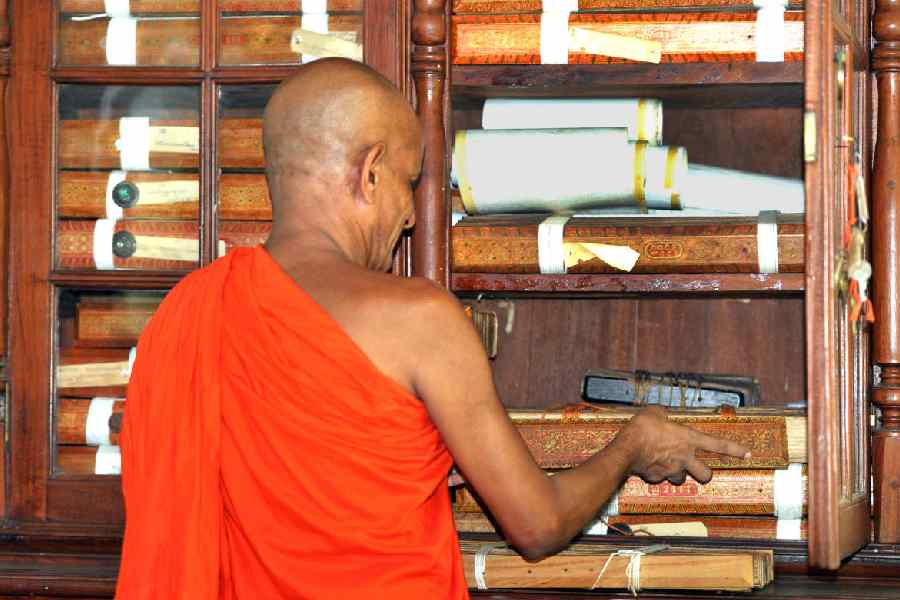
Sir — The Union ministry of culture has begun a nationwide survey to map India’s manuscripts. This is laudable because India possesses one of the world’s largest manuscript collections. Many manuscripts today remain in private homes where climate and neglect threaten their survival. A nationwide survey could finally bring them into the national record. Authorities must ensure that custodians feel respected rather than pressured into giving up their inheritance. Further, documentation alone will not unlock knowledge stored in these texts. Scholars must edit, translate and publish them with proper supervision.
Priyanka Chakraborty,
Calcutta
Political contests
Sir — The Election Commission of India has announced the dates of assembly elections for Assam, Kerala, Puducherry, Tamil Nadu and West Bengal, setting the stage for intense political contests across regions (“April elections in 4 states, UT”, Mar 16). Polling will occur in April and results be declared on May 4. Each state presents a different political landscape. Kerala will test the strength of the Left Democratic Front against the United Democratic Front; Tamil Nadu will see a competition between the Dravida Munnetra Kazhagam alliance and the All India Anna Dravida Munnetra Kazhagam; and West Bengal remains a contest between the Trinamool Congress and the Bharatiya Janata Party.
Aranya Sanyal,
Calcutta
Sir — The EC’s decision to hold assembly polls in West Bengal in two phases instead of eight is significant. Fewer phases may reduce fatigue among voters, poll officials and security personnel. It may also shorten the campaign period, which often becomes bitter and disorderly. The real test, however, lies in enforcement. Free elections need more than a schedule. They need neutral policing, swift action against violence and equal treatment of all parties. Voters deserve calm streets, clear rules and confidence that every ballot will count.
Noopur Baruah,
Tezpur, Assam
Sir — The most troubling part of the upcoming assembly election is the uncertainty regarding over 60 lakh electors in West Bengal. When such a large number of people remain under adjudication and may be unable to vote, public trust in democracy suffers. The EC and the judicial officers must act quickly and transparently. A democracy cannot appear fair while millions remain unsure about whether they can even vote.
Ireima Imsong,
Imphal, Manipur
Sir — The immediate reshuffle of top officials in West Bengal after the Model Code of Conduct came into force will undoubtedly invite debate. Some will call it necessary for neutrality. Others will see it as disruption at a sensitive moment. Both concerns are understandable. Senior officials play a crucial role in maintaining order during elections. Sudden changes should therefore be explained clearly to the public. Confidence in polling grows when institutions look even-handed, not hurried or driven by political motivations. Unfortunately, the EC has lost the trust of the people of Bengal.
Aayman Anwar Ali,
Calcutta
Sir — The Special Intensive Revision of electoral rolls has become central to the imminent assembly elections. The stated aim is to clean up voter lists and prevent duplication. That sounds reasonable on paper. The problem begins when the process leaves large numbers of people facing hearings and uncertainty over their status. For citizens, this is not just a technical exercise. It affects a basic democratic right. Any revision of rolls must be accurate, humane and open to scrutiny. Administrative efficiency cannot outrun fairness.
K. Agarwal,
Calcutta
Sir — West Bengal’s history of poll violence makes the EC’s promise of a violence-free election especially important. Extra security personnel and Central forces may help, but their presence alone is not enough. Prevention depends on rapid response, local intelligence and visible neutrality on the ground. Political workers also carry responsibility. Parties cannot praise democracy in speeches and undermine it in the streets. Voters should not need courage to stand in a queue outside a polling booth.
Monidipa Mondal,
Calcutta
Voice of reason
Sir — News of the death of Jürgen Habermas marks the passing of one of the most influential thinkers of the modern era. His work insisted that democracy survives through open discussion among citizens. At a time when politics often rewards noise rather than reasoning, his ideas remain instructive. Democracies require patient dialogue, clear arguments and citizens willing to justify their views.
K.A. Saikia,
Guwahati
Sir — Jürgen Habermas sought to restore faith in reason after the failures of the twentieth century. His answer was dialogue among citizens guided by evidence and justification. Democratic life requires constant public conversation rather than authority imposed from above.
P.K. Sharma,
Barnala, Punjab