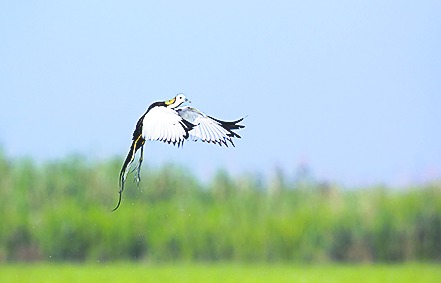

The rufous necked hornbill catches light as it unfurls its jet-black wings laced with white. That colour combination is reversed on the wings of the pheasant-tailed jacana. Its huge white wings, dipped in black at the edges, look like a photographic representation of motion in stasis as the jacana rises like the firebird on a mauve sky (picture). Not only the creatures of the sky but also those of the earth are found poised on the brink of flight. Spotted deer in the Nagzira tiger reserve stare at the camera - eyes alert, muscles taut, ears pricked - as the herd gets ready to run away in a flash. The animals, birds and insects in the photographs of Sandeep Sarkar throb with kinetic energy, even when they have been transformed into 'still life'.
The title of Sarkar's exhibition, A Foto Essay: The Invisible Ink (held at Emami Chisel Art from November 27 to 29), hinted at this oft-unheeded yet constant movement inherent in nature that can be traced only by an eye attuned to its rhythm. Sarkar captures this frenetic activity, this mark of life, not just in the flight of birds and deer but also in the tiny housefly which sits still on a branch (a bubble of saliva forms at its mouth), in the hawk eagle that stalks its prey with apparently unmoving eyes, in the pony that rises like a statue from the Maidan bedimmed with mist. Sarkar's photographs read indeed like essays - on life as experienced in its continuous movement, which inevitably beckons at the time when this bustle will cease altogether.
That cessation is felt in the photographs featuring gulls -Sarkar keeps going back to these eerie white birds in his photographs and installation. They are seen flying in an arc over the Ganga at Varanasi, looking like spirits of the dead risen from the water. The blurred sadhu on the boat in the background seems to act as a priest, easing the passage of the souls from earth to heaven. In another photograph, the gulls, sprinkled all over the horizon, create a contrast between the freedom of the sky and the restricted space of the river packed with boats. The connection with Varanasi made the white ceramic gulls look like metamorphosed human souls transiting from life to the thereafter as they perched on the broken planks of a boat, in the only installation of the exhibition.
Death, however, had not cast its shadow in the photographs by children that accompanied Sarkar's exhibition. But the children seem to have taken a leaf out of Sarkar's book in looking at nature as keenly as he does, if not in the forests then in the urban wilderness ( Creatures in the Concrete Jungle). They spot such rarities as a snake shedding its skin, an orchard spider hanging from its web, two treepies having a raucous conversation on a high branch, a moth camouflaged among dry leaves. The photograph, A Grasshopper's view, invited the audience to look at the grasshopper as well as to participate in the grasshopper's-eye view of the world.
Eyes - whether of grasshoppers, cats or of eagles - seemed to fascinate the young photographers. The picture of an eagle's eye at very close range, which magnified the eyelashes, the golden iris, the dilated pupil, invoked the unbridled power of nature. It is a photograph that could have accompanied a Ted Hughes poem.