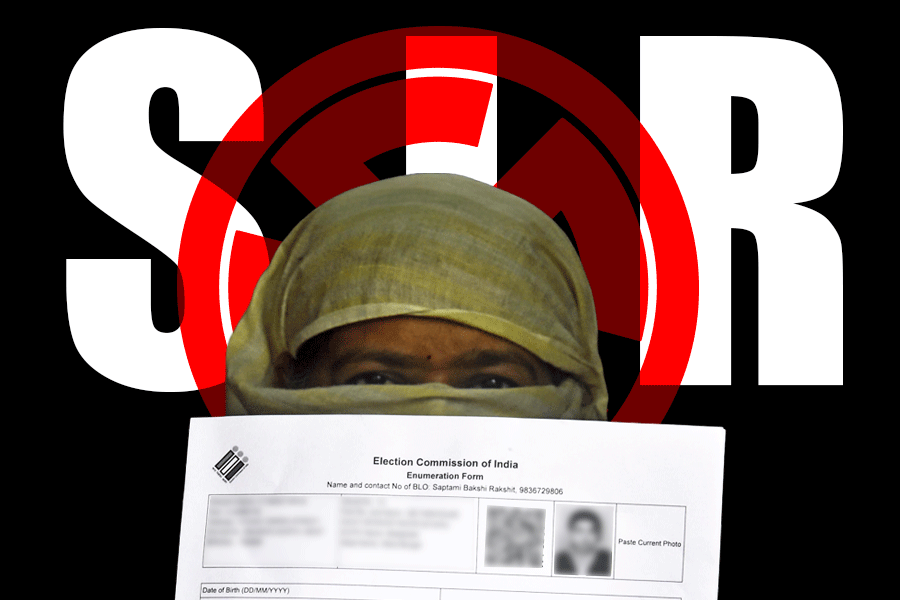
Exclusion cannot be the principle underpinning an exercise like the Special Intensive Revision of electoral rolls. In Bengal, there was concern that it was this principle that was being honoured in the course of the SIR: lakhs of people, cutting across religion, class and gender lines, had found their names struck off the voters’ list after the SIR, often allegedly on dubious grounds.
Hearteningly, the Supreme Court has now ensured that the door for voting remains ajar for those whose appeals are cleared by the 19 appellate tribunals that
have been constituted for the purpose. In a significant order, the highest court has decreed that voters in Bengal whose names have been endorsed by the appellate tribunals on or before April 21 can exercise their franchise on April 23, the first phase of this year’s assembly election. Those whose names are in the green by April 27 will be able to vote in the second phase scheduled for two days later.
The Supreme Court invoked Article 142 of the Constitution to pass this order. This is instructive. Article 142 vests the Supreme Court with an inherent power to pass judgments for the sake of “complete justice”. What could be a greater instance of ‘complete justice’ than speaking up in favour of segments of electors who have been threatened with disenfranchisement, that too in a democracy, in an arbitrary manner? This judicial order sends out two unambiguous signals. First, there appears to be the scope for restitution in the face of institutional indifference — willful or otherwise. There can be no doubting the fact that the Election Commission of India’s conduct of SIR, especially in Bengal, was insensitive, even high-handed, earning it public disaffection. Second — this is of utmost importance — the court has prioritised the electoral right of the people, many of whom are from the margins, at a time marked by executive overreach on public rights and even on august institutions. This autonomy is precious.
It can be argued, however, that the judicial relief should have come earlier. Already, there are whispers about the speed of work of the appellate authorities. Officials have also pointed out that the latest order would complicate matters further because permitting people to or disallowing them from voting after the tribunals’ verdict a short time before the actual voting day would present stiff logistical challenges. Whether the court’s order makes a difference to the ground realities thus remains to be seen. But these bottlenecks cannot undermine the wisdom of, and the principled position taken by, the court.
The political consequences of the judicial order are unfolding already. Mamata Banerjee has, unsurprisingly, expressed her joy at the development in court. The grapevine has it that the — orchestrated? — deletions could have adversely affected her party’s electoral prospects. She would now undoubtedly aim to use the court’s verdict to cement her image in the public eye as one of the principal architects of the resistance towards the exclusion of voters. The Bharatiya Janata Party, as a vocal proponent of the SIR, might find itself on a tricky pitch in terms of optics. Its challenge would be to come up with a convincing counterpoint.