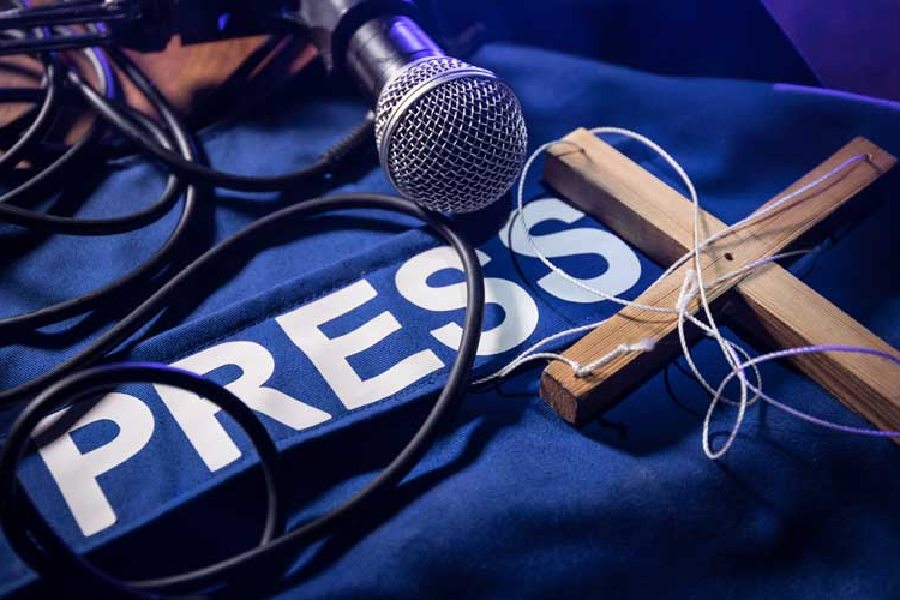
The recent trip to Europe by Prime Minister Narendra Modi was punctuated with many saccharine moments: such as the one in Italy. But these were offset by a few sour moments as well. One such took place in Oslo, Norway. There, while Mr Modi was leaving a joint press conference without taking any questions — apparently this is the convention when it comes to the prime minister of one of the world’s largest democracies — he was asked by a courageous and conscientious Norwegian woman journalist, Helle Lyng, why he was not intent on answering questions from “the freest press in the world”. Her claim about the independence of the Norwegian press is not a figment of her imagination. Norway occupies pole position in the World Press Freedom Index, published by Reporters without Borders: India, on the other hand, has slipped further on the rankings, falling six places to occupy the 157th position among 180 countries this year. Tellingly, a day after Ms Lyng’s question raised a storm, the journalist alleged that her accounts on social media had been suspended amidst a pushback online.
The weakening of the Indian media’s spine in the last decade or so has often been discussed through the country’s consistent slipping on the press freedom register. But shrinking press freedom — dangerous as it is for democracy — is but one manifestation of a deeper crisis that has coincided with the political dominance of Mr Modi and his Bharatiya Janata Party. The crisis is that in this Age of Information, India seems to be functioning as an opaque polity. Consider the following examples that often get eclipsed by the heated debate on the poor state of India’s press freedom. During Operation Sindoor, the Establishment, including representatives of the valiant armed forces, did hold regular briefings. Yet, gaps in the information — defended on the grounds of operational sensitivity — led to a flood of disinformation leading to considerable anxiety. An even more insidious assault on transparency has been the weakening of India’s right to information edifice. Not only has the ruling regime been parsimonious in its RTI responses but the legal route — such as the exemption for ‘personal information’ in the Digital Personal Data Protection Act — has also been explored to defang the RTI ecosystem. These have been compounded by known as well as novel ways of intimidating an already cowering media.
The pitfalls of an obedient media are well-known. Shrinking leverage for transparency and scrutiny, elements integral to democracy — the Fourth Estate upheld both once upon a time — makes regimes, including elected governments, unaccountable. There is, though, a related irony that must not go unaddressed. Information is now an economic good. But it is not a public good: it cannot be in the face of an eroding media fraternity. This transformation of information into an entity with economic heft but one stripped of its moral force is a peculiar blemish that the Age of Information must concede.