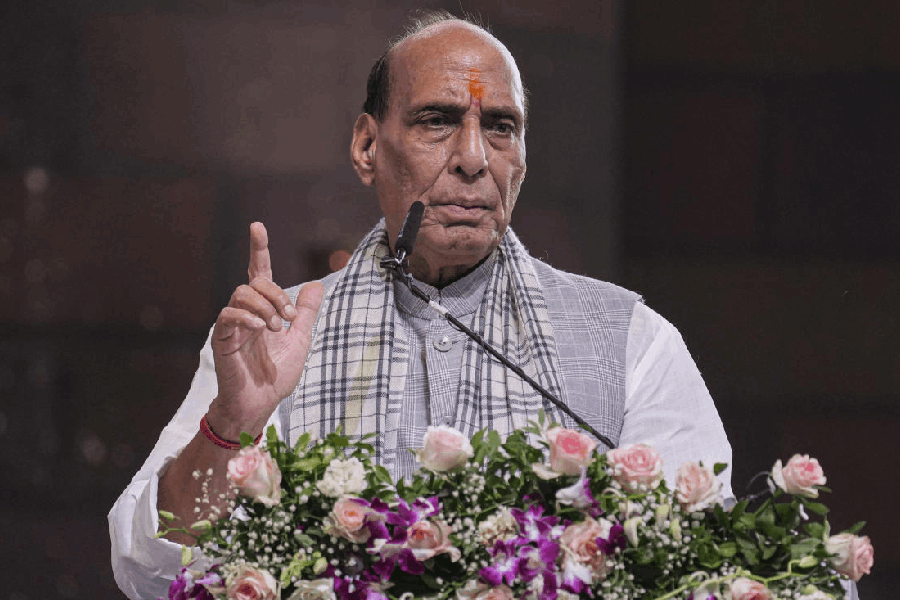
Defence minister Rajnath Singh on Saturday said no power can stop India, once considered an importer of weapons, from becoming the biggest exporter in 25-30 years.
After inaugurating an ammunition manufacturing unit in Shirdi, Singh said a nation that makes its weapons writes its own future.
He said the role of private players in defence manufacturing was negligible a few years back, which now stands at 25-30 per cent, while the government has set a target to increase it further to 50 per cent.
"The private sector is not just a supplier of nuts and bolts in defence, but also a producer of state-of-the-art weapons systems," he added.
Singh said India was considered a weapons importer, but no power can now stop it from being the biggest exporter in 25-30 years.
He said that when the government's vision and the private sector's innovation align, then the country reaches new heights.
"All have to work together to make India the hub of munitions and automation," he added.
During the rule of the British East India Company, potassium nitrate was used as raw material to make gunpowder, and the company strengthened its military capability, Singh said.
He said India has come a long way as far as its defence industry is concerned.
Singh said that while ordnance factories existed even before Independence and the defence industry is deeply rooted in the country, after Independence, there was no balance between the country's old capabilities and modern requirements.
The main reason behind this was that private players did not get the opportunities and the sector was restricted to defence PSUs and ordnance factories, the defence minister said.
He listed steps undertaken by the Central government to increase private participation in the defence sector, including policy-related reforms and liberalisation of foreign direct investment.
He said the government implemented a strategic partnership model, prepared a positive indigenisation list of 5,000 items, making it mandatory for armed forces to procure them in India.
Young innovators, too, are being encouraged, Singh added.
On the defence manufacturing unit, Singh said a golden chapter of self-reliance is being written in India's defence and space sector.
Chief of defence staff gen Anil Chauhan and Chief Minister Devendra Fadnavis also attended the event.
The factory at Shirdi is built on 200 acres of land, and is expected to generate direct and indirect employment for 2,000 people and also support Medium, Small and Micro Industries. The unit will also export defence equipment to other countries, the chairman and managing director of Nibe Group, Ganesh Nibe, had said.
The unit in Ahilyanagar district will manufacture artillery bombshells and also support the aerospace segment.
Singh and Fadnavis also visited the Saibaba shrine in Shirdi.