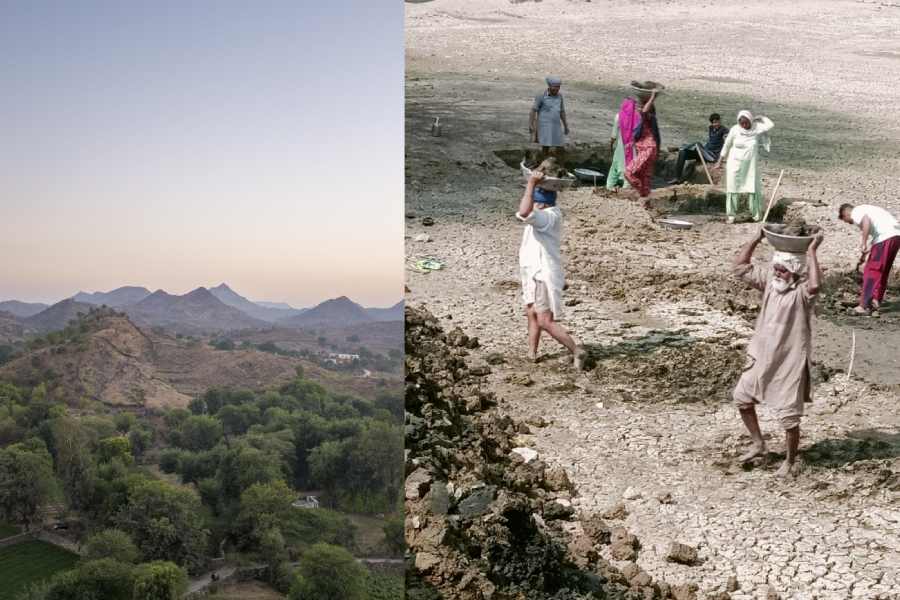
In recent times, the Union government has taken two steps that have worried citizens of India. The first is the dilution of the definition of the Aravalli hills, removing a set of complex, layered norms that defined and protected these ancient hills. This will lead to a large part of the Aravalli terrain becoming vulnerable to rampant exploitation by real estate and mining companies. At a time when Delhi is struggling to breathe, this thoughtless and brazen action comes as a shock.
Then came another drastic and insensitive move. The Government of India replaced the Mahatma Gandhi National Rural Employment Guarantee Act with the Viksit Bharat-Guarantee for Rozgar and Ajeevika Mission (Gramin), demolishing the very basis of the MGNREGA in the process. A rights- and demand-based legislation has become a centralised, ad hoc welfare programme that strips states and local bodies of their power to initiate work for the marginalised as per the needs of the people.
A casual browsing of the internet would reveal that apart from social activists, there is one group that is bothered by the destruction of the Aravallis and another that finds the attack on the MGNREGA unacceptable. This separation is a matter of concern. While each person tends to prioritise his/her areas of interest, there needs to be a realisation that we cannot protect nature without prioritising livelihood and sustenance for the poor. Nature is not an abstract phenomenon with which we need to develop a compassionate relationship. Neither is it just there to fulfil our needs. We are nature and our existence is as natural as that of the birds and the trees. Similarly, livelihood, nutrition, and shelter for every human being are not services that need to be provided. They are about the dignity of every individual, the rights of every citizen, and their right to work. A profoundly powerful empowerment of people can transform societal attitudes towards nature. It is immoral to hold a flag for the Aravalli hills but ignore the decimation of people’s lives. Similarly, excusing environmental degradation as just a consequence of providing livelihood is unacceptable. There will be no one to provide for if our surroundings crumble.
There is another connection between these two issues. Both exist in the commons. The Aravalli hills are the commons and most of the MGNREGA work happens in and for the commons. The idea of the commons has been forgotten, and all governments and corporations have systematically erased its meaning from memory. The commons are our hills, rivers, grazing lands, forests, streets, beaches, and much more. Even the air we breathe is the commons. Every one of these shared spaces belongs to us, the people. But through laws and rules, governments have not only restricted our access to them but also sold them over to interest groups. It is also significant that a majority of the people who get work through the MGNREGA live in or off the commons and share a deep historical and cultural connection with it.
The word in Tamil for the commons is poromboku; a term that has acquired a pejorative connotation. You will hear it as a cuss word on the streets of Chennai and in innumerable Tamil movies. During the colonial times, the British realised that they could not tax that which is not owned. Since the poromboku did not belong to any private individual and was shared by communities, it did not generate revenue for the colonial government. It was hence considered useless and of no value. Over time, the idea that the poromboku is of no use to anyone became entrenched. The implications of this change in meaning have led to unquestioned manipulation and destruction of our natural world. The word also began to refer to someone who is useless, not capable of anything, with no location or relevance. People who live on the margins became disposable. Along with people and nature, we began to destroy cultures, songs, rituals and ways of life.
Exploitation becomes acceptable when the intrinsic value of something is torn down. The moment we are convinced that something is purposeless in its present form, we permit — even aid — its erasure. Societal discrimination, too, stems from the same place. Based on caste, race, gender, religion or ethnicity, human beings are placed on a vertical chart of value. The lower their level on that chart, the greater the probability of them being considered a burden — poromboku. Once someone is placed in that position, the powerful decide how to ‘save’ that individual. From this stems the criticism that the MGNREGA is pointless work that makes people lazy. The term, ‘freebies’, is only used with regard to what the State provides for the poor and the needy. Corporate tax concessions will never be regarded as a freebie. Words such as productivity and efficiency are also thrown about without any thought to explain the difference. Socio-economic factors such as an equal playing field, education, healthcare, and access to economy are all ignored.
We have to ask why people — especially the urban middle class and the elite — keep these two issues in silos, with many veering towards the environmental side. To put it simply, it is a convenience of conscience. The general realisation that we need to pollute less and protect the environment has permeated most social circles. Therefore, behaving in a manner that is uncaring of this problem has become difficult. In other words, being environmentally conscious is normative behaviour. Urbanites have also adopted certain common practices to display their environmental consciousness. Carrying a water bottle and a cloth bag are typical examples. Beyond these performative acts, there is little engagement with local or global environmental issues. In this entire performance, human beings who are most affected by environmental destruction are absent. Therefore, the fishers and the forest dwellers are invisible. This invisibilisation of people is what allows the elites to denigrate the lives of those who are excluded. Those who focus only on providing livelihood do not ask questions about the ethics of development; something they claim will be dealt with after the question of work is addressed.
The Aravalli hills are precious and need to be safeguarded. Every person has the right to work and grow. The destruction of the Aravallis and the scrapping of the MGNREGA are symbiotically linked. The flattening of the hills will lead to the impoverishment of people. The more people are deprived of their right to live with dignity, the greater will be the destruction of our natural habitat. It is imperative that we, the privileged, recognise the inextricable connection between the ‘right to life’ and the ‘right to equality’ as enshrined in the Constitution of India.
T.M. Krishna is a leading Indian musician and a prominent public intellectual