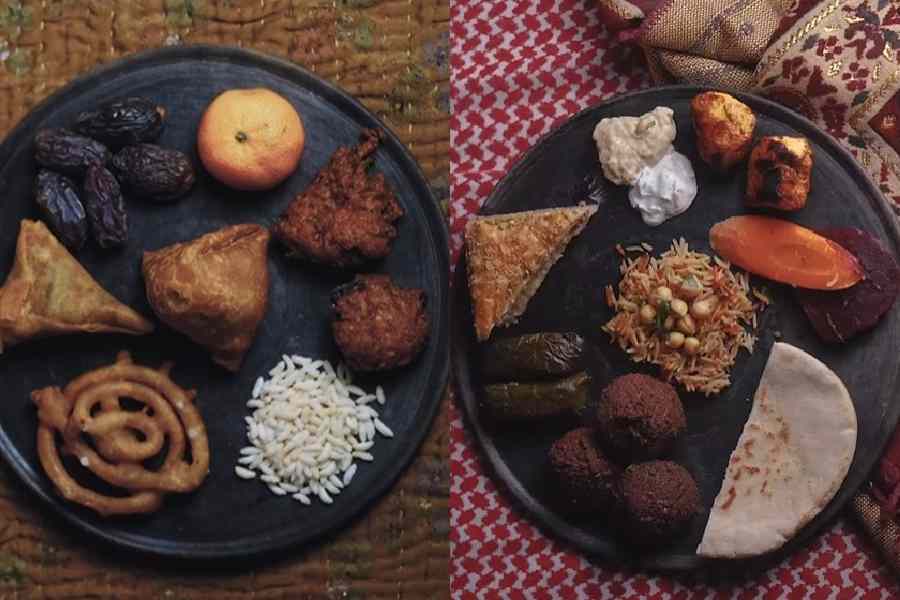
New York City Mayor Zohran Mamdani began Ramadan with a sprawling iftar plate that travelled across geographies and class histories, from Middle Eastern staples to South Asian street food, and posted it on Instagram.
The platter featured pita bread, falafel, kebabs, hummus, dolmas, spiced rice and baklava alongside muri (puffed rice), pakoras, jilipi (jalebi), Persian-style samosas or samuchas, shingara, dates, cashews and tangerines.
During his mayoral campaign last year, Mamdani had shared a photograph of himself breaking his fast with a burrito on the Q train after a day of canvassing. The image that drew more than a million views online.
Each year, Muslims worldwide observe Ramadan through fasting, prayer and acts of service. From sunrise to sunset, they refrain from eating and drinking, gathering at dusk for iftar, a meal shared with family and community.
While dishes such as falafel, dolmas and baklava are coded as elite Islamic cuisine, their origins lie in working-class economies across the Ottoman Arab world.
Falafel, ground chickpeas or fava beans mixed with parsley, garlic and spices, then deep-fried, remains a cost-effective staple breakfast in parts of Gaza, even today.
Dolmas, vine leaves stuffed with rice, herbs and sometimes minced meat, trace their name to Armenian usage within the Ottoman world and travelled across Jewish diasporas, evolving into regional variations from Iberia to Iraq.
In Ramadan settings, such foods return to their earlier logic: hearty, modest and structured around accessible ingredients.
On Mamdani’s plate, these Middle Eastern components were placed alongside South Asian staples.
It had muri. Parboiled rice sand-roasted until it puffs, which can be eaten plain, with mustard oil and salt, or mixed with onions and chillies.
Mamdani showed plain muri, the kind that can accompany pakoras or be eaten by the handful.
Mamdani’s choice to show plain muri signals cultural familiarity. Its presence also reads as a nod to the existence of New-Yorkers with muslim roots in Bangladesh, says Ishita Dey, faculty member at South Asian University’s Department of Sociology.
Dey also notes that ritual food often works as a class leveller.
“Ritual food has to be affordable in every sense, so that it can be accessed and shared across social hierarchies,” she told The Telegraph Online.
"Muri illustrates that principle, but in migrant settings, sourcing ingredients of one’s homeland can be expensive or difficult. Yet incorporating something as modest as Muri becomes a way of carrying memory into new geographies", she added.
Dey suggests that such food choices also acknowledge that cities are built on the backs of migrant labour. "Urban food cultures, much like the cities themselves, cannot be imagined without the contributions of migrant communities", she said.
The platter also featured both samosa (Persian style samosas, also known as samuchas in Bangladesh) and shingara, the Indian version stuffed with spiced potato, peanuts or cauliflower in a short-crust shell.
According to senior aide Zara Rahim, Mamdani plans to host iftar dinners with firefighters, delivery drivers and other working Muslims across the city.
His office will support meal distribution efforts led by mosques serving large migrant populations.
Over the coming weeks, the mayor is expected to fast while giving speeches and travelling across boroughs, breaking his fast at local restaurants.
His team is also planning Ramadan outreach to West African, South Asian, Middle Eastern and Black American Muslim communities.