|
|

The photograph of Albert Einstein in the office of the Communist Party of India (Marxist) in Calcutta’s Alimuddin Street looks a little out of place, for the wall is otherwise plastered with portraits of communist leaders from Cuba to China. But the words accompanying the picture are telling.
“Great spirits have always encountered violent opposition from mediocre minds,” it reads, quoting the physicist. At a time when the CPI(M), Bengal’s ruling party for 29 years, is wracked by spasms of change, the words can be ominous. At least, for chief minister Buddhadeb Bhattacharjee ? spearheading reform despite opposition from a section of Marxists and other partners ? the message is significant.
Throwing the state’s doors wide open to all kinds of investment, the Left seems to be turning Right. The move is not out of any love for capitalism, party leaders insist, but a result of pragmatic politics. The government has to create jobs for tens of thousands of educated unemployed youth in the state. And that can’t be done without bringing in industry or global capital. For the government to survive, they argue, this is the way to move ahead.
In 1994, Jyoti Basu, then chief minister of Bengal, rued his government’s failure on the industrial front in an interview to Business World, and voiced concern over rising unemployment even in the countryside. Eleven years on, things have come to such a state that “either you bring in investment and create jobs or perish. There is nothing in between,” a CPI(M) Central Committee member says.
But that’s easier said than done. While Bhattacharjee pursues investment aggressively and relentlessly ? as evident from his just-concluded trip to Southeast Asia ? there are many who are concerned over the clash of interests within the party, which counts workers and farmers among its supporters. But, strikingly, the debate raging in the party is not so much over its open-door policy ? which most feel is inevitable in times of globalisation ? but about how to carry different interest groups together and retain the party’s traditional base.
Stumbling blocks
The path to reform is fraught with complications, some purely ideological. Bhattacharjee’s recent trip to Singapore and Indonesia was greeted with howls of protests by the Opposition and Left Front partners alike. Among the vocal critics was former finance minister and Marxist ideologue Ashok Mitra. “Some elements within the Left want to compromise with forces of capitalism,” he says. “If we, as ministers, had said what they are saying now, we would have been expelled from the party.”
At the core of the controversy is the government’s decision to allot primarily agricultural land of 5,000 acres to Indonesia’s Salim Group, which wants to set up a health city, a satellite township and a special economic zone in the district of South 24 Parganas, neighbouring Calcutta. The move will involve amending a land ceiling law. The government tried to change the law in the last Assembly session, but had put its plans on hold following widespread dissension. The government was deeply embarrassed when land and land reforms minister Abdur Razzak Molla himself opposed the Bill while presenting it in the Assembly.
Clearly, there are apprehensions in the party about the impact the Left Front government’s new industrial policy would have on the party’s traditional vote-bank. Some fear the state government is following in the footsteps of N. Chandrababu Naidu in Andhra Pradesh ? who focused on the city dweller and lost the last state Assembly election to the Congress.
Ostensibly, though, nobody is worried ? even though the CPI(M) faces an election in the state next year. State secretary Anil Biswas says the party is aware of the mistakes the Telegu Desam leader made and is trying to achieve “balanced growth” in Bengal. At the same time, he stresses that no government can ignore the impact of globalisation. “You have to recognise it and take advantage of it,” says the Politburo member.
For a party that once looked at foreign investment with suspicion, these are strong words. The Marxists, undoubtedly, are reinventing themselves as an investor-friendly party. “It’s a new situation that poses new challenges and calls for a new response,” says CPI(M) Rajya Sabha MP Nilotpal Basu, a member of the party’s Central Committee. He stresses that the party is not against foreign direct investment (FDI), but wants it restricted to certain sectors.
On the move
For the CPI(M), the position on foreign investment has been taking concrete shape for over a decade now. But it was at the last party congress in Delhi that the role of private capital was discussed at length. Doubts about private investment were clarified at two successive state conferences.
Veteran CPI(M) leader Biman Bose holds that Marxists are not “dogmatists,” as many would think. “We are not against multinationals. We do not, for example, ask anyone not to use Parker pens because an MNC makes them,” he says, touching the Parker in the breast pocket of his white kurta.
The CPI(M) has other pressing reasons for pursuing industrialisation on its home turf. It is no longer a party with its bases limited to rural Bengal, where it successfully carried out land reforms. The party’s base is growing in urban Bengal, as was evident when it won 48 of the 79 municipalities ? 15 more seats than in 2000 ? in the civic polls barely three months ago and captured the Calcutta Municipal Corporation. In the 2004 Lok Sabha elections, it won all but one seat in Calcutta.
The party can no longer ignore urban Bengal. There is a focus on education, and Bose, who is also chairman of the state Left Front committee, points out that the government has set up a string of private and engineering colleges so “our students won’t have to go outside for higher studies”. There is a zeroing in on information technology, sparked by the hope that it would generate high salaries in select sectors.
Industrialisation is the buzzword even in rural Bengal. Gone are the days when people could live off the land in villages, says peasant leader Benoy Konar. The cost of farming has gone up, and the income from land has plummeted. With joint families breaking up in villages, farmland is getting parcelled out. Konar, vice-president of the CPI(M)-affiliated All India Kisan Sabha, says an acre of land may provide a family 70 mandays at the most, while a cold storage, built on a three-acre plot, offers 18 permanent and scores of temporary jobs. “People are naturally looking for an alternative source of employment,” he says. “Industry benefits not just the urban people but rural people as well.”
The Bengal village is no longer what it was. With the building of new roads, shops and markets and the advent of satellite television, rural areas are fast getting urbanised. Aspirations for a better life are on the rise. “People in villages used to be happy with cycles, but they are now looking to buy motorcycles,” Biswas says.
Many farmers living along the Diamond Harbour Road in South 24 Parganas are selling their agricultural land at a premium to promoters building resorts for the rich. “From Durgapur to Kalyani to Rajarhat, new townships were built only on what was once farmland. So what’s this hullabaloo all about?” asks Sujan Chakroborty, CPI(M) MP from Jadavpur.
The hullabaloo, clearly, is about the direction that the party is taking ? a move that some in the state are wary of. Partner Forward Bloc (FB), for one, is extremely critical of the agreement Bhattacharjee signed with the Salim Group in Jakarta last month. “The chief minister is giving away fertile agricultural land belonging to the poor and marginal farmers to this group in the name of industrialisation,” FB president Ashok Ghosh says.
The flip side
Ashok Mitra is equally scathing about the government’s industrial policy. “They are proceeding from agriculture to commercial activity, not industry, as they claim,” he says. “They say the Salim Group will set up an industrial city, but it’s a misnomer. It will actually be a commercial complex for which the government wants to displace the farmer. Any displacement will negate all benefits of the project,” Mitra says.
Like a surrogate mother who lets out her womb but has no right to the child she gives birth to, Mitra says the government is pursing a “rent-a-womb” economic policy. “People will give away their farmland and help build the commercial complex, but someone else will reap the benefits,” he says.
Aware that a storm is brewing, the CPI(M) leadership is also working out solutions. To allay the fears of the dissidents in the government, the CPI(M) is holding talks with its allies. The party has agreed to the Forward Bloc’s demand for bilateral talks with Front partners “to clear the air and reach an amicable settlement”.
But what is clear is that most critics want the government to be cautious. Konar believes that to the extent possible, it should try and provide essentially arid or marshy land to industry. He, however, acknowledges that it may not always be possible. “We have to protect agricultural land, but industry should get priority,” he says.
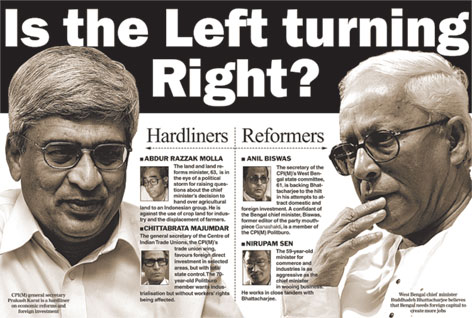
Trade union leaders are worried as well. “The trade union movement is facing a huge challenge in the face of globalisation,” says Chittabrata Majumdar, the 70-year-old general secretary of the Centre of Indian Trade Unions. “Workers are getting desperate with the stripping away of their rights, including job security. Now the main problem is how to hold the workers together under a banner.”
The biggest challenge the party faces is how to weld the interests of global capital with the interests of marginal farmers or factory workers. Leaders admit that they cannot do anything that would turn the rural masses against the party. “It would be suicidal,” a leader from South 24 Parganas says.
“We want to protect the interests of the poor while developing the state,” Biman Bose says. “It’s not going to be easy, but we are determined to do it.”
SEE WHAT CHINA ALLOWS
From 1978, and especially after joining the World Trade Organisation in 2001, China has liberalised its foreign direct investment (FDI) rules. In several industries, 100 per cent FDI is allowed. Consider:
• 100 per cent FDI is permitted in manufacturing, in the retail industry and in the hospitality industry, except in certain geographical areas such as Tibet.
• 100 per cent FDI is allowed in infrastructure but no foreign ownership is allowed if the project being constructed is of strategic importance or raises security issues. A foreigner, for example, can build an airport but not run it. But most foreign investment in infrastructure in China comes from overseas Chinese investors or non-resident Chinese entrepreneurs in Taiwan and other parts of the world.
• Companies can hire and fire labour. Workers have a right to obtain justice but with the state being the ultimate employer, justice isn’t dispensed if the state doesn’t feel like doing so.