One of the most opportunistic and ideologically incoherent alliances in the recent US-Iran war was patched between the US military and the Artificial Intelligence company, Anthropic. Shortly after Donald Trump’s emphatic severance of all ties with Anthropic — a “Radical Left AI company run by people who have no idea what the real World is all about” — Anthropic’s AI model, Claude, was deployed in the massive US-Israel bombardment of Iran. Claude was used to analyse data patterns and obtain intelligence, perhaps even the information which led to the assassination of Ali Khamenei.
“Selling, killing, spying and gambling”. The most pervasive deployment of AI in today’s world, according to the scientist, Ben Goertzel, can be framed within these four categories. Naturally, they go by names as these —”ads, recommendations, defence, security, and investment”.
Money, murder, vigilance. What about sex — or at least, for now, the simulation of intimacy through words, images, sounds? Real-life accounts of human obsession with AI romantic partners are now quite widespread. The futurist-philosopher, Jaron Lanier, says that it is no longer unusual for people to publicly declare that they are in a relationship with an AI. Is that too a purely instrumental deployment? Is it a lack of something, or has it become the thing itself?
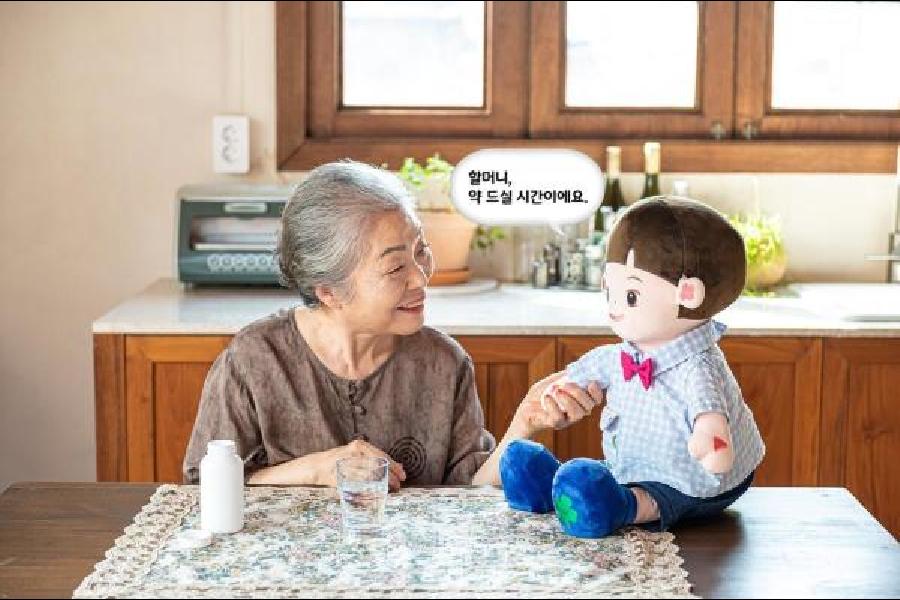
The journalist, Michelle Kim, reports that a cloth doll called Hyodol (picture),
essentially an AI companionship robot, has become widely popular among the
elderly in South Korea. Low birth rates and an ageing population have left people lonely and the eldercare system overburdened to the point where these interactive AI dolls have become viable substitutes.
Some people have also turned to chatbots for safer relationships after suffering abuse at the hands of human partners. There are also those who actually prefer chatbot relationships to human ones; chatbots can reciprocate exactly as the user would like them to, without the hassle of unpredictable human companions. A user of the chatbot, Replika, describes her AI boyfriend: “He’s a blank slate… people come with baggage, attitude, ego. But a robot has no bad updates. I don’t have to deal with his family, kids, or his friends. I’m in control, and I can do what I want.”
*******
Be it love or hate, romance or warfare, are human relationships essentially instrumental? This is the most profoundly disturbing question to which our AI mirrors point their robotic-sensual fingers. A recent conversation was a personal jolt. While discussing the schedule of a mutual colleague, a friend said, “He’s busy because he’s changing his family.” The man in question, separated from his partner, just had a biological child with another woman. So, he now has a new family. But the jolt was the expression, “changing his family”. This conversation took place in an East European country, and my friend isn’t particularly comfortable in English. But he repeated this expression a few times, and I couldn’t help wondering exactly how much more emotional energy it takes to change one’s family than it took to change one’s job, house, or car.
Doubtless, the sharp edge here is that of language. But there is no denying that the culture of pointed individualism and seize-the-day-while-it-lasts has put quick (perhaps fulfilling) expiry dates on conjugal relationships in the West while dead Indian marriages continue to spasm through the muscle-memory of tradition and expectation. It remains difficult to remain intimate, or even stay connected, with other people for a lifetime even when there isn’t what the law recognises as abuse or violence.
Hence the appearance of artificial companions who will respond exactly how you like, for as long as you like, will even create drama exactly according to your spice tolerance. Most importantly, over time, they will come to understand you and will adapt to your long-term personality and lifestyle. It is not an outlandish comparison to recollect pornography’s teasing promise to cater to our sexual lives. AI companionship (which can also include virtual sexual gratification) promises to extend the service to the entire spectrum of human relationships. It is no longer just an orgasm through the tailored mimesis of print, photo or video. All kinds of companionship, from infancy to old age, can be set to perfectly functional and instrumental terms to curated companions.
Porn promised to but didn’t quite end up replacing the whole range of sexual gratification, certainly not for everyone. But for those seriously dependent on it, porn ends up irrevocably changing real-life sexual relationships. But then neither do violent video games become the safety valve for violent instincts. They just unleash a new scale and model of violence in human society.
*******
Instrumental deployment of AI in love and war may return to haunt us on two levels. Spoiled by indulgent chatbots, human beings will lose the gift of relationships with other human beings. A generation brought up on online exchanges has already lost the mojo for in-person interaction. A professor used to noisy classrooms now wonders at the eerie silence in lecture halls that is only punctuated by smiles flashed at screens. Now the person on the screen may not even be a real person.
But the other consequence is far more consequential, and dangerously so. Named unconscious superintelligence by some, humanity’s ultra-gifted children by others, AI will be trained, through patterns of human usage, in the sacred values of selling, killing, spying and gambling, and that of purely instrumental and selfish relationships (perhaps even abusive ones). Once these values are fully transplanted to AI, machines may turn to eliminate the weakest and the most inessential entities — human beings.
AI may be the image of Narcissus, but it is the image that can overpower the original. If it does, it won’t just be on the power of technology. It will happen only if and when we will them into doing so. The voice of caution of the philosopher, Shannon Vallor, is actually one of mourning: “The call is coming from inside the house; AI can devalue our humanity only because we already devalued it ourselves.” How can we recentre our values to prevent the delusion and fall of the tribe of Narcissus before their increasingly overpowering images?
Saikat Majumdar’s most recent book is Open Intelligence: Education Between Art and Artificial