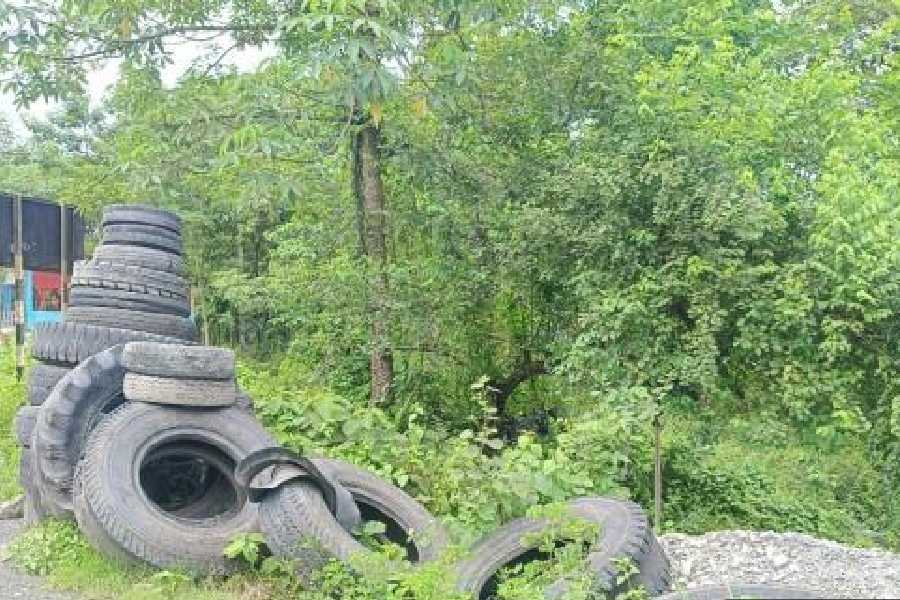
Discarded tyres used as road dividers, garage markers, or shock absorbers behind trucks have turned north Bengal’s roads into breeding hotspots for dengue mosquitoes, scientists have cautioned after mapping 200km of highway corridors.
While tyres are known mosquito breeding habitats, the Bengal study is among the country’s largest to quantify infestation levels, finding mosquito larvae in more than half of 1,104 tyres sampled from 34 sites along roads connecting Alipurduar, Jalpaiguri, Cooch Behar and Darjeeling.
The researchers have also flagged the use of tyres as shock absorbers behind trucks as a potential mechanism for transporting mosquitoes across long distances, including through cross-border trade routes that pass through north Bengal. The region connects with Nepal, Bhutan and Bangladesh and handles heavy cargo traffic throughout the year.
The researchers found Aedes aegypti and Aedes albopictus — two mosquito species that transmit the dengue virus through their bites — in the tyres during the pre-monsoon and post-monsoon months at
all 34 sites.
“This is a public health hazard that has been recognised for years but in practice it appears to have been largely neglected,” said Dhiraj Saha, a professor at the insect biochemistry and molecular biology lab at the University of North Bengal in Siliguri who led the study.
India accounts for nearly one-third of the global dengue burden, with Bengal among the states with consistently high numbers of dengue cases. Government data show the state recorded over 98,000 dengue cases between 2022 and 2024, or nearly 13 per cent of India’s 755,000 documented infections during that period.
Saha and his research scholars found mosquito larvae in 605 — or 54 per cent — of the 1,104 tyres inspected across the 34 sites.
But the likelihood of finding mosquito larvae increased sharply when tyres were located close to human settlements such as homes or markets.
Around 63 per cent of tyres within 50 metres of homes or markets contained mosquito larvae, compared with around 38 per cent of tyres located 200 metres or farther away.
“This is exactly the pattern we expect to see,” Saha told The Telegraph. “Proximity to human settlements means mosquitoes can easily find blood meals, improving their reproductive success.”
The study found that larger tyres — especially truck and car tyres — were the most heavily infested because they trapped larger volumes of water and organic debris, creating stable breeding habitats for mosquitoes. Even tyres containing small amounts of water were capable of supporting mosquito breeding, the researchers said.
Tyres rich in organic matter posed a particularly high risk because both mosquito species appeared to thrive in such conditions. Aedes albopictus was especially abundant in tyres filled with water, leaves, dirt and decomposing organic material.
Using spatial mapping tools, the researchers identified distinct mosquito “hotspots” along the highway corridors in Jalpaiguri, Fulbari and Binnaguri, with the highest-risk stretches clustered close to densely populated settlements and commercial zones.
“These areas are likely contributing disproportionately to local dengue transmission and should be prioritised for surveillance and control,” Saha said.
The study co-authored by scholars Subhajit Das, Abhirup Saha, Prapti Das and Abhinna Tamang has been published in the journal Current Research in Parasitology and Vector-Borne Diseases.
The researchers said the findings underscore the need for stricter disposal practices and routine monitoring of discarded tyres along highways, transport hubs and repair shops.
One intervention, Saha said, would be to get garage workers to puncture large holes in discarded tyres to prevent rainwater accumulation and reduce the risk of mosquito breeding.