
It seems that every business has an active marketing effort these days, from the confectioner to the luxury automaker. Marketing departments and advertising agencies become increasingly zealous in their "sell, sell, sell" approach, whether it be comedic advertisements, "sadvertising", or just plain touting on television. However, even in the rough-and-tumble that is our marketplace, there should be limits to what advertisers can do.
We can agree that outright falsehoods and deceptive messages are detrimental to the market. Consumers should have the ability to make informed decisions based on accurate information, rather than making choices based on falsehoods or fraud. However, the boundaries sometimes become blurred.
Apple recently found itself the subject of a California lawsuit accusing it of false advertising, a claim worth potentially five million dollars in damages. The accuser says that Apple's advertising for the iPhone 6, that lists "16" gigabytes, does not explain that a percentage of the space is occupied by the operating system and is therefore unavailable to the purchaser. The lawsuit alleges that Apple then turns around and offers additional storage for a monthly fee. Are these ordinary business practices or spoilage of hard-earned good will? The case demonstrates that even the most sophisticated corporate organizations can find their marketing zeal pushing into legal tangles.
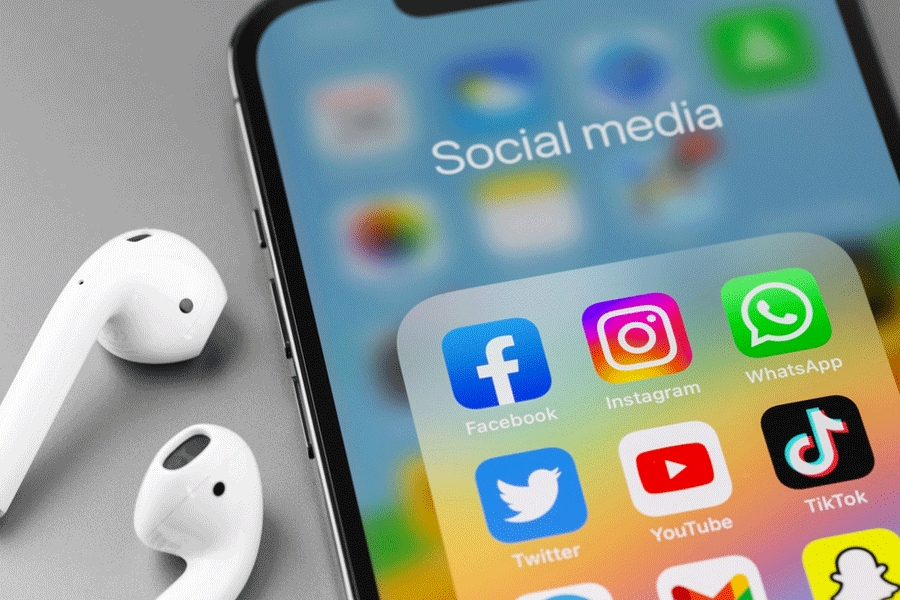
Social media are increasingly used by marketers to reach out and access consumers instantly with a few strikes on the keyboard, at any time and from any location on earth. Such power presents numerous traps for the unaware, and the content often escapes the ordinary vetting applied to conventional advertising. Online messages should still be subject to restrictions regarding fair competition and false advertising that apply to television, radio, and print messages.
For example, Twitter presents a challenge with its limited message size. Tweets that are incomplete, misleading, or inaccurate can open the door to liability. Advertising experts may be sought because of their social media savvy, but they should be aware that advertising is regulated, regardless of the forum. Disclaimers, links to restrictions or conditions, and other requirements should be met.
Another interesting aspect of false advertising in the social media context is how any user can widely disseminate a message. This can lead to issues regarding fraud and anonymity. For example, an online consumer may claim that a box of worthless rocks was received after ordering from a famous website. A photo can be provided as proof. However, what if the complaint is not true or the user not real? Interestingly, we now have reviews of reviews, where persons can comment on the comments of other consumers. And the online retailer can track and display whether an actual purchase was made by the commenter, lending credence to complaint or praise. So, an amazing new dynamic has opened up where consumers can gather purchasing information directly from other consumers rather than relying on the biased puffing of advertisers.
We also have the cyber-creatives who instigate online support for their product. Here it can be possible to exceed the bounds of fair play. For example, a seller may fail to reveal artificial incentives to consumers. Imagine, for example, a company that manufactures false users or pays real ones to "like" a product.
Of course, the truth eventually comes out, and the company's brand may be tarnished. But, what if the company disappears and reappears under another assumed name? Or, what if a competitor surreptitiously launches a bot automated negative social media campaign? It would seem that such misleading efforts should be prevented, but it is quite difficult to track scamsters in the virtual world.
A final issue is the global reach of social media. Advertisers may find themselves summoned to courts in far-off lands. So it pays to take the laws of other nations into account, especially if consumers are targeted there. As far-reaching connectivity technologies emerge, there seems to be increasing automated accommodation for national and regional norms and sensitivities. How could one set of rules possibly fit all cultures and all countries?
As more and more advertisers realize that an online social media presence is a must, it is hoped that they also corral their eager marketing efforts to restrain them within ethical and legal practices. The law is often slow to catch up with new technologies, so we will surely see some interesting disputes emerge. Hopefully, everyone can agree that truth in advertising will lead to a stronger economy, but "restrictions apply".
The authors are US IP attorneys. Both are associated with Klarquist, a law firm that has been engaged in providing IP legal services. Maurer has been visiting India annually since 2008