|
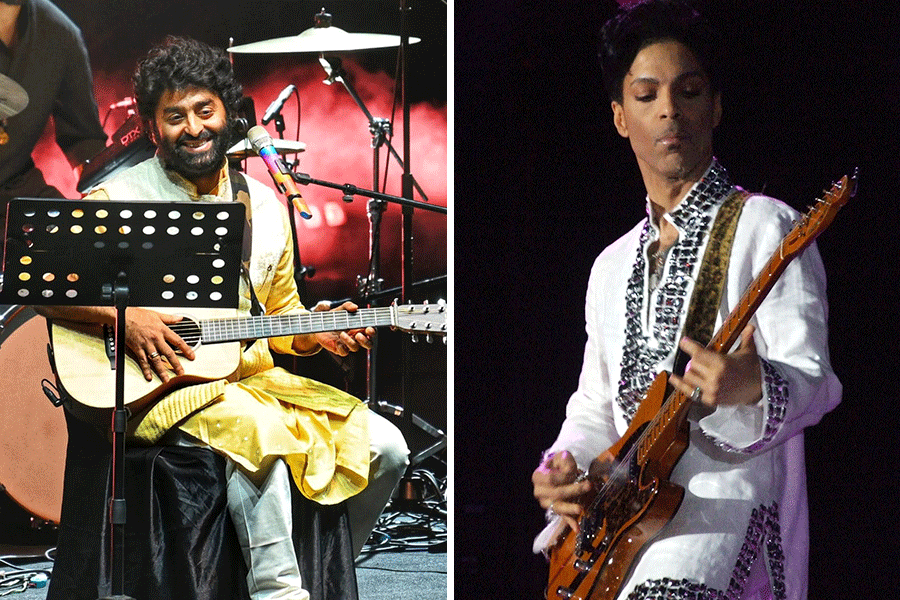
It was a shower of colours, an outburst of passion and a reflection of nature. The evening was a gift from the young classical vocalist, Ankan Bandyopadhyay, to the audience last week in the cosy, homely atmosphere of Studio 21 (picture, top). Ankan started his classical training from his childhood and has been under the tutelage of late Pandit Manas Chakraborty for the last 10 years. He has already emerged as a painter. But this sincere disciple of the Kotali Gharana never kept music as a second choice. He seemed to be as comfortable and relaxed as a painter as when he expressed his inner voice through his favourite musical genre, Indian classical music. Ankan commenced his performance with Raga Kedar. He sang a vilambit kheyal, “Barkha rutki...”, in ektaal. His style distinctly carries his guruji’s trademark — the smooth and flawless movement of notes, slightly sharpened in the upper octave, but never losing sweetness. The vilambit kheyal, with its beautiful vistaars and taans, was thoroughly enjoyable. It is a bit difficult to present an elongated vilambit in Raga Kedar, but Ankan presented it successfully, without deviating from the mood and ambience of this particular raga. He also sang a drut kheyal in teental, “Bhala re Kanha tum ayo”, where the vistaars of antara and taans were the main attractions.
But Ankan’s voice got its full bloom with Raga Desh, which was his next presentation. He started with alaap, where he focused on the lower octave. Even without a microphone, his renditions were clear and distinct. He sang a famous composition in drut ektaal, “Beet jaat barkha ritu”. Raga Desh is quite popular among listeners and the composition has been sung by many doyens of Indian classical music. But the originality of Ankan’s presentation made it special. His small vistaars were interesting, although a little variation was necessary. He spontaneously presented some complicated taans with gamak — only he needs to be more focused in prolonged taans and vistaars. In the last phase of his performance, Ankan sang “Vande Mataram” (which is based on the same raga) in a generous voice. It carried the mark of his inner passion. Ankan manifested his emotion with the absolute freedom of a painter.
The young and talented sarodiya, Soham Datta, who accompanied Ankan throughout his performance with great maturity, also demands special mention. It is difficult to play a heavy instrument like sarod in a way that keeps its own magic intact alongside the vocal recital. But Soham did his job with ease. Both in Kedar and Desh, his perfect renditions created a charming atmosphere. Soham never dominated Ankan’s performance but simultaneously established his own identity. In tabla, Pradip Chakraborty, and in harmonium, Shubhadip Paul, were perfect for this musical evening, which brought out the melancholy and grandeur of varsha with two appropriate ragas.
Anonagenarian artist’s vocal recital accompanied with harmonium played by himself, was an unique experience for the city. In an evening organized by Sangeet Ashram, the audience got a rare opportunity to witness a performance by senior artist, Ustad Lachhman Dass Sandhu (picture, bottom), a disciple of the doyens of Patiala Gharana, Bade Ghulam Ali Khan, Ustad Barkat Ali Khan, and later, Ustad Ali Baksh Zahoor.
A veteran radio artist from pre-Independence India, Lachhman Dass Sandhu, in his long musical journey, has created a colourful style of his own, blending the gayaki and traditions of his great mentors. He has achieved mastery in the distribution of words in the versatile style of bol-banawat. The listeners got a taste of his glorious past on that particular evening.
 |
He focused on thumri, dadra, ghazals and other light classical compositions. He commenced with the thumris, “Piya nahin aye”, based on Raga Mishra Madhuvanti, “Saiyan bolo”, based on Raga Mishra Piloo, and the famous “Saavre salone more Shaam”.
He sang ghazals which were originally Ghalib’s composition based on Multani-Kafi: “Sajni tere bal paroon” and “Lage more nain”. He also sang a dadra, “Kidhar gawai ratiya” and then the perennials, “Aja balam pardes” and “Bezuban jaban na ho jaye”, based on Raga Desh.