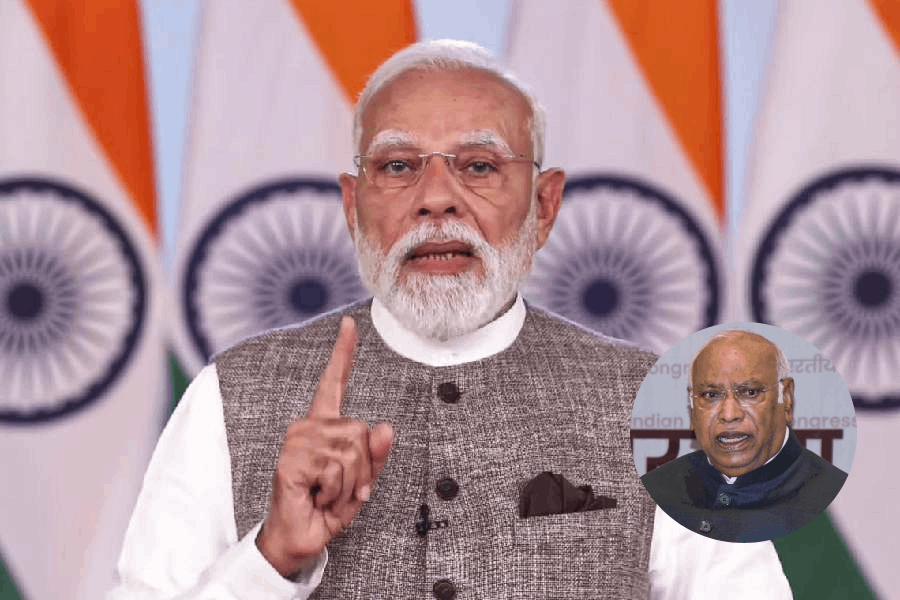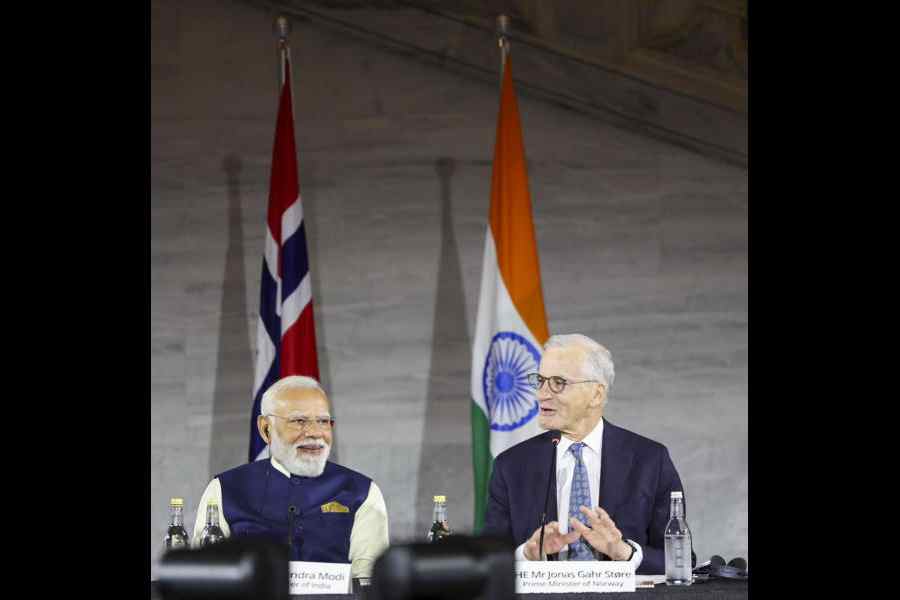
Visits to five countries; meetings with leaders of seven nations; multiple deals — from semiconductors to clean energy — struck. All in less than a week. The characteristically high-tempo overseas trip of Prime Minister Narendra Modi to the United Arab Emirates, the Netherlands, Sweden, Norway and Italy yielded several newsworthy moments. Yet, it will likely be remembered for the government’s ham-handed response to two moments.
In the Netherlands, the prime minister, Rob Jetten, spoke of concerns about how India treats its religious minorities. And in Norway, a journalist first tried to ask Modi a question and then posed an aggressive question to the ministry of external affairs. In each case, India was left embarrassed, not by the diplomatic corps that tried to defend India but by the cold facts that the country’s foreign service officers have to contend with. At the best of times, their job is hard: they are understaffed, overstretched and trying to serve both the Indian government’s priorities and the world’s largest diaspora. They have to strike defence pacts, secure energy supplies, plot complex diplomatic juggling acts and rescue Indians stuck in war zones all at once. They need all the help that the government can give them.
Instead, it feels like they are often thrown under the bus. Modi’s current trip is a prime example. After Jetten’s comments about India’s track record on minority rights, a senior diplomat from the ministry of external affairs was fronted to push back. The response to a political statement should have come from a political leader, perhaps the foreign minister.
The diplomat tasked with defending the indefensible — the Bharatiya Janata Party just won the West Bengal elections on a campaign openly based on religious polarisation — tried using the best weapon he had: India’s past. The veteran foreign service officer spoke about how India had been a home to Christians and Muslims much before those faiths travelled to several other lands and how people of all religious backgrounds persecuted elsewhere had found a welcoming home in India.
He was right, except the India he was talking about was not the India he was trying to defend. In today’s India, persecuted religious minorities who sought shelter, such as the Rohingya, are targeted for deportation; an asylum seeker’s application for Indian citizenship is processed based on his or her religion owing to the Citizenship (Amendment) Act; and even bona fide citizens often need to prove that they are not undocumented immigrants. Modi and the Indian government own their anti-immigrant, sectarian politics at home. But they want to present a Gandhian or Nehruvian image of India’s social contract when addressing the rest of the world. That hypocrisy is impossible to defend credibly.
Things turned even bleaker in Norway. First, Modi either did not hear or ignored a Norwegian journalist’s question at a press meeting with his counterpart, Jonas Gahr Støre. Modi walked away, Støre took questions from Norwegian journalists, and later from Indian journalists.
The same Norwegian journalist who tried to question Modi then landed up at a media briefing organised by the ministry of external affairs and asked how Norway could trust India given its record on minority rights. The foreign office could have told the reporter to direct that question at her own government: clearly Støre trusts Modi enough to have hosted him. Instead, the same diplomat who had spoken about India’s religious diversity in the Netherlands launched into a 10-minute-long speech on everything from how the concept of zero originated in India to how New Delhi sent millions of Covid-19 vaccines overseas.
In the meantime, Indian journalists were able to interview not only Støre but also the prime ministers of other Nordic nations in Oslo for a summit with Modi, highlighting a contrast in the present that no amount of harking back to the past can hide. The memes going viral target the diplomat. They should instead focus on the terrible cards he was dealt by the government.
Charu Sudan Kasturi is a journalist who specialises in foreign policy and international relations