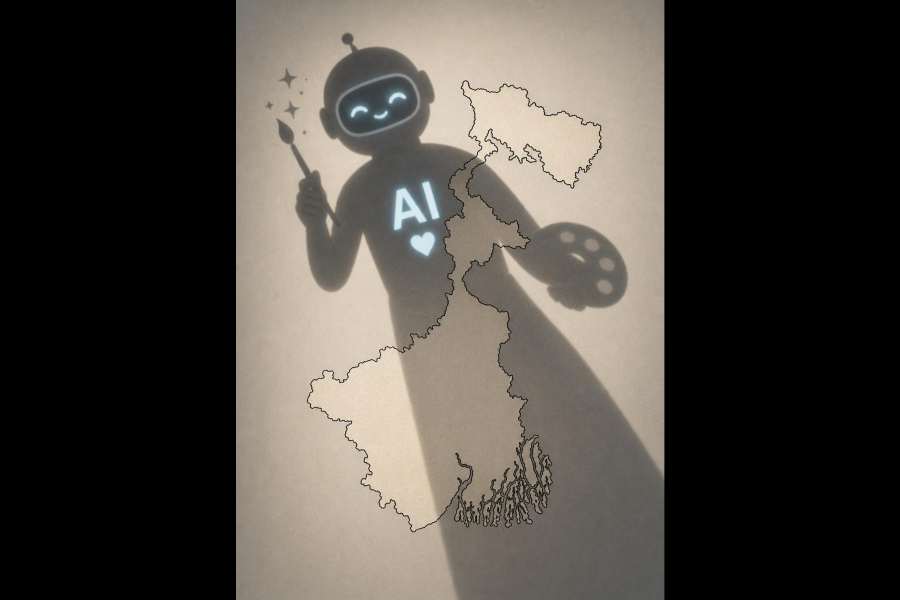
The recent report released by OpenAI, on April 15, 2026, offers an inspiration for India and a discomfort for Calcutta. It confirms that India is among the most active users of Artificial Intelligence globally. But it also reveals that AI adoption is highly concentrated in a few cities and states; Calcutta and West Bengal do not figure among them. Cities like Bengaluru, Hyderabad, Delhi and Chennai dominate. Some smaller states and Union territories, like Assam, Odisha, Manipur, Tripura, Chhattisgarh, Punjab, Himachal Pradesh, Kerala, Jammu & Kashmir and Chandigarh, are showing sector-specific adoption. It is an ominous signal.
To understand the present, we must revisit the past. In the 1980s, when India stood at the threshold of the information technology revolution, West Bengal chose hesitation over adoption. Sections of the Left leadership and trade unions opposed computerisation, fearing that technology would destroy jobs. That moment proved decisive. While cities like Bengaluru embraced IT and transformed themselves into global technology hubs, Bengal gradually slipped behind. Investment shifted elsewhere. Talent followed. Ecosystems grew outside Bengal. Even today, decades later, we are still grappling with that lost opportunity.
AI, particularly Large Language Models like ChatGPT, Google Gemini and Claude, represent a new technological epoch. Unlike the IT revolution of the 1980s, on this occasion, there has neither been ideological resistance from political parties nor any institutional opposition. I can say this with conviction from my experience in the IT&E department. The Bengal Silicon Valley Tech Hub in New Town is helping the AI eco infrastructure. There is an AI laboratory at the Webel Bhavan premises. Both are state government initiatives.
ChatGPT reached India in early 2023. Other LLMs followed soon. In just three years, it has transformed workflows across coding, writing, analytics, design, governance, and education. This was Bengal’s opportunity for a clean reset, a chance to leapfrog. And yet, we did not, as the OpenAI April 2026 report shows.
West Bengal is not short of talent. Quite the contrary. Our students excel in mathematics, engineering, and analytical thinking. Our professionals lead global firms across the world. Our intellectual tradition is deep and respected. And yet, AI adoption within the state remains muted. The hubs of advanced usage, like coding, data analytics, and automation, are elsewhere. Calcutta is not even mentioned among the leaders. This raises uncomfortable questions. Have our young minds migrated, leaving behind a hollowed ecosystem? Have easy welfare structures reduced urgency and risk-taking? Have we created a culture where celebrity is valued more than innovation? Is there a lack of reward mechanisms for merit and enterprise? These are questions we must confront honestly.
In April 2024, I had organised what was perhaps one of the earliest public exhibitions of AI-generated art on canvas. These were displayed on the walls of the North Gallery of the Academy of Fine Arts. The intention was not merely artistic. It was demonstrative. It was meant to show the writing on the wall. AI was no longer abstract. It was not confined to the chat boxes of smartphones. It could create art on the walls of an exhibition gallery in Calcutta for all to see what AI can do. It was to provoke thought among visitors at the AI Art on Canvas exhibition. And, for the record, later in 2024-2026, I used generative tools to create contemporary art for displays at the Gaganendra Art Gallery, ITC Sonar, Indian Museum, Indian Council for Cultural Relations, Biswa Bangla Mela Prangan and at a Puja pandal in South Calcutta. The conversation on creative AI had begun. But conversation alone is not enough.
AI is not just about creative tools in an Orange Economy. Its real power lies in applied transformation. Across forums, I have consistently advocated for practical use cases in agriculture, urban governance, healthcare, and tax administration. They are already being implemented elsewhere. And yet, in Bengal, adoption remains sporadic.
The real problem is not opposition, but lethargy. This is perhaps the most critical insight. In the 1980s, Bengal suffered from active resistance to technology. Today, the problem is different and more insidious. It is passive inertia. No one is pushing AI adoption. No coordinated strategy exists. No urgency is visible. This silent gap is more dangerous than open opposition because it delays action, and opportunity flies.
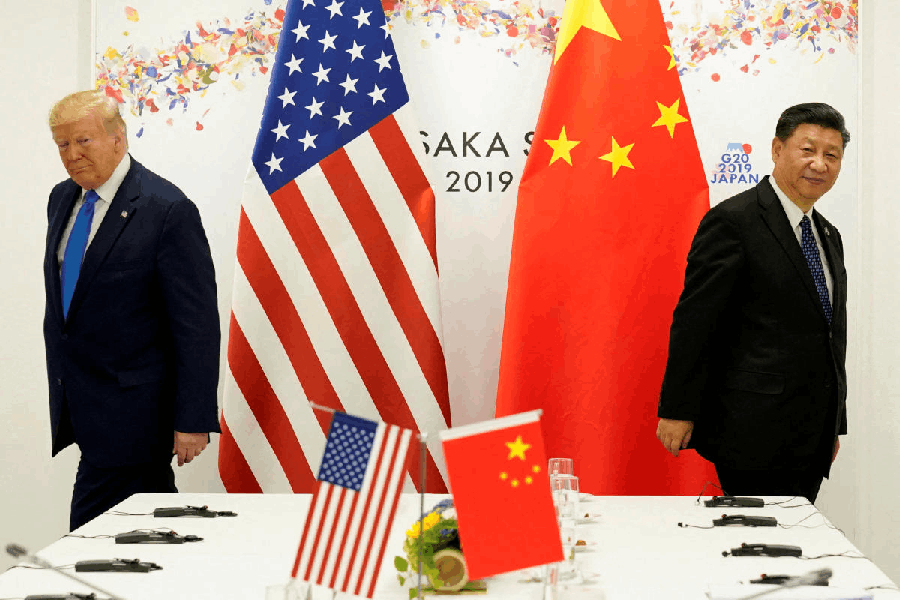
If we are to correct course, incremental steps will not suffice. We need a structural intervention. It is believed, but not verified, that in the United States of America, there exists a core governance consisting of stalwarts and thinkers who drive US policy. It refers to career civil servants, intelligence officials, military personnel, Silicon Valley chiefs, Wall Street experts and media moguls who remain in power regardless of which party wins the White House. This group ensures policy continuity. Names like Bill Gates and Elon Musk have sometimes cropped up, without proof. This core group is sometimes referred to as the Deep State, but there is little corroboration.
I propose the creation of a ‘Deep State’ in West Bengal as a collaborative think tank that operates outside formal governance. This body should include experienced administrators, successful corporate leaders, AI entrepreneurs, young, tech-savvy innovators, academics, investment bankers, media houses and domain experts. It will not talk of Hindu and Muslim vote banks, or about the Special Intensive Revision of electoral rolls and direct cash transfers. Its mandate should be to identify high-impact AI use cases for Bengal, create pilot projects with measurable outcomes, facilitate partnerships between government and start-ups, businesses and innovators, and ensure rapid scaling of successful models.
We are late already, but not too late. AI, especially LLMs, is evolving at an extraordinary pace. The next breakthroughs in reasoning, multimodal intelligence, and autonomous agents are still unfolding. This means the playing field is not yet frozen; new leaders can still emerge, late movers can still catch up, if they move fast. But the window is narrowing.
West Bengal stands at a crossroads, once again. We have the talent and the intellectual capital. We must build a deep framework. Let us integrate AI into the Deep State, and be ready to reward talent as much as CEOs of the largest corporations. Let us kickstart the Deep State today.
Debashis Sen is a retired IAS officer