|
|
| Asian Games, New Delhi, 1982 |

It is a tale of two events, two different eras and one city: Delhi. The first occasion was an unprecedented success — the IX Asian Games that were held in the capital city in 1982.The second — the XIX Commonwealth Games, 2010 — to be held in the same city, however, has given the people of India an opportunity to oppose and criticize the officials as stories of financial irregularities tumble out of the closet with every passing day. So much so that the prime minister of the country has had to intervene and steer the sinking and stinking ship with only a few weeks left before the scheduled start of the event. Indeed, as things stand today, the Commonwealth Games could end up embarrassing India and dent the nation’s credibility on the international stage.
As it is, the Commonwealth Games have never been considered to be a top-notch sporting event. Compared to the Olympics or the Asian Games, it is, at best, seen as a sporting competition of minor importance, with most of the participating nations considered lightweights in world sport. If one were to search the Encyclopaedia Britannica or the internet to find out the details and accomplishments of the participants, one would conclude that India’s prospects of striking gold are considerable, given the quality of the competitors. The quality of the effort put in by the host for the preparations is as inferior.
Nevertheless, the Commonwealth Games originated in the United Kingdom, which ruled the sporting world for a long time. The event features some sporting heavyweights such as Australia, Canada, New Zealand, some African nations and the UK. This gives the Commonwealth Games the aura of an international event, which, in turn, make the Games a matter of prestige and honour for the host. In brief, therefore, the Commonwealth Games may be short on quality but with 51 nations participating in the arena, they will certainly not see any dearth of quantity.
Compared to this, the Asian Games in 1982 saw 38 countries participating with 4,000 athletes. Yet, the 1982 competition was a triumph for the organizers. Why? Perhaps because the organizing committee — rechristened the special organizing committee — was directly controlled by the redoubtable Indira Gandhi, the then prime minister of India.
After the Emergency of the mid-1970s, which was characterized by long days of despair, Indira Gandhi planned on a sensational re-emergence. This required restoring her credibility, charm and magic. Hence the bottom line for the organizers was not to brook any nonsense. Thoughts of failure or opposition to the event were banished quickly. Indira Gandhi sought to achieve glory and success for both herself and the nation. The successful completion of the Asian Games was a challenge to her. Hence, she put the best men available on the job. Moreover, she did not hesitate to change those occupying the top of the hierarchy whenever there was a need to do so.
Thus, Vidya Charan Shukla, the chairman of the SOC since its inception, was replaced by Buta Singh in April 1981. Similarly, the secretary-general of the SOC, the late S.S.Gill, was replaced by K. Shankaran Nair only a few months before the event. With this replacement, Indira Gandhi demonstrated that she could change the captain of a ship in mid-stream, even though her critics thought that the move had come too late in the day. It was the manifestation of a latent determination that often transformed itself into firm and decisive action. Men may come and go but the show must go on. This was the adage that Indira Gandhi seemed to adhere to. And the show did go on and was hailed a grand success.
There were several daunting crises that afflicted the 1982 tournament as well. The construction of the Jawaharlal Nehru Stadium and some other venues was delayed significantly. The vice- chairman of the Delhi Development Authority was given marching orders. For a while, it seemed that the electronic score-board manufactured in Hungary would not reach the main stadium in time. Belated action by a SOC official and choked transit links had led to the creation of this particular problem. Ultimately, to the relief of the organizers, the equipment reached Delhi after passing through Budapest via Hamburg. However, in retrospect, several other factors appear to have clicked in favour of the event in 1982. Full responsibility and unbridled power were bestowed on the SOC officials with ‘accountability’ as the accompanying rider. Those who failed to deliver had to be shown the door immediately. Rajiv Gandhi was asked to be a part of the SOC along with two of his trusted aides, Arun Singh and Arun Nehru. Both the Aruns were no- nonsense men, though with different management styles. However, Rajiv and his team did succeed in commanding respect, owing to their clinical efficiency and professionalism. The SOC transformed into a well-oiled machine from May-June 1982.
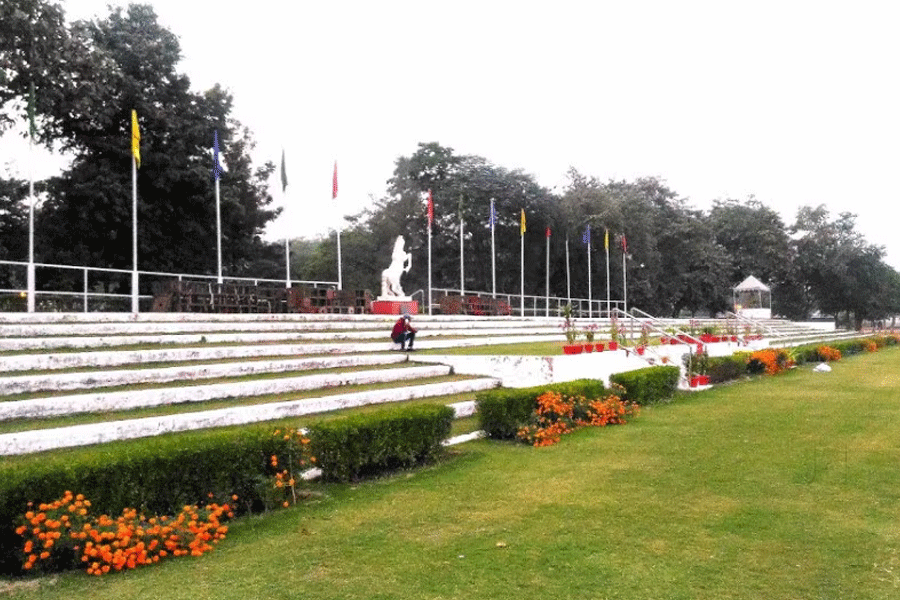
The stadiums and the Games Village were completed on schedule. Roads, flyovers, an exclusive, single-floor airport terminal came up in record time and hotels and subsidiary infrastructure too were spruced up. Tickets for the extravaganza were sold from designated pubic outlets from August 1, 1982. The flood-lit Jawaharlal Nehru Stadium staged its first serious trial run with a football match played between India and Russia. The match helped test whether everything was in place exactly 33 days before the inauguration of the Asian Games.
Thus, the success of the IX Asian Games truly lay on single-channel command, control, communication and co-ordination. The most important and crucial of all this were the ‘minutes’ of the meetings. They were sent to every official concerned and in the shortest possible time. Hence, the entire team of organizers, ranging from the under- secretary to the secretary as well as the political appointees, knew the outcome of each and every meeting and the resultant plan of action that had to be executed by each committee. Committees were divided into various sections — works (stadium construction), finance, protocol, customs (import, export, passengers, VIPs), accommodation, transport, security, village administration, publicity and administration, and so on, and each of them performed their tasks in an efficient manner.
It was an example of incredible team-work on the part of the government of India. This had been possible because there had been no intrusion by lobbies with vested interests or the private sector. The lure of money had also been resisted. Organizing the Asian Games was a matter of prestige for India. There were instances of some rare, but superb, convergences between the political and bureaucratic classes. This was because of a number of factors. First, except for two, none of the other civil servants in the SOC was of doubtful integrity, thereby making the two officials extremely wary of the potential challenges. Second, unlike the present situation, the number of SOC officials was extremely low. Even at the height of action, the total number of officials did not cross 20. Third, the SOC was under no compulsion to take orders from any foreign officials regarding its day-to-day activities. There was the Olympic Council of Asia, which was the apex body of the Games. But it was not known to have pushed around Indian officials or made blatantly unsavoury demands of the host.
After all, it was an era dominated by Indira Gandhi. The then prime minister was certainly not the type to take instructions or fatwas from any one. The 1980s cannot be compared with the India of 2010. India now is ruled by an ethic that combines the mantras of globalization and liberalization. ‘Open up whatever you have and can provide’ is the prevalent attitude and this seems to hold true in the context of the Commonwealth Games as well. As of now, every glitch that the event has faced has been blamed on ‘command failure’. One hopes that the organizers will be able to put together a successful show, the daunting responsibility notwithstanding.