
The Pritzker Prize is to architecture what the Nobel is to science: a global recognition for a person's achievements and contribution; a note of appreciation for being exemplary. This year, Balkrishna Vithaldas Doshi, the 90-year-old beacon of Indian architecture, received the Pritzker. He became the first Indian to join the stellar list of architects who have contributed in shaping the built environment of the world with their creativity.
Doshi is the protégé of one of the masters of modern architecture, Le Corbusier. He studied in Sir J.J. School of Architecture, Mumbai, before spending three years in Paris to learn at in the French architect's atelier. Doshi returned to India in the 1950s to supervise the construction of Le Corbusier's Chandigarh and buildings in Ahmedabad. Doshi founded his firm, Vastushilpa, in 1956 in Ahmedabad and was instrumental in inviting the American architect, Louis Kahn, to design the Indian Institute of Management, Ahmedabad.
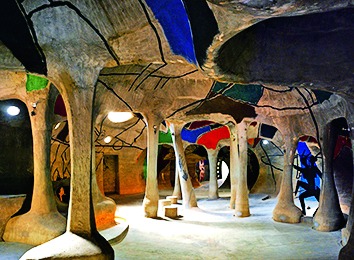
Doshi went on to design IIM, Bangalore and collaborate with M.F. Husain for the gallery, Gufa (picture), in Ahmedabad, not to mention design and found the Centre for Environmental Planning and Technology, Ahmedabad, that today is the alma mater of some of the finest architects. In his vast body of work is the Aranya Low Cost Housing, Indore. He thus set a precedent by pioneering low-cost and sustainable housing in India.
Doshi, along with his contemporaries and predecessors, can be credited to a large extent for shaping the urban environment that Indians live in today. These visionary architects and engineers of the newly-independent India shouldered the responsibility entrusted on them by the young governing bodies to mould a nation, creating a fine balance between the international and vernacular styles of architecture and coming up with the unique face of modern Indian architecture. B.V. Doshi is one of the last torchbearers of this legacy.
Architecture still remains in the background in a country that is engrossed in the vagaries of politics, of religious gurus, in television serials and burdened by inequality. But architectural practice has adapted, for want of a better word, to the way of living in the twenty-first century by turning to building steel and glass canyons across cities. Architects with little or no training are planning buildings with aplomb, under the protection of civic bodies. Architectural practice today is being gnawed hollow.
Someone once said that architecture is an art that survives on patronage. But when patrons like the government and business tycoons prefer foreign architects for landmark projects like building Amaravati, the capital city of Andhra Pradesh, there is little scope for indigenous architects to make a mark on a grand scale. To add insult to injury, when given a chance, the indigenous architects either show a complete disregard for the history of their country - as in the case of the Hall of Nations in Delhi - or squabble among each other, bringing disrepute to the profession - as in the case of the competition for designing the National War Museum. One is forced to be concerned about the direction in which the profession is progressing.
Yet, architecture continues to contribute regularly to the country with limited help from authorities and councils representing the architects. While some are fortunate enough to rise above competition and establish themselves, most fade away into the swamp of commercialization in order to survive and a few turn away having failed as a result of the idealism taught in architecture schools. In this scenario, Doshi's Pritzker is a gentle reminder to the nation, a ray of hope for all Indian architects in an increasingly clouded profession.