The traditional Republic Day parade in the nation’s capital was held under blue skies this year. The country’s horizons, however, continue to be grey because of the grave ideological contestations that mark its society and polity. The only way out of these divisions is through the path of constitutional nationalism flowing from the Republic’s Constitution.
All through history, India was governed by monarchies. It is now being claimed that India is the mother of democracy. Is this true? There may have been a few tribal political organisations, which did not have hereditary kings. These were not, however, democracies. They were oligarchies. The concept of power residing in all the people of a political entity and being exercised through their representatives, elected through free and fair elections, is relatively recent. The true test of a democracy is whether all the people of the country have the right to vote as well as the unfettered freedom to exercise it. Anything less than adult franchise makes a political system undemocratic.
The Americans often claim that their country is the world’s oldest democracy. In their interaction with Indians, they state that India is the world’s largest democracy. Facts belie the Americans’ claim about themselves. Until the civil war of the 1860s, slavery was legal in 15 of the then 34 of American states. After slavery’s abolition, the US Supreme Court accepted the pernicious doctrine of “separate but equal”. This denied
rights to the Black community. The American claim to democracy is thus only tenable after the Civil Rights Movement of the 1960s when segregation ended and the Blacks could openly exercise their vote.
In sharp contrast to America, the Indian Republic’s Constitution gave every adult the right to vote. Such a development had never occurred till that time in a poor and largely illiterate country. The Constitution also prescribed that no one would be discriminated against on grounds of caste, colour, creed or faith. The implication of these constitutional provisions was that all Indians, irrespective of religious persuasion, would be equal participants in the polity; that no section would be denied from wielding power or from being involved in governance and policy-making. Going further, the Constitution also made provisions for affirmative action for those sections of society which had suffered historical discrimination. It is essential that these vital and foundational principles and values of the Indian State be always preserved and promoted. This can be the only basis of Indian nationalism, a nationalism rooted in the Constitution.
It is incumbent on all constitutional authorities and their advisers to promote the values of the Indian Constitution. Indeed, constitutional authorities take an oath on the Constitution. They have to therefore only think of themselves as Indians and promote constitutional nationalism. They do not have the liberty of promoting sectional interests or of putting their sectional identity over their national identity. Unfortunately, it is being increasingly witnessed that some Indian leaders are projecting their sectional or subnational identities over their Indian identity.
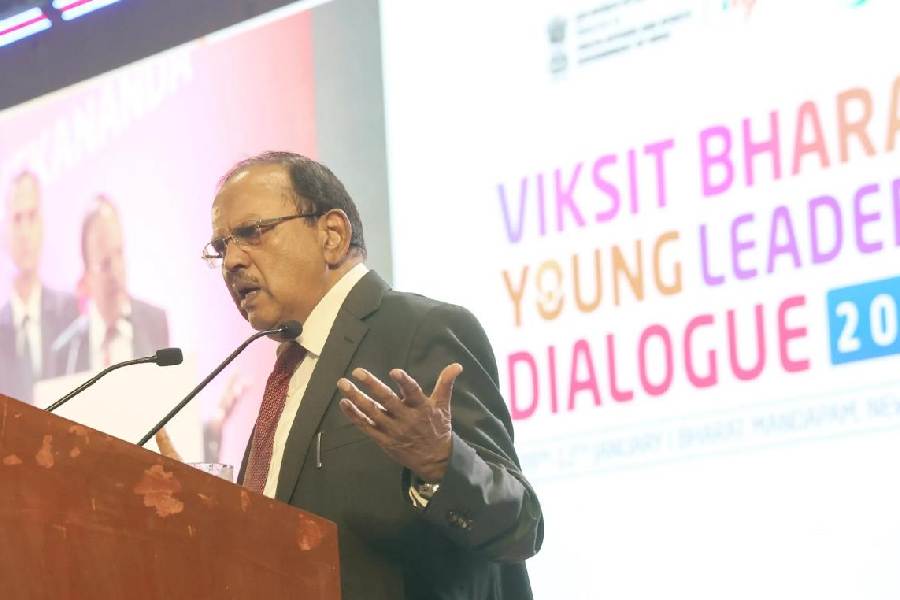
Perhaps the most important official in the country is the national security adviser. His remit is vast. It encompasses strategic issues, defence matters, and internal security. The NSA’s appointment is political, but it is essential that he acts completely professionally. The NSA also cannot deviate from constitutional principles. The current NSA, Ajit Doval, is a seasoned intelligence official. He retired as director of the Intelligence Bureau. It is to be expected that he, of all officials, would not falter in giving objective views to the political leadership. Above all, the NSA cannot but adhere to constitutional principles. Sadly, he has not done so unequivocally all the time.
There is no doubt that Doval strayed far off the course during his talk on January 10 to the youth who had gathered for the Viksit Bharat Young Leaders Dialogue. Doval recalled the sacrifices that were made for the achievement of India’s Independence. He went on to add, “Our villages were burnt, our civilization was ‘ended’, our temples were looted. We watched as helpless spectators.” Doval emphasised that this history posed a challenge and every member of the Indian youth should have the fire of vengeance. He flatly said that we have to avenge our history. Doval conceded that vengeance is not a good word but asserted that vengeance in itself has great strength.
Is it the mandate of the NSA to preach to the youth of India that they should carry within themselves a spirit of vengeance? The answer can only be in the negative. Besides, two questions arise: vengeance against whom? And, how is this vengeance to be extracted?
Doval’s words were equivocal regarding these issues. The freedom fighters he named were Bhagat Singh, Netaji Subhas Chandra Bose and Mahatma Gandhi. This would indicate that his focus was on the colonial period. However, he also mentioned that “our temples were looted”. The formulation indicates that he was referring to pre-colonial times. It would be appropriate for Doval to clarify what he meant. Constitutional propriety demands that the NSA cannot be ambivalent on the issue of communalism. National security is above the security of a section of the population. The NSA is responsible for advising the political leadership on the security of the entire nation.
It is particularly disturbing that the attention of the youth should be drawn to vengeance for the past when the real challenges facing them are those of the future. These emanate from the enormous scientific and technological change that is taking place in the world. Doval would not be oblivious to the fact that India comprehensively declined when it did so in the realm of knowledge. Yet, he wants the youth to remain focused on past wrongs instead of looking to future achievements.
As the NSA, Doval would be aware of the need for social unity when the country faces enormous strategic challenges from abroad. The only way to achieve this unity and also political coherence lies through the path of constitutional nationalism. That will ensure that no section of the people feels alienated. History bears witness to the negative impact on nation-states on account of the lack of social and political harmony. India has suffered that fate in the past. It has to be avoided in the future.
Vivek Katju is a retired Indian Foreign Service officer