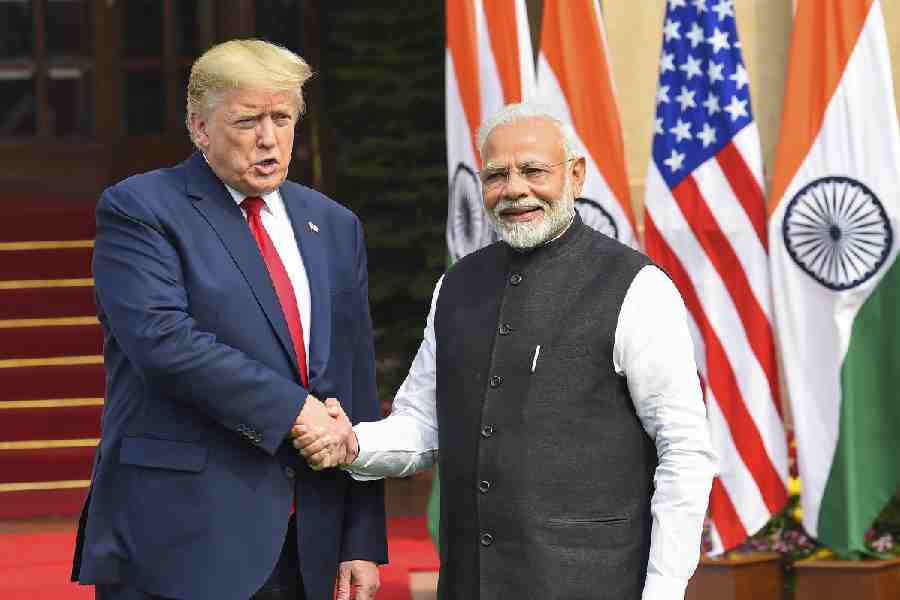
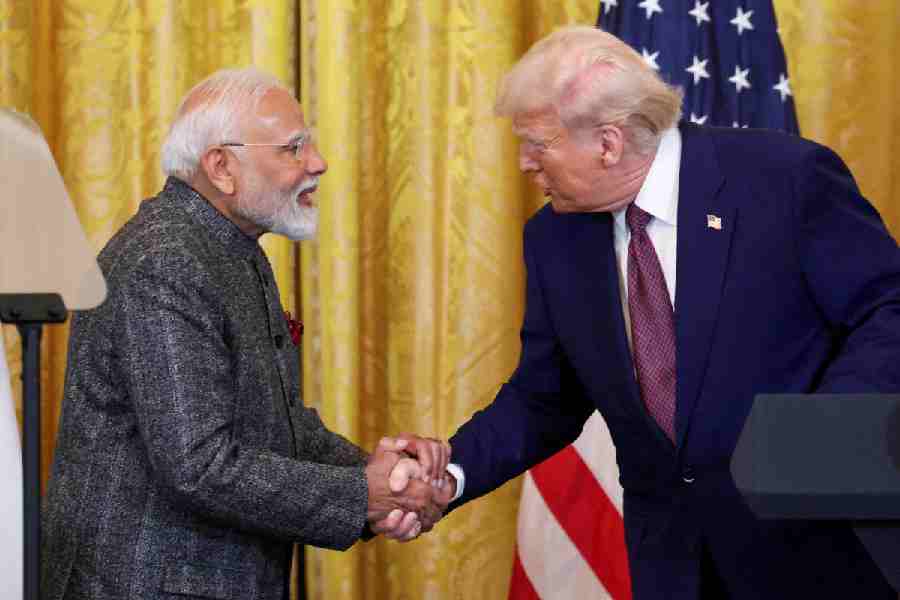
Cheers reverberated across export-oriented sectors, from rice to shrimp, on Tuesday, welcoming US President Donald Trump's announcement to bring down the reciprocal tariff on Indian goods to 18 per cent from 25 per cent.
Trump had announced the deal on Monday night, and Prime Minister Narendra Modi also hailed the tariff cut.
The Indian Rice Exporters Federation (IREF) said it expects the move to restore price parity with competing nations and significantly boost shipment volumes.
The revised tariff would place India on a par with competitors like Thailand and Pakistan, which currently face duties of approximately 19 per cent, pointed out IREF national president Prem Garg. He called it a “significant victory for price parity.”
Exporter RiceVilla Group's CEO Suraj Agarwal said: "Indian rice can now compete on a level playing field in one of our most high-value markets."
The industry is also hopeful that a potential penalty related to India's purchase of Russian oil would be waived by US authorities.
Garg pointed out that the development comes as India enters the season with a record rice production of approximately 149 million metric tonnes.
The IREF said that Indian agri-products have shown remarkable resilience; for instance, rice exports to the US rose even when duties were previously hiked from 10 per cent to 50 per cent.
From April to November 2025, Basmati exports reached 1,99,558 tonnes valued at Rs 1,749.17 crore, while non-basmati shipments stood at 40,960 tonnes, worth Rs 284.12 crore.
The IREF said that it does not anticipate disruptions in trade with Iran, despite questions regarding additional tariffs linked to that corridor. "Based on current visibility, IREF expects continuity in export flows," a statement said.
Seafood exports to the US are also expected to recover following months of declining shipments, the Seafood Exporters Association of India (SEAI) said on Tuesday.
Fish exports to the US fell 15 per cent by volume to 201,501 tonnes in the April-November period of the current fiscal year, while value declined 6.3 per cent to US $1.72 billion from $1.84 billion a year earlier, SEAI general secretary K.N. Raghavan said.
"The field has become level again, exports should get the boost," Raghavan told PTI.
"We expect that with tariffs coming down to 18 per cent, we should get back to the previous levels."
During the period of elevated tariffs, Indian exporters were fulfilling existing contracts, but new orders had stalled due to uncertainty over rates, Raghavan said.
Buyers held shipments in customs-bonded warehouses and released them as needed.
The US is India's largest seafood export destination after China and the European Union. Frozen fish accounts for 83 per cent of total exports.
Raghavan declined to comment on concerns about policy uncertainty, calling tariff decisions "geopolitical and geostrategic" matters decided at the highest levels of government.
Positive for labour-intensive sectors: Moody's
Moody's Ratings on Tuesday said the reduction of the US tariff rate on most Indian goods is credit positive for labour-intensive sectors such as gems, jewellery, textiles and apparel, which are the top export sectors.
Moody's in a statement said the trade deal will reinvigorate India's goods export growth to the US, which remains the country's largest goods export market, accounting for about 21 per cent of India's total goods exports for the first 11 months of 2025.
"Lower tariff rate will also be credit positive for labour-intensive sectors such as gems, jewellery, textiles and apparel, which rank the top export sectors," it said.
However, pharmaceuticals and consumer electronics, the other two major export sectors, had been exempt from the 50 per cent high tariffs imposed by the US and therefore are unlikely to be affected by the reduction.
Moody's said even though India has reduced its purchase of crude oil from Russia in recent months, it is unlikely to cease all purchases immediately which could be disruptive to India's economic growth.
"A complete shift toward non-Russian oil could also tighten supply elsewhere, raise prices and pass through to higher inflation given that India is one of the world's largest oil importers," Moody's said.
"Likely to bolster credit profiles of textile, chemicals, shrimp, gems and jewellery players," India Ratings and Research said on the trade deal.