|
|
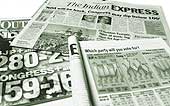
| Press reports: Forecasts made on the eve of the forthcoming elections (above). Election commissioner T. S. Krishnamurthy (below). Photos: Subhendu Chaki / Reuters |
 |
| The EC under T.S. Krishnamurthy hopes that it can now present its case more forcefully |

In an election, the loser loses twice. First, when the opinion poll results are splashed in the media, and then at the hustings. Is it fair? What if the sampling was wrong, or the interpretation of the sample survey got skewed? What if the supposed loser wasn’t quite losing in the end but the early foretelling of his doom created a “bandwagon” effect, making his voter throw up his hands in despair and sit back at home on the polling day?
Can’t it have disastrous consequences particularly for exit polls conducted through a staggered election such as in India? While nobody questions the underlying principle of survey research — that a randomly selected, small percent of a population of people can represent the attitudes, opinions or projected behaviour of all of the people — who can guarantee the ‘randomness’ of a sample in a country as diverse as India?
The questions have been haunting again the political class and the mandarins of the Nirvachan Sadan. The doubts have acquired gale force with each of the first round of opinion polls predicting a return of the A.B.Vajpayee-led National Democratic Alliance (NDA): 330 to 340 seats by India Today-ORG; 287 to 307 by NDTV-Indian Express-A.C.Nielsen; and 280 to 290 by Outlook-CMS. So the Congress-led front is out of the race, at least in the expectation of those who believe the pollsters, a good three weeks before the press of the first button on the voting machine.
Worried over the invasion of its turf by the smart set of sample researchers, the Election Commission (EC) has called an all-party meeting on Tuesday to decide if it should re-invoke its 1998 guideline that banned publishing opinion poll or exit poll results from two days before the commencement of polling till half an hour after its close in all states and Union Territories.
For the commission, then under M.S. Gill (who’s now a Congress member of the Rajya Sabha), the 1998 guideline met with a tragic end as the Times of India and Jain TV decided to publish or broadcast the exit poll results regardless and the Supreme Court turned down the commission’s request on the ground that it could not lawfully compel the executive to enforce the guideline, publication of such sample survey results being no ‘election offence’ under the Representation of the People Act.
Since the apex court did not consider the constitutional aspect of the guideline — whether it was in line with the ‘reasonable restrictions’ charted out with the fundamental right of freedom of expression — the commission, now under T. S. Krishnamurthy, hopes that given another chance, and with the support of most of the political parties, it can present its case more forcefully this time round.
Significantly, the political parties, particularly the large duo, BJP and Congress, seem to be in agreement on the undesirability of the exit poll. “We want exit for the exit poll,” says Congress spokesman Kapil Sibal. Echoes BJP general secretary Pramod Mahajan, “The exit poll results should be published after the last polling is over.” Then, with a mischievous glint, he adds, “Since we’ll have the poll spread over four days in two weeks, I don’t think it’ll be fair to, say, the Congress if it keeps hearing from the beginning that it has lost the election.”
But Mahajan is all for opinion polls. “The political parties should take these sample surveys in their stride, just as they take general praise and criticism of others.” Sibal, on the other hand, would have them only with the caveat of “full declaration” of sample selection method, size, questions, etc., complete with past records of accuracy, or otherwise, of election surveys conducted by the same agency.
Election Commission officials are hopeful that a consensus will emerge at least to keep the exit polls out till the last day’s polling, and to block the opinion polls as the campaigns end for the first day of polling. “It’s election by the media,” says a commission official, “and it’s as bad as trial by the media”. But why should pre-election publication of sample research findings be such an ominous threat to democracy if they’re correct within a given margin of error?
The trouble with election forecasts in India is that they can get dodgy far too often, with the probability of success not much brighter than that of the roadside tarot reader. In last year’s assembly elections, for example, pollsters had predicted a close fight in Rajasthan between the Congress and the BJP, but the final results showed a landslide of seats in favour of the latter. In 2001, forecasts in Tamil Nadu gave an edge to the DMK but it was left to Jayalalithaa’s AIADMK to be the winner, and that too by a long shot.
No one, for that matter, had a prior sense of the saffron wave that was to lash Narendra Modi’s Gujarat after the riots, in December 2002. At times, the star psephologist-cum-pollster Prannoy Roy won the day by sheer luck. In 1989, when NDTV chief hadn’t begun his empire yet and was still India Today’s bellwether in every election season, he was feted for being spot on with the forecast of 193 seats for the Congress; the party got exactly that many.
But the area-wise forecast gave the party 20 more in one region and 20 less in another, the two errors neatly cancelling out each other. If he had erred in a somewhat different way, by giving excess seats to the Congress in both regions, the forecast would have put Rajiv Gandhi back in power and Roy too would have risked his reputation.
While the chances of going haywire on the aggregates are remote in a country of India’s size, with localised errors likely to be deluged in a vast mass of correctly predicted trends, the state-wise forecasts can still be baffling.
An example is the controversy over two sets of forecasts for Maharashtra — by NDTV and by Sharad Pawar’s NCP — based on data collected by the same survey agency, AC Nielsen. NDTV, the first to engage the agency for the state, however, did the interpretation work itself and forecast 27 seats for the BJP-Shiv Sena alliance and 20 for Congress-NCP. For the NCP assignment, though, AC Nielsen did the field study later, on a much more grand scale, and also did the analyses all by itself.
The result was entirely different: 31 seats to Congress-NCP and 17 to BJP-Sena. “Such difference is not inexplicable,” says NDTV psephologist Yogendra Yadav, “as the NCP study may have picked up the later trends”. However, managing director of AC Nielsen in India Partha Rakshit was equally indecisive as he said that 20 per cent of the 73,000 respondents (against 4,000 in the NDTV poll) were undecided and “things can change in a month”.
The sample research business for elections is therefore a veritable minefield, especially for a country as heterogenous as India. The voters are mercurial, as the Maharashtra experience tells. The science of sample survey is based on the theory propounded by Adolphe Quetelet, a Belgian mathematician, in 1848, that the perfect sample represents the “average man”, or the mean around whom the normal distribution of behaviours should correspond to that in the entire society, or the ‘universe’, in statistical parlance.
But such perfect randomness of sample is hard to find in India, with its clusters of attitudes and cultures. Besides, in the country’s first-past-the-post elections, it is a nightmare to convert vote shares to seat shares. In the UK, which follows the same electoral system, pollsters are bold on vote share forecasts but are usually discreet about predicting numbers of seats. Furthermore, the interpretation of survey reports can be wrong or biased for a number of reasons. It happens as the top editors of publishing houses — print or electronic — who’d commissioned the surveys, get down to discounting the results for perceived ‘under-reporting’ or ‘over-reporting’.
Yadav thinks that such a bias may have been at work in the past 10 years’ forecasts consistently having given the BJP excess seats in Uttar Pradesh, “because appropriate correction is not made for the skew in sampling due to the fact that the lower castes are far less articulate than the upper castes in that state”.
A panel of the Social Science Research Council reviewed polling procedures in use and urged the pollsters to improve their sampling methods and continue interviewing until the closing days of future election campaigns. The focus was on measurement issues and improved sampling procedures. The importance of “callbacks”, of repeated efforts to contact respondents who’re hard to find, became the order of the day.
Attention was paid to ‘non-sampling errors’, such as the ways in which question wording, question order, and the interviewing process itself may affect the results of a poll. All this resulted in a near foolproof method of forecast with the margins of error clearly defined, and, as it has been proved empirically, being a function of the sample size. As the nation got wired up with telephone and Internet connections, the cost of sample survey dropped while its accuracy improved.
However, in the West too, new concerns are coming to the fore as to the legitimacy of polling. Concerns were expressed in 1984 when exit poll results in the east coast of the US were thought to have had affected the outcome of results in the western state of California where ballots were still being cast. It was felt that the pollsters’ art had stretched beyond the honest forecast. Instead, the sponsors were using it for other purposes. While news organisations put a premium on ‘news-worthiness’ rather than reliability, political parties used funds to order polls for everything — from framing campaign themes to putting the finger on rivals’ weaknesses.
Much of these new thoughts are wafting across to India, which, despite the limited reliability of its forecasting resources, is waking up to the ethics of prying into the collective mind. Small wonder that even the big ticket parties are getting round to an exit for the exit poll and would like opinion polls to come under some regulation.