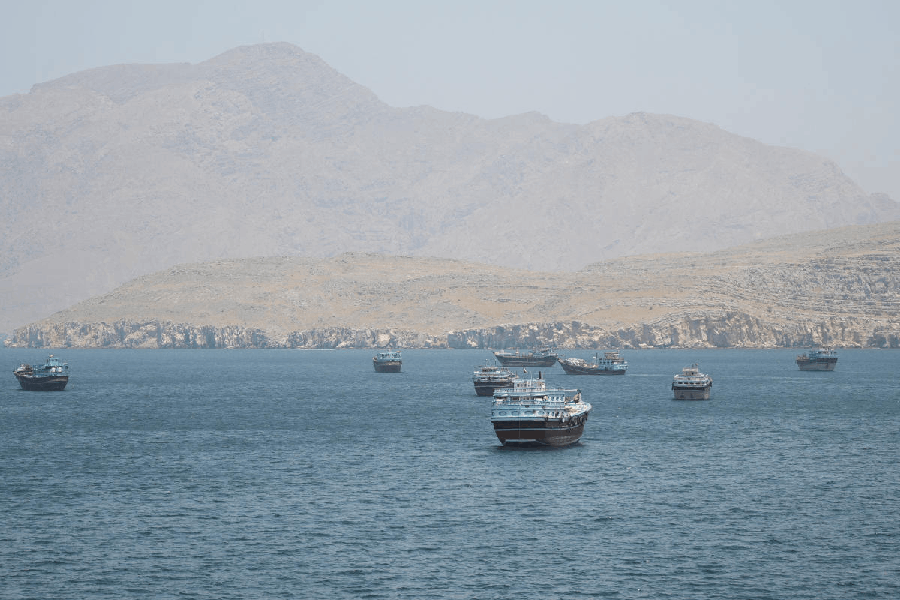
India will be amongst the countries worst hit by the US-Israeli war on Iran. India, Pakistan and Bangladesh are poor countries critically dependent on the Gulf for oil and gas. As the price of essential energy escalates with Iran’s blockade of the Strait of Hormuz, rich countries like South Korea and Japan will use their resources to win these auctions. Poorer countries like India will buy what they can or do without.
The disaster radiating outwards from Israeli-American vandalism in Iran is not confined to energy. For Asian countries, the synthetic nitrogen fertiliser that is the basis of our agriculture is derived from natural gas sourced from the Gulf. All of it flows through the Strait of Hormuz. As Shanaka Anslem Perera points out, “… the spring planting clock is ticking toward a deadline that no diplomatic breakthrough can extend, because seeds do not negotiate…” There could be a crippling scarcity of both the gas that lights Indian stoves and the cereals cooked on them thanks to this war that Israel and the US chose to launch.
It is in this context that we should assess the response to US-Israeli aggression from the Government of India. The Indian prime minister’s professions of undying solidarity with Israel in the Knesset days before the war left India in the undignified position of being complicit in retrospect. Narendra Modi and his partymen are violently attracted to Israel’s fanatical, anti-Muslim Zionism because it has achieved the disenfranchisement and apartheid that Hindutva aspires to.
India’s closeness to Israel is older than the Bharatiya Janata Party’s infatuation with it, but the present relationship is more than the sum of arms deals and intelligence; it is, on Modi’s part at least, a meeting of minds. For all the talk of realpolitik, what we have is an ideological connection that, like Israel’s curious hold on the American mind, seems to transcend national self-interest. The prime minister’s delight in being decorated with a bauble improvised by the Israelis for his gratification is further evidence, if any were required, that his personalisation of Indian diplomacy and his backslapping connection with global strongmen (which served India so well with Xi Jinping and Donald Trump) has begun to damage India’s standing.
The question that the Indian government and its apologists like Shashi Tharoor should address is this: how does silently acquiescing in the ongoing US-Israeli bombardment of Iran and Lebanon, that has led to these catastrophic shortages of energy and fertiliser, help India’s cause? India has called for diplomacy and negotiations without mentioning the flagrant illegality of the US-Israeli bombardment. Tharoor acknowledges the war’s illegality but argues that keeping mum about it is an act of realist statesmanship because we depend on the US’s grace to cope with China.
It’s worth comparing India’s position with China’s take on the war. China is a large importer of Iranian oil. The closure of the Strait of Hormuz is not in its interest. China did not veto the UN Security Council’s Resolution 2817 (2026) condemning Iran’s “egregious attacks” upon its neighbours, it abstained. But China’s representative pointed out that the US and Israel had bombed Iran without Security Council authorisation and called upon these countries to stop. China supported the protests of the Gulf Arab states against Iran’s strikes, while arguing the obvious: that the resolution was lopsided because it didn’t mention the US-Israeli aggression that began the war. India co-sponsored the resolution without mentioning the attack on Iran.
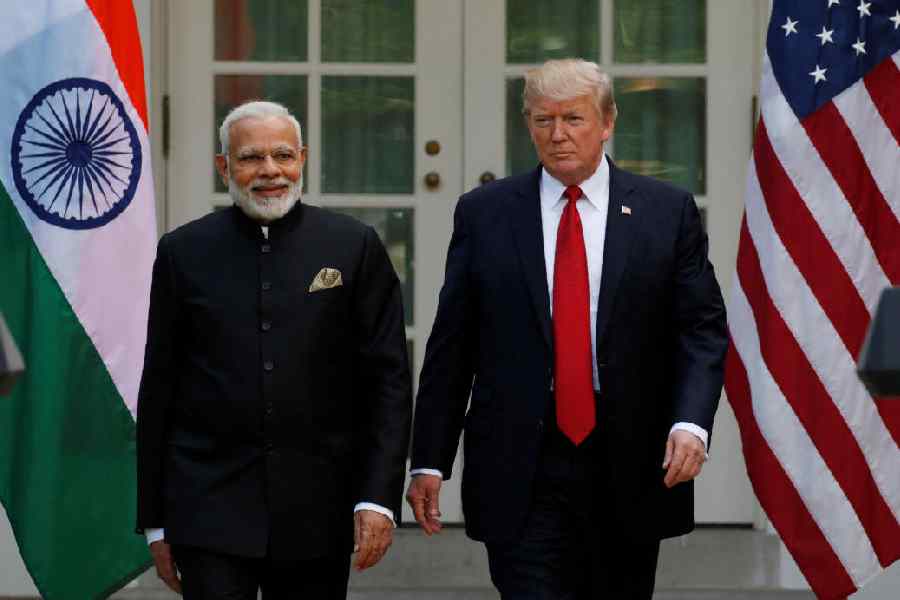
What would it have cost India to say something similar? Tharoor’s answer is, the favour of the US. But this isn’t obvious. Modi’s decade-long cultivation of Trump, the tamashas he organised to ingratiate himself with “Doland” and India’s participation in the Quad didn’t stop Trump from taking Pakistan’s part after Operation Sindoor, from publicly humiliating the Indian government by insisting that the ceasefire came about through his personal intervention. It didn’t protect India from swingeing tariffs. The trade deal that India signed with the US was contingent on India agreeing not to buy Russian crude. S. Jaishankar, India’s minister for external affairs, had earlier cited India’s determination to keep buying Russian oil despite the Ukraine war as an example of its strategic independence; India now depends on US waivers to continue that trade.
There is no evidence to suggest that sucking up to Trump has done India any favours. In a desperate attempt to signal that India was on America’s side of the war on Iran, the Indian government instructed its diplomats not to sign condolence books at Iranian embassies after Ayatollah Ali Khamenei’s assassination. A week later, amid mounting domestic criticism, the government changed its mind, and its foreign secretary signed the book. This indecision about routine diplomatic decorum showed the world a government afraid of its own shadow.
Modi’s reward for being a part of Trump’s baggage train was that a US nuclear submarine sank an Iranian frigate in the Indian Ocean near Galle on its way home from a naval exercise hosted by India in Visakhapatnam. Jaishankar now negotiates the release of Indian tankers with Iran one ship at a time. Tharoor writes of the importance of staying on Trump’s right side on account of India’s China problem. The Indian government quietly eased investment rules for Chinese companies earlier this month. If this is, to use Tharoor’s phrase, “multi-alignment”, what would multi-abasement look like?
Just as the unipolar moment was coming to an end, the Indian government chose to attach itself to the coat-tails of the US and its clients in the Middle East. One of these clients, Saudi Arabia, has a formal military pact with Pakistan. Another, Israel, has conducted a genocide in Gaza and is in the process of flattening Beirut and Tehran. Israel and the US together have instigated a war that their allies in the region didn’t want, that threatens to destabilise the world economy and ruin countries like India that are existentially dependent on oil, gas and fertiliser from the Gulf.
This is the war through which realists like Tharoor would counsel silence, because silence is restraint and restraint is, through some mysterious alchemy, strength. It isn’t. Governments that mutely line up behind the US as it prosecutes a sinister, illegal war that threatens to destroy their citizens’ ability to cook and eat aren’t rational actors, they are lemmings. “Responsible statecraft”, the euphemism that Tharoor ends his piece with, is a slippery term designed to dignify anything a realist wants
to launder, but surely it can’t stretch to suicide?
mukulkesavan@hotmail.com