

Bhubaneswar, May 26: Marriages may be made in heaven, but in violation of rules a couple tied their nuptial knots at God's ASI-protected earthly abode in the city.
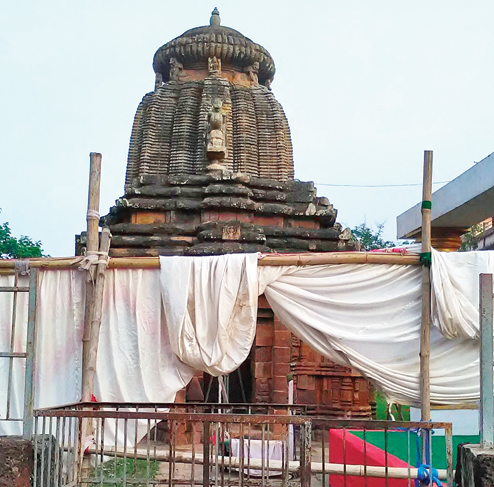
A 12th century shrine, Maitreswar Temple at Old Town, was turned into a marriage venue yesterday. While the bride and the groom performed rituals before the deity and offered prayers, the wedding party was on in full flow at the ASI-protected monument. The temple is located about 50 metres from Badhei Banka Square and adjacent to the Papanasini shrine.
But if you thought that such blatant violation of the Ancient Monuments and Archaeological Sites and Remains Act (AMASR), 1958, is an aberration, residents living in the vicinity of the shrine will prove you wrong.
"Already the Old Town area is very crowded. We do have a marriage venue just behind the temple and that is also used for holding social events. But, the space is not enough. As the Maitreswar Temple remains empty almost all the time, those organising the wedding ceremony must have decided to use the space," said a resident who did not want to be named.
However, such practice has hinted at two issues. First, the residents are ignorant about how to deal with an ASI-protected monument and the laws to abide by regarding conservation of such heritage structures. Second, the Archaeological Survey of India (ASI), itself, has turned a deaf ear to the plea of proper maintenance of the temple.
When pressed further, residents of the area sensed trouble and refused to disclose the identity of those whose marriage had been solemnised in violation of the ASI act.
Yesterday morning, when The Telegraph visited the site, the premises around the temple were decorated for the event. Despite the site being tagged as prohibited and regulated area, tents were set up on the temple premises. This afternoon, the entire area was littered and labourers were seen busy dismantling the mandap.
Ironically, as the labourers dismantle the mandap, they remain unmindful of the board that warns ASI act violators of punishment and even imprisonment. The board is the only measure that the ASI has taken to protect the shrine that lies unguarded.
When The Telegraph asked the residents about how the temple could be used as a marriage venue, they cry compulsion. One of the residents said that venues nearby did not have adequate space and they were compelled to use the temple premises on such occasions.
Another septuagenarian resident Arabinda Behera blamed ASI officials for the mess.
"We have never seen any ASI official visiting the temple and properly barricading the premises. For the past 15 years, nothing concrete has taken place," Behera said.
He said that nothing much had been done to conserve the temple. While Bhubaneswar Municipal Corporation workers occasionally clean the premises, a bit of cement work had been done in the past. But that's just about it. Nothing much has been done to convey the message that the shrine was being "preserved" in true sense of the term, he said.
When The Telegraph approached Hemasagar A. Naik, superintending archaeologist, Bhubaneswar ASI Circle, he was ignorant about the matter. "We will send officials to the site at the earliest and create awareness among the residents not to engage in such activities in the future," he said.
On why the temple has so far been neglected, Naik said he had joined his post a month ago. It was, therefore, not possible for him to address the long-pending issues that had been plaguing the monument.
However, the incident has brought to the fore the need to protect and conserve historical sites in the city.
Another ASI-protected temple located in the area is the Papanasini Temple and a tank. Of late, the deserted shrine has become a haven for criminal activities during the night hours, while during daytime, children could be seen playing cricket and adults enjoying a game of cards on its premises.
Encroachment, defacement and garbage dumping are major threats that ancient monuments in the city are facing. Heritage conservationists feel that the need of the hour is proper security arrangements and regular surveillance by ASI officials to ensure safety at such sites.
"What the authorities do is to mark them as an ASI site and leave it that way. There is need for security guards in temple complexes and CCTV surveillance," said Sadashiv Pradhan, former professor of ancient Indian history, culture and archaeology department of the Utkal University.
Conservationists also called for stringent action against the violators.
"In the past few years, many structures have been demolished due to lack of maintenance. The day is not far when many others will face the same fate, and the city will lose its charm. Until strong action is taken, lesson will not be learnt," said Hemant Rath, a researcher.
In another development, the ASI officials are busy repairing the structural damage of the Jagmohan at the Jagannath temple in Puri.
"Once the Puri temple issue is taken care of, we will definitely sent notices to the people engaged in encroachment and other illegal activities. That apart, steps will also be taken to tighten security at the sites, and we will look into problems of water drainage, which poses a major threat to the heritage monuments," said Naik.
ANCIENT MONUMENTS AND ARCHAEOLOGICAL SITES AND REMAINS ACT, 1958, DEFINES AN ANCIENT MONUMENT AS
any structure, erection or monument, or any tumulus or place of interment, or any cave, rock-sculpture, inscription or monolith that is of historical, archaeological or artistic interest and has been in existence for not less than 100 years and includes:Remains of an ancient monument Site of an ancient monument Such portion of land adjoining the site ofan ancient monument as may be required for fencing or covering in or otherwise preserving such monument
SECTION 2(D) DEFINES ARCHAEOLOGICAL SITE AND REMAINS AS
any area which contains or is reasonably believed to contain ruins or relics of historical or archaeological importance which have been in existence for not less than one hundred years, and includes — such portion of land adjoining the area as may be required for fencing or covering in or otherwise preserving it
PROTECTION OF MONUMENTS
ASI under the provisions of the AMASR Act, 1958, protects monuments, sites and remains of national importance by giving a two-month’s notice for inviting objections, if any in this regard
After the specified two-month’s period, and after scrutinising the objections, if any, received in this regard, ASI makes
decision to bring a monument under its protection
• Nation-wide there are more than 3650 ancient monuments and archaeological sites and remains. These monuments belong to various periods, ranging from the prehistoric to colonial. They include temples, mosques, tombs, churches, cemeteries, forts, palaces, step-wells, rock-cut caves, and secular architecture as well as ancient mounds and sites that represent the remains of ancient habitation
• These monuments and sites are maintained and preserved through various circles of ASI spread all over the country.
The circles look after research on these monuments and conservation activities, while the science branch carries out chemical preservation and the horticulture branch takes care to lay out gardens and environmental development
Source: Archaeological Survey of India