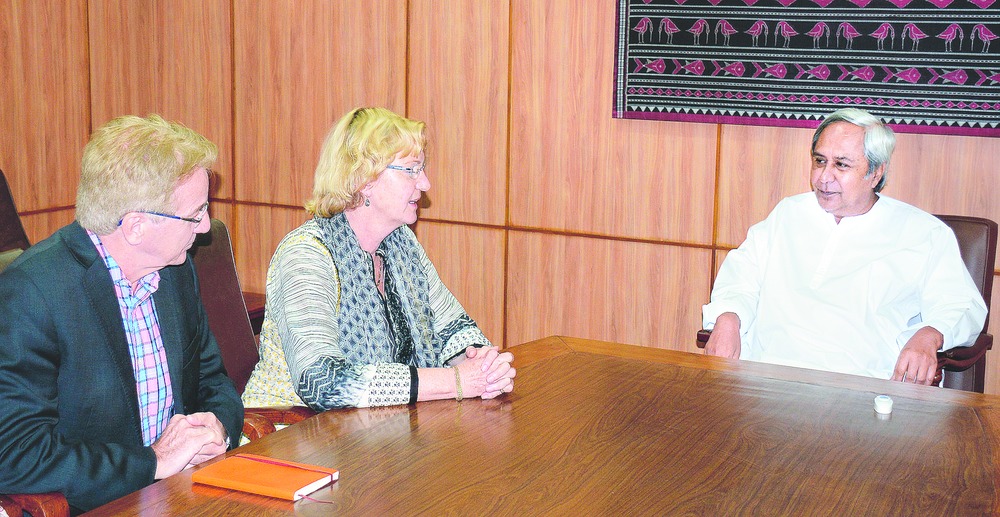

Bhubaneswar, March 17: The government needs to set up a nutrition mission in the state to reduce the stunting of children under the age of five years, said Unicef's regional director for South Asia Karin Hulshof.
Hulshof, who is on a three-day visit to Odisha, made the proposal during a meeting with chief minister Naveen Patnaik, chief secretary Aditya Prasad Padhi and other government officials yesterday.
According to data gathered by Unicef, almost 45 per cent children younger than five years in Odisha are stunted - a manifestation of chronic malnutrition. Almost half of global child deaths are caused by stunting and other forms of malnourishment, the report said.
Hulshof appreciated the progress made by the state government in taking reforms and initiatives towards making Odisha a better place for the children.
She, however, said there was a need for a strategy with focus on providing quality services and care at schools and health care centres for the kids' well-being.
"If the cause is undertaken in a "mission" mode, the entire state machinery, including administrative officers, will take it ahead with all seriousness," she said.
Hulshof also expressed satisfaction at the advancement of the state government in eliminating open defecation. She shared her experience of how the village population of Odisha were using smartphones to upload the pictures of the toilets constructed by them under the Prime Minister's Swachh Bharat Mission.
"I was impressed with the residents of Gandhihram village of Khallikote in Ganjam district. They were using smartphones to upload pictures of their newly constructed toilets on the government website. This was done to convince the government that these were not "fake claims" but that they had constructed it for real," she said.
"The villagers would then be credited Rs 10,000 in their accounts. This system ensures less corruption," she said.
Around 2,51,295 of the 7,14,645 beneficiaries in the state have already uploaded the pictures, according to the Swachh Bharat Mission website.
She said that only 14 per cent of the state's rural population use toilets. The target of making Odisha 100 per cent open defecation free by 2019 would be impossible unless 15 lakh toilets are built every year. It would only be possible if the people are convinced that a toilet is good for them, therefore, creating a demand.
Odisha is among the few states to report an increase in sanitation rates.
"There remains, however, several challenges in accelerating coverage, including prioritising target-driven approach to build toilets before bringing in behavioural changes at the grassroots level, lack of access to water, sanitation facilities and their maintenance in health centres, schools and anganwadi centres, besides proper supervision and monitoring of sanitation motivators," Hulshof said.