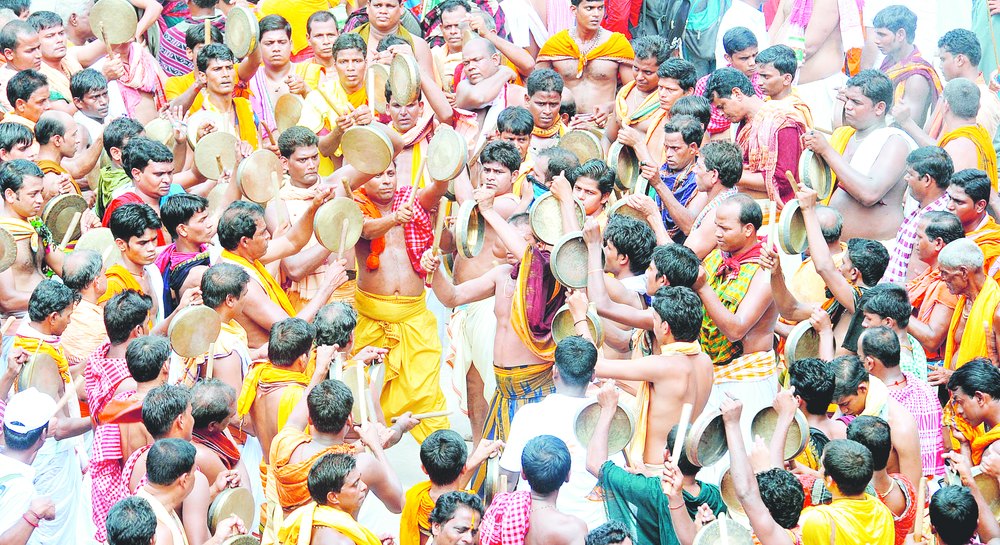

Puri, July 18: Devotional fervour reached a crescendo as the Bada Danda (Grand Road) outside the 12th century Jagannath temple here turned into a sea of humanity with over 15 lakh people chanting Jai Jagannath and Hari bol to the accompaniment of thousands of drums and cymbals beating in unison.
Colourfully decked out Gotipua dancers and banati (rope wheel) players added to the ambience as the century's first Nabakalebar-rath yatra got off to a smooth start amid unprecedented security arrangements.
"The crowd was unprecedented with all lanes and by-lanes in the town chock-a-block with people. The turnout was at least 50 per cent higher than the last time. On a rough estimate, over 15 lakh were in attendance this time," said director-general of police Sanjeev Marik.
This being the year of Nabakalebar that marks replacement of the old idols with the new ones, today was the first occasion when devotees had a glimpse of the freshly painted images. Fortunately for them not only the weather held with rain forecast falling flat, all the rituals associated with the festival, including pahandi bije (ceremonial procession of the deities to their chariots) were also performed dot on time. There was no delay in the pulling of the chariots, which in the past has been a major cause of concern for officials.
The state government having learnt its lessons from the recent controversy over the delay in the Brahma paribartan (soul transfer) ritual of the deities, ensured that the daitapatis (temple servitors) played no tricks this time. "They were made to fall in line - which was the reason behind timely conduct of rituals," said an official.
However, Jay Krushna Das Mohapatra, one of the two daitapatis suspended in the wake of the soul transfer fiasco and barred from all services of the temple, was seen atop the chariot of Lord Jagannath raising many eyebrows. However, apparently unfazed by the controversy surrounding him, the servitor claimed that he was there as he could not be barred from making devotional offerings to the Lord. "How can they deprive me of my rights as a devotee of the Lord," he asked pointedly.
Watched by lakhs of devotees, including VVIPs such as governor S.C. Jamir, his Jharkhand counterpart Draupadi Murmu, chief minister Naveen Patnaik and Union minister Jual Oram - Taladhwaj, the mount of Lord Balabhadra was the first of the three chariots to roll following the ceremonial sweeping of their decks by Puri King Dibya Singh Deb.
It was followed by the chariots of Goddess Subhadra and Lord Jagannath. However, given size of the crowd and the anxiety of the administration to avoid accidents to the extent possible, the chariots moved slowly with only Taladhwaj reaching its destination, the Sri Gubndicha temple, in time. The two others had to be stopped on the way with officials saying that they will be pulled again tomorrow.
Puri Shankaracharya Swami Nischalanand Saraswati, who had kept away from the festival last year following a controversy, duly turned up this time and offered prayers to the deities atop the chariots.
The chief minister came down from the VVIP podium set up along the Grand Road to touch the ropes of the chariots in a gesture that drew applause from the gathering. Most of his ministers, including the four who had been asked to camp here to supervise preparations, were present to greet him. Puri MLA and chairman of the Nabakalabar infrastructure supervision committee Maheswar Mohanty was seen monitoring the proceedings from a vantage point under the chariot of Lord Jagannath.
The town had been turned almost into a fortress with multi-layered security in place in view of intelligence inputs about a threat perception. An unprecedented 164 platoons of police had been deployed here with jawans taking position on rooftops along the Grand Road and on the seven watchtowers that had been specially set up for the purpose.
While coast guard vessels maintained round-the-clock vigil in the sea off the Puri coast, tourist police personnel and members of bomb disposal squads combed the beach and other sensitive areas of the town. Around 200 CCTV cameras installed at strategic points kept watch on the crowd.
Despite the unprecedented turnout for the festival, the government took care to ensure that people did not suffer in any way. Thousands of pilgrims from various parts of Odisha and neighbouring states such as Bihar and Bengal enjoyed free hospitality in the 33 temporary shelters, erected by the government where voluntary organisations served them food.
Mobile medical teams roamed the town with special focus on the Grand Road where a number of drinking water posts had also been set up. "Nothing was left to chance. Our effort was to ensure that visitors go back with sweet memories of the event," said a senior official.