|
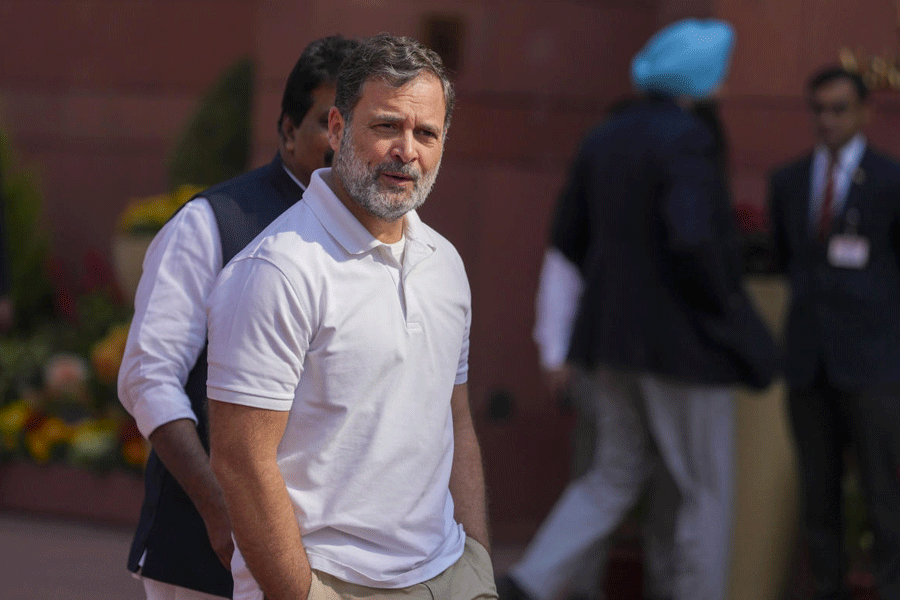
Bhubaneswar / Sambalpur, Feb. 18: All India Congress Committee vice-president Rahul Gandhi today began his efforts to rejuvenate the party across the country by meeting workers in Sambalpur.
The choice of the venue is significant because Sambalpur happens to be part of the underdeveloped western Odisha, which is a known Maoist bastion.
Rahul, who was in Sambalpur during a two-day visit to the state today, used his first interaction with the party rank and file as a launching pad to strengthen the party’s base. He gave a patient hearing to the party grass-roots workers.
After being elected as the party’s second-in-command at the Jaipur session, Rahul is now focusing on six states, including Odisha, where the party is weak or has remained out of power, to revamp the organisation. The other states in his priority list are Chhattisgarh, Madhya Pradesh, Jharkhand, Andhra Pradesh and Karnataka.
These states constitute 145 seats in the 543-member Lok Sabha. During his interaction with workers of the 17 organisational districts, Rahul got a first-hand knowledge of the factionalism that has hit the party and is eroding its base. Tomorrow, Rahul will engage in a similar exercise with workers of the remaining 16 organisational districts of the party in Cuttack.
Rahul met the workers in batches and senior functionaries of the party were not present during the interactions. Party sources said he did not want senior leaders to be present, so that the workers could give their free and frank assessment of the party’s state of affairs.
Speaking to party workers from Sambalpur, Rahul wanted to know why the Congress was out of power in the state for the past decade and how could it win again. “Rahul listened to the issues raised by the functionaries carefully and tried to explore the reason behind the debacle of the party in the state,” said a leader.
Encouraged by Rahul, the workers opened their heart out to him. He even asked them whether regular meetings of workers were being held in the districts.
Sundergarh district Congress committee president Dusmant Naik said: “Strong action should be taken against the people, who indulge in anti-party activities. That will definitely help the Congress to get united and stronger.”
Sushanta Dansana, a Congress councillor of the Sambalpur Municipality, said: “Opinion of grass-roots workers should be taken into consideration while deciding party tickets. Often, the party decides ticket at the last moment. This trend should be changed. Moreover, the youth should take up leadership. The right persons should be given the opportunity to contest elections.”
Bijaya Sahu, another Congress councillor, said: “The party organisation is weak. Stress should be given to strengthen it. The party is divided into several groups.”
However, senior party leaders were frustrated because Rahul did not meet them. Jharsuguda MLA Nabakishore Das apprised Rahul of how the state government was using the central schemes, including the PDS rice one, in its favour.
“Rahul’s visit will definitely help the party to get stronger in the state,” said Basudev Naik, a sarpanch.
The Congress’s strength in the Assembly has taken a nosedive since its defeat in the 2000 elections. While the party had formed the government with 88 MLAs in 1995-2000, its strength shrunk to 25 in 2000. However, it slightly improved its tally and was able to add another 14 seats to its kitty by securing 39 seats in 2004 Assembly polls. But, the number slid to 27 in 2009. Of the six Lok Sabha MPs of the Congress, four are from western Odisha and of the 27 MLAs, 16 are from western Odisha.