| Guest Column Biswamoy Pati |
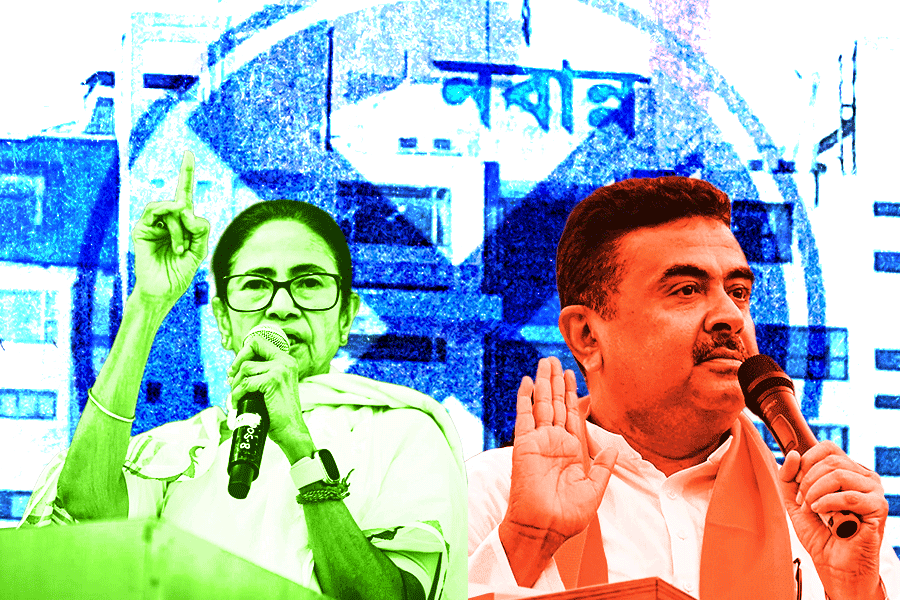
The defeat of the Left Front in Bengal elections and the rise of the Trinamul Congress-Congress alliance has serious implications. Interestingly, this is despite the increase in the votes polled by the Left Front in the 2009 Lok Sabha elections. The media bombards us with reports of the ‘routing’ of the Left Front, being largely amnesic about the psephological invention - viz. ‘the index of Opposition unity’. In such a context, it is worth exploring how the Left Front has managed to retain its base in spite of its electoral defeat, after 34 years of being in power.
A social historian cannot miss the similarities between Orissa and Bengal when it comes to the level of domination and exploitation of peasants, tribals and outcastes by the princes, zamindars, sahukars and the colonial sarkar in the past. It is rather well-known that anti-feudal/imperialist movements strengthened the Congress-led mass struggle since the 1920s. What, of course, remains largely clouded by nationalist historiography is the transformation of the Congress from a movement to being a party in power by the late 1930s.
In Orissa, this trend is particularly visible with the Congress going back on the abolition of the zamindari system that was promised in the election manifesto of 1936. However, by 1946-47, the promise had been formally abandoned. In March 1947, Premier H.K. Mahtab made it adequately clear in the Assembly that the government was in no hurry to abolish the zamindari system as, ‘with all its ills’, it had been in existence for several centuries.
This was a clear signal for the Kisan Sabha to plan the Bhagachasi (sharecroppers) Movement, the most powerful movement of the rural poor in coastal Orissa. By November, 1947, the pressure of the Bhagachasi Movement had forced the Congress ministry to issue a communiqué which led to the enactment of the Sharecroppers’ Act. This gave 3/5th of the produce to sharecroppers and 2/5th to landlords. However, the problem was one of actual implementation of this Act. After independence, the Bhagachasi Movement spread to the entire coastal region, developing rapidly even under extremely repressive conditions. It spread to Takarada in Ganjam, where the Kandhas rose up to fight against water scarcity, and landlordism and its exploitative practices. A major irritant was surrendering 3/5th of the produce to the inamdars. The sweep of the peasant movement, and ironically, the campaigns by prominent Congress leaders such as Biswanath Das, made them pay a reduced rent. What developed was a major movement to end landlordism and assert the rights of the rural poor. The Congress government, keen on backing landlords in this volatile context, retaliated by using force that ended with a bloody firing in May 1948. This was the first occasion after independence when state violence of this nature was directed against a peasant movement in Orissa. It demonstrated the extent to which the government could go in order to protect its class allies. The pressure of the Kisan Sangha and the sharecroppers’ movement forced the Congress government to accept that the Sharecroppers’ Act would remain valid till January 1949. After 1949, the Oriya ruling class asserted itself and wiped out this problem from its agenda.
The Tebhaga Movement in Bengal worked on the premise that the sharecroppers (bargadars) retained two-thirds of the produce and surrendered one-third of it to the landowner (jotedar). In fact, this had been recommended by the Bengal Land Revenue Commission in 1940. As estimated, the total strength of bargadars, including the small peasants (who were part bargadars tilling their small plots) stood at about seventy per cent of the total peasant population of undivided Bengal in the 1940s. The Kisan Sabha called for the movement in the context of the riot-torn Noakhali, with a certain amount of hesitation.
The Tebhaga Movement was the most militant and broad-based class struggle witnessed in the Bengal countryside up to this point of time. It involved nearly five million poor peasants, who were from parts of 15 out of the 20 districts. The Tebhaga struggle united the people - Hindus and Muslims - and saw a large participation of peasant women in a context charged with communalism and vicious divisive propaganda. The peasants faced massive repression by the colonial government and the goondas of the exploiting classes. The effort by the Muslim League ministry to smoothen things through legislation in January 1947 led to the calling off of the movement. However, very soon after this, the Bill was dropped.
If one explores the post-colonial situation, the similarities, in so far as hoodwinking the rural poor, seems to have been a common feature when it comes to the ruling classes in both Orissa and Bengal. The Oriya ruling class hid behind the abolition of the princely states and the zamindaris, which was touted as ‘land reforms’. Its Bengali counterpart asserted itself by abandoning the idea of land reforms in the name of repairing the terrible dislocations caused by the Partition. Interestingly, successive governments in postcolonial Orissa and West Bengal - including those formed by the Congress - defended the capitalist-landlord state that emerged after independence. The logic of land reforms and any change in the life of the millions of peasants, tribals and dalits remained a distant dream - very much like in Orissa. The Oriya ruling class managed to defend the landed elements in a context where their legitimacy had remained largely intact. After all, the land struggles were limited to the coastal tract and only to about four of the 24 princely states that finally merged with the province after independence. However, in postcolonial West Bengal, the unresolved nature of the contradictions led to militant peasant movements. It was this pressure that led to the decimation of the Congress and the formation of the Left Front government in 1977.
‘Operation Barga’, which was implemented within three to four years after the Left Front government assumed office, saw serious efforts that were made to take over surplus land and identify and issue pattas (recorded land rights) to sharecroppers, who had for generations worked on land and had been coerced to yield whatever was demanded from them. After all, they had no land rights and could be easily evicted. This method of land reform, which included shifting administrative responsibilities to the local levels, does not have any parallel in any post-colonial society. It altered the structure of poverty in rural West Bengal and impacted the lives of millions of tribals, peasants and dalits. West Bengal’s agricultural output increased dramatically.
Beyond these statistically verifiable points, it is worth pondering if this also created a new order in a state. One aspect of this relates to the populist image adopted by Trinamul Congress, which is contradicted by its class position and its links with the Congress. The other aspect relates to the absence of corruption or any scam associated with any Left Front ministers over these years. Equally significant and strikingly visible from Orissa is the absence of communal tension in a state that had been severely impacted by partition violence. After all, West Bengal seems to have parted ways with communal violence, and Kandhamal-like experiences have not had any chance to raise their heads in the last 34 years.