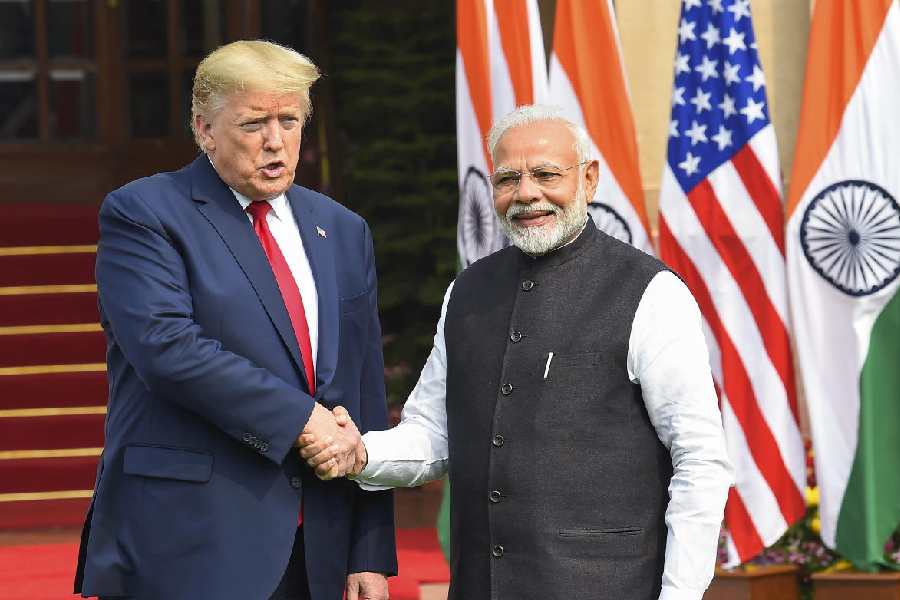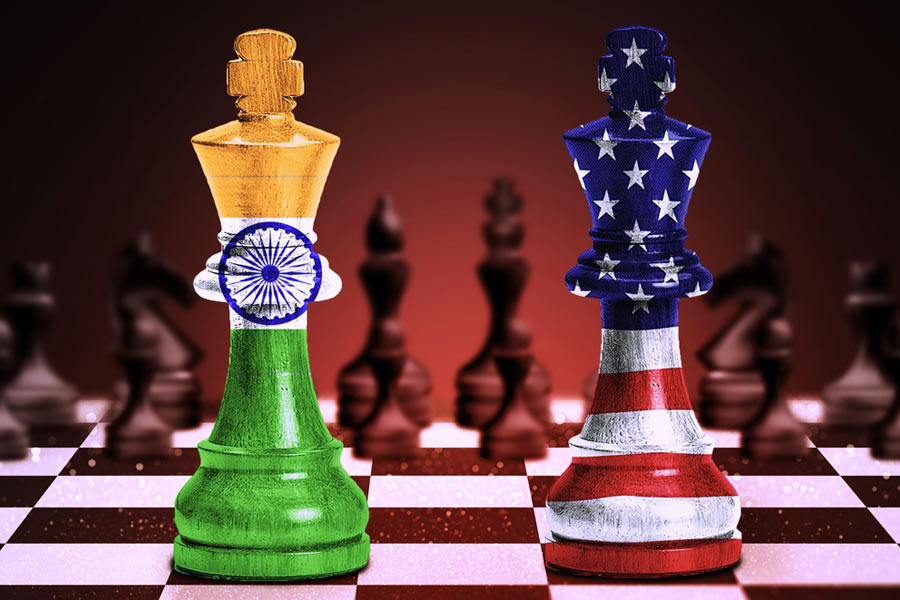
India and the US have unveiled the framework for an interim trade agreement that ushers in modest market access with targeted tariff reliefs, signalling a renewed push to stabilise commercial ties in an uncertain global environment.
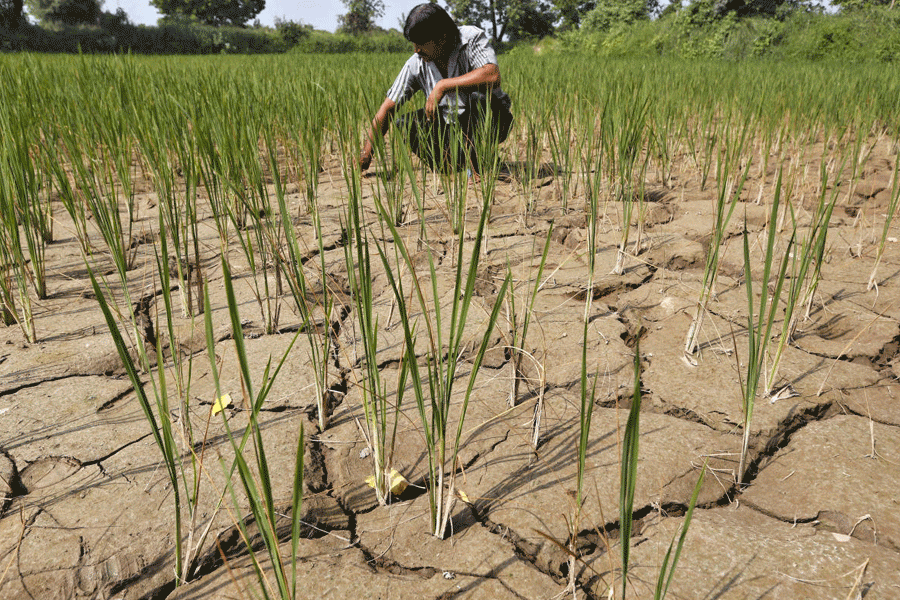
In a politically sensitive shift, New Delhi has agreed to partially open its heavily protected agriculture sector to American imports — a move likely to lower animal feedstock and food costs in the country while testing the Modi government’s balancing act with farmers.
Under the joint statement, India has offered to cut or eliminate duties on a selection of US agricultural products, making apples, almonds, pistachios, walnuts and soybean oil cheaper for Indian consumers. It also agreed to grant access to distillers’ dried grains and red sorghum used in animal feed.
Additionally, the Modi government has committed to addressing longstanding non-tariff barriers that have constrained US farm exports. India will also cut or eliminate existing tariffs on a range of US industrial goods (organic and inorganic chemicals), medical devices (pacemakers, diagnostic machines, imaging apparatus & hearing aid systems), high-end cars and bikes, and electronic devices, among others.
Washington, in turn, signalled concessions through expanded market access for certain Indian goods and a willingness to ease trade frictions, reflecting a reciprocal effort to advance a limited deal even as negotiations towards a broader agreement continue.
Almost half of India’s $87-billion exports to the US have been subjected to a 50 per cent tariff since August 7 last year after US President Donald Trump doubled the reciprocal tariffs to punish India for buying Russian oil. With an executive order on Saturday morning (IST), the US removed the 25 per cent penal tariff linked to Russian oil with immediate effect.
Another executive order is expected next week, bringing down the reciprocal tariff to 18 per cent, commerce and industry minister Piyush Goyal said.
Goyal hailed the deal, which he claimed had opened up a $30-trillion market for Indian businesses. According to the minister, $44 billion worth of goods would have zero-duty access to the US. In contrast, around $26 billion worth of imports from the US are going to have greater market access to India, he added.
He defended the selective opening up of the economy, describing the measure as a “calibrated” one that took into account the interests of Indian MSMEs, farmers, consumers and industry.
“We have not given any concession on wheat, rice, dairy, poultry, meat, maize, millet, sugar, soybean,” Goyal said.
The concession on apples, grown largely in Himachal Pradesh and Kashmir, will be quota-based and subject to a minimum import price of ₹100 per kg.
“There is no competition between the US, which has a per capita income of $90,000, and India, with $3,000 per capita income. There are complementarities,” he added.
Yet the calibrated give-and-take risks stirring unease at home. Cheaper imports could compress margins for domestic oilseed processors and feed producers while exposing farmers to sharper price competition.
Think tank Global Trade Research Initiative (GTRI) argued that most of the concessions had come from India.
“India’s interim trade deal with the US offers some relief on tariffs, but a closer reading suggests an uneven exchange,” GTRI founder Ajay Srivastava said, adding the US had traded relief from its “unsustainable and illegal reciprocal tariffs” for “permanent market access gains” in India. He also argued that Indian farmers and industry would be hurt.
The joint statement skirted the Section 232 tariff imposed by the US on certain steel and aluminium products.
Wider commitments
According to the joint statement, India intends to purchase $500 billion of US energy products, aircraft and aircraft parts, precious metals, technology products and coking coal over the next five years.
Both sides also agreed to strengthen their economic security alignment to enhance supply chain resilience and innovation through complementary actions to address non-market policies of third parties. Additionally, the US and India agreed to address discriminatory or burdensome practices and other barriers to digital trade.
Commenting on the import commitments, which can potentially reverse the balance of trade in favour of the US, Goyal said it would be up to Indian industry, and not the government, to import.
Gulzar Didwania, partner, Deloitte India, said it would be “interesting” to see how India realised its intention of purchasing goods worth $500 billion over five years.
The GTRI’s Srivastava said the target appeared “unrealistic” as it would require more than doubling India’s $45-billion import from the US.
“Taken together, the US has secured far-reaching commitments from India on agriculture, regulation, digital policy, security alignment, and large-scale purchasing — concessions that go well beyond trade,” Srivastava said.