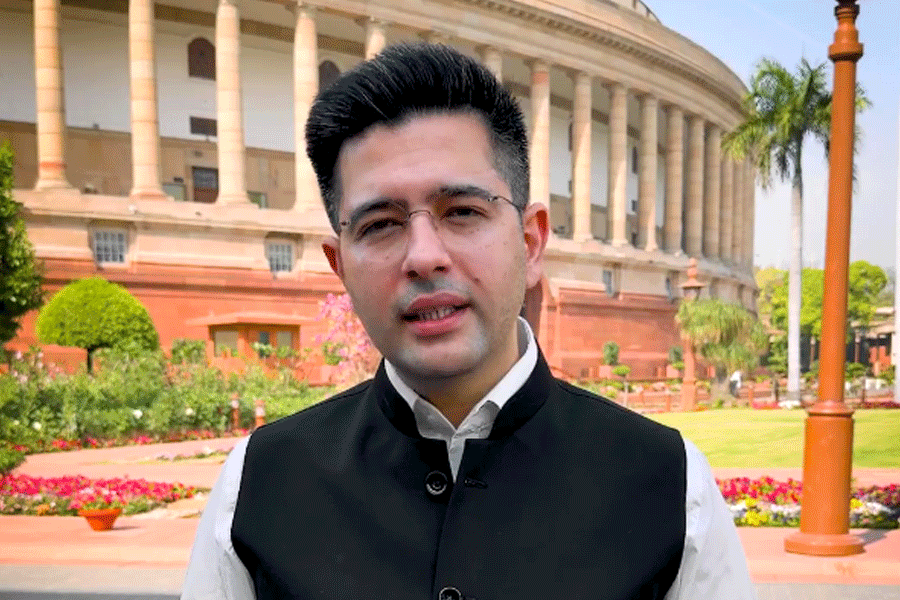
Hot seat - Trilochan Mohapatra, director, Central Rice Research Institute
The Central Rice Research Institute (CRRI) was established in 1946. How has it related itself to the needs of a state like Odisha where agriculture is almost completely dependent on rainfall and not irrigation?
Odisha is prone to natural calamities and has varying ecological conditions. Our objective is to increase the productivity per hectare through technological intervention. In the last 65 years of our existence, we have developed more than 100 varieties of rice. This is the institution which was established before Independence in the backdrop of the Bengal Famine that claimed thousands of lives because of a disease in rice called Brown Spot. The then British government, thus, thought of setting up this institute to cater to rice-consuming regions like Odisha, Bengal, Assam and other neighbouring states.
 |
Do you think the introduction of genetically modified paddy will eliminate the vast range of indigenous paddy varieties available in Odisha — a state credited with the discovery of the primitive rice crop, Aarasu?
Traditional varieties have already been displaced but we have kept them in our gene bank. We have collected the primitive varieties as well as 20 wild varieties of rice. We don’t grow traditional varieties large scale anymore following cultivation of high yielding varieties.
Is rice production a profitable business in Odisha?
No, the yield per hectare of rice is quite low, only 1.78 tonnes, at present. If we are able to achieve at least seven or eight tonnes per hectare, rice cultivation would be profitable.
Farm mechanisation is in a nascent stage in Odisha. How does mechanisation help farmers?
As the input cost and labour cost have gone up, we have to go for mechanisation. Farmers in Sonepur district are practising the system of custom hiring of equipment. This model can be replicated in other parts so that the cost of cultivation can be reduced through mechanisation.
Do you think the Assamese variety like Komal Chawal, which does not require cooking, can succeed in Odisha?
It is not yet commercial. Our scientists have done some research on the soak-and-eat variety, which has been experimented in our lab. It has worked on a small scale, but we cannot predict its success on a large scale at this point. This season, we are doing multi-location evaluation in Odisha, Bihar, Jharkhand, Assam and other parts to test if it behaves differently in different regions.
How responsive have the state government and farmers been to your innovations?
We are regularly interacting with officials of various government departments and research universities, including OUAT. The state needs cold-tolerant and virus-resistant pulses like moong and green gram (biri), water logging tolerant sugarcane, short duration drought tolerant paddy varieties and sufficient quantity of hybrid seeds. We have passed on the information on other crops to our sister institutions and they are working on it. Since we have limited land (75 hectares) on our campus, we have taken up 30 acres in Mahanga for production of paddy seeds with the participation of local farmers. Pure seeds of our popular varieties will be made available to farmers directly in this process.
Odisha is primarily a paddy producing state. How far have you been successful in ensuring farmers in the state, both in coastal and high-land areas, to fight drought, salinity and poor fertiliser inputs?
The state has indented, certified and supplied seeds of our varieties to the farmers. The Naveen and Pooja varieties have been successful. Other varieties — Sahabhagidhan is drought-tolerant while Varshadhan can be cultivated in water-logged areas. For saline areas, we have developed many varieties like Luna Sampad, Lunishree and Luna Suvarna, which have been tested in Ersama in Jagatsinghpur district.
Have funds been a constraint in research here?
Yes, we require more funds. The institution gets about Rs 25 crore under plan budget for a period of five years and Rs 40 crore under non-plan budget per annum. But a major share of the non-plan funds goes for payment of salaries and retirement benefits. The Indian Council of Agricultural Research is considering our request to enhance the budget. Besides, we are seeking financial support from other funding agencies like department of bio-technology, government of India and other Central institutions.
Odisha government as well as the Centre are urging scientists to initiate steps for transfer of technology from laboratory to the land. Has your institution been successful in this regard?
Technology transfer should have happened at far greater efficiency than what we see today in the field. Unless technology reaches the target farmers, it has little value. We are constantly interacting with various government agencies, agricultural universities and NGOs in this regard. The Centre has initiated a number of programmes such as Rashtriya Krishi Vigyan Yojana. Now we are focusing on bringing green revolution to the eastern India.
Scientist par excellence
• Bio-technologist Trilochan Mohapatra (50) heads the Central Rice Research Institute located in Cuttack
• Hailing from Kharibil village in Cuttack, Mohapatra completed his graduation from the Odisha University of Agriculture and Technology, Bhubaneswar, in 1985. He then did his master’s degree and Ph.D. in genetics from the Indian Agricultural Research Institute (IARI), New Delhi
• He began his career as a scientist probationer at National Academy of Agricultural Research Management in Hyderabad. He served in his alma mater — IARI for two decades. Earlier this year, he took over as director of the premier rice research institute
• Mohapatra developed DNA fingerprinting technology in 10 crops using molecular markers
• He constructed the first genome map of Indian mustard
• He developed the first basmati rice variety resistant to bacterial leaf blight disease
employing molecular marker assisted selection
• He has over 100 research publications, mostly in international journals
• He has a 20-year teaching experience and has guided 140 M.Sc./Ph.D. students of the IARI as a member of the its committee
What would you have been had you not been a scientist?
I would have been a doctor or an IAS officer.
From the very beginning of my academic career, I always wanted to
explore something new.
I was thinking of pursuing engineering or medicine but ended up studying agriculture.
In fact, I went from agricultural engineering to agriculture.
I was also trying for civil services, not because I was interested, but because all my friends were going for it.
But I dropped midway and decided to pursue a career in science because I realised that is what really excites me.