|
The Orissa State Pollution Control Board (OSPCB) has issued a show-cause notice to major state public sector undertaking (PSU), Rourkela Steel Plant (RSP), for violating pollution control norms. It recently ordered the shutdown of four units of the National Thermal Power Corporation (NTPC) for ignoring its warnings against environmental pollution. There seems to be a cold war going on between the state and the PSUs.
We don’t interfere in the business of the OSPCB. They know best about the regulatory norms and are the authority to decide what action is to be taken when those norms are violated. The forest and environment department does not direct them to issue notices or order the shutdown of a plant. My job is only to bring it to the notice of the public. We don’t differentiate between private sector and public sector.
You are now in charge of the most high-profile department, which was under the control of chief minister Naveen Patnaik for six years. Is there a lot of pressure?
No department is high profile or low profile as such. I am thankful to my leader for reposing faith in me. I will do my assignments with sincerity and the help of my colleagues.
Former Union minister for environment and forests Jairam Ramesh was painted as the enemy of Orissa in terms of granting environmental clearance to projects in the state. After his exit from the ministry in the last Union cabinet reshuffle, are you now breathing free?
During his last visit to the state in May, I spoke to Ramesh regarding various projects and related environmental concerns. Don’t paint him as Orissa’s enemy (smiles).
Can you tell us how many proposals in Orissa are awaiting clearance from the Union ministry of environment and forests?
The Union forest and environment secretary had met me on Thursday seeking clarifications about the pending proposals. Other projects such as Vedanta are under the court scanner.
Are you finding it difficult to deal with the Vedanta and Posco issues?
We are not timid. We will adhere to norms under all circumstances.
The state is planning to produce an additional 45,000 MW of thermal power. Burning so much coal will generate astronomical amounts of ash. Is Orissa ready with a plan to deal with the ash output?
Power generation is a key aspect for development. Right now we have an installed capacity of 7,500 MW power and it contributes 20 billion tonnes of ash. So, ash disposal is definitely a challenge. The pollution control board is suggesting measures. Environmentalists have advised us to move from the liquid slurry system to the concentrated type so that ash may be dumped in one-fourth of the space required earlier.
Orissa was the first state to draft a State Climate Change Action Plan but pollution levels are rising in spite of this. The year 2011 is the International Year of Forests but so many trees are being felled everywhere for development and construction activities.
Trees have to be cut for developmental work. But we are taking up compensatory afforestation programmes by planting 10 saplings for one tree felled. We aim to create another 10 lakh acre of green cover in the next five years. I can say with confidence that in Bhubaneswar we are planting 10 saplings for every tree cut. We have identified 10 more cities for plantation.
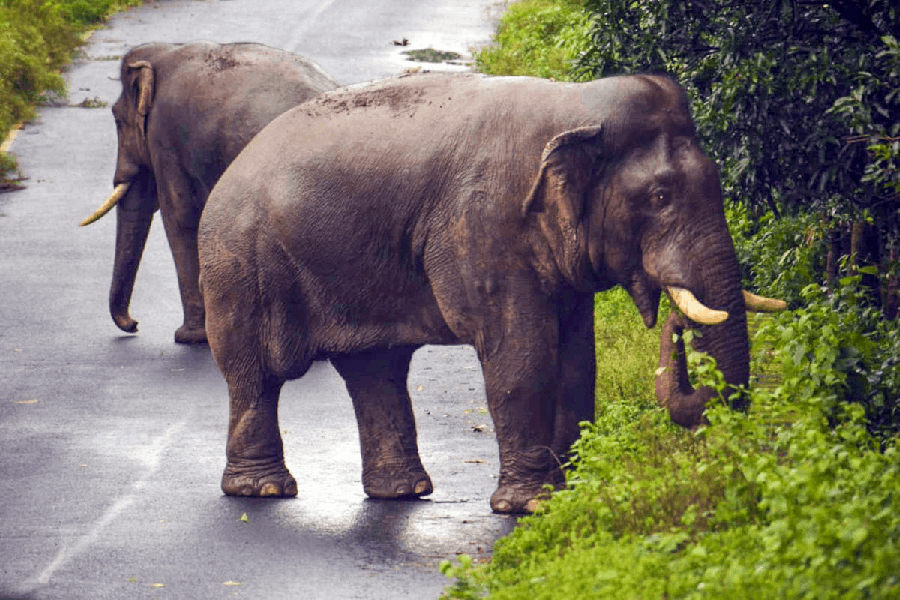
In the last one year, a large number of elephants have died of electrocution. Increased mining has threatened their habitat. Elephant deaths are on the rise. What is being done to create a corridor for them?
We can only conserve their habitat. The chief minister has already conducted several meetings with the forest and energy departments to reduce incidents of electrocution. But the number of deaths has not increased at an alarming rate.
Until 2006, Orissa claimed to have 192 tigers, including 101 in Simlipal, based on the method of counting tigers by their pugmarks. But the 2006 National Tiger Census based on other methods found only 45 tigers in Orissa while the 2010 Census put the number at 32 (excluding those at Sunabeda sanctuary). What is the reason — excessive poaching or exaggerated figures from forest officials all these years?
The camera trap method used for counting tigers during the national census is not reliable. For more than 1,000 sqkm at Simlipal, 25 cameras are not enough to record number of tigers. They found 31 tigers in Simlipal alone. Do you think we have just one more tiger in some other part of the state? We have asked them for fresh reports so that we can analyse it scientifically and get the real picture.
Coming to politics, is everything going well within the BJD?
Yes. In a five-member household, people argue and differ with each other but that does not mean they are not a family.
So, are there differences among party members?
No, the party is united under Naveen Patnaik’s leadership. .
It is said you could make a comeback to the ministry because of your proximity to the so-called second power centre, Pyari Mohan Mohapatra.
I share a good equation with everyone. There is no truth in what gossip mongers are saying about a second power centre. In a regional party, there is only one leader and in BJD, it is the chief minister Naveen Patnaik. Pyari babu is a leader in his own right. My understanding of both of them is clear.
Political man to the core
Witty and articulate, 52-year-old Debi Prasad Mishra shot back to the limelight when he assumed the charge of the forest and environment department in the last cabinet reshuffle in May. He is known for handling issues deftly and cautiously
A graduate in political science from Cuttack’s Christ College, Mishra has been associated with social activities and politics since his college days. He took active part in the JP Narayan movement during the national emergency in 1975
Mishra was the president of All Orissa Yuva Janata Dal from 1996 to 1998, and was also its general secretary
This four time MLA was elected to the state legislative Assembly for the first time in 1980 from Patkura constituency
He was first elected to the Orissa Legislative Assembly on a Janata Dal ticket from Baramba constituency in 1995. Since then, he has never lost an election and has been representing the same constituency
He was first inducted in the ministry as minister of state for health and family welfare in 2000. However, he, along with three other senior ministers, was dropped from the cabinet after two years. Mishra made a come back to the ministry again in 2006 as minister of state for excise. He has been in charge of other departments like tourism, culture and higher education
To his credit, Mishra has introduced a number of bills including the Bihar and Orissa Excise (Orissa Amendment Bill), ICFAI University bill, Vedanta University and Sri Sri University Bill
What would you have been Had you not been a politician?
I had never thought that I would join politics. As a child, I wanted to enter public life for the welfare of the people. I wanted to do something worthwhile for the development of the masses and so I stepped into politics during my college days. The late chief minister Biju Patnaik was the youth icon then and inspired aspiring politicians like me. The JP Narayan movement also influenced me. Had I not entered into politics, I would have been a doing research on water quality or food and nutrition. I was also quite interested in journalism as a career.