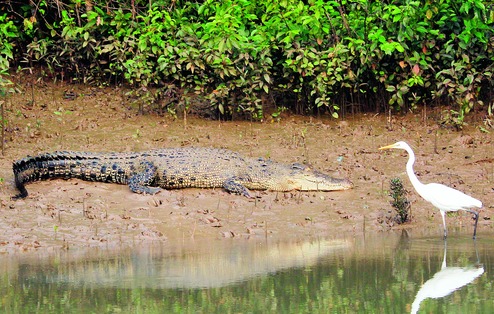

Kendrapara: Reports of crocodiles sneaking into water bodies human habitations areas have forced the authorities to extend the census operation of these reptiles to places outside the Bhitarkanika national park.
The census got under way on January 3 and would conclude on Monday. The national park has been kept out of bounds for tourists in order to keep the place free from human interference, an official said. Apart from the Bhitarkanika river system, water inlets, creeks and nullahs within the national park, the crocodiles' enumeration is also being done in new areas along the deltaic region of the Mahanadi river.
The upstream of Brahmani, Baitarani and Kharasrota river system has been identified as habitation corridor of estuarine crocodiles. Enumerators are also covering these areas, said Bimal Prasanna Acharya, divisional forest officer, Rajnagar mangrove (wildlife) forest division. After the census ends, its findings would be released in a day or two, he said.
The newer areas are being taken up in the headcount operation to ascertain the movement pattern of these animals, he said.
Several villages Bhadrak's Chandballi block, besides Aul, Rajkanika, Rajnagar and Pattamundai blocks in Kendrapara district are located along the upstream of these rivers. Majority of crocodile-man conflict cases registered this year are from these places.
During the last census undertaken in January last year, forest officials had listed 1,682 crocodiles, up from 1,671 in 2016, an official said. The list included 608 hatchlings, 334 yearlings, 266 juveniles, 172 sub-adults and 302 adults.
Last year, the wildlife enumerators had also spotted about a dozen of highly threatened albino saltwater crocodiles in the Bhitarkanika area.
Saltwater crocodiles thrive in saline water. The national park is the place where rivers Brahmani, Baitarani, Dhamra and Pathsala meet before moving into Bay of Bengal. The mangrove wetland and large number of muddy creeks provide the perfect conditions for estuarine crocodiles to nest.