
Revellers in a few places across the state have to wait for a day for the car festival to begin.
Though the deities are taken out of the temple for their annual sojourn on the day Puri celebrates the festival, the raths get moving a day later in Baripada.
Rath yatra is a three-day affair in Baripada. On the first day, the ritual of pahandi bije (bringing out the deities from the temple in a procession) is performed, next day the chariots of Lord Balabhadra and Goddess Subhadra are pulled, and on the third day, Lord Jagannath's chariot is chugged.
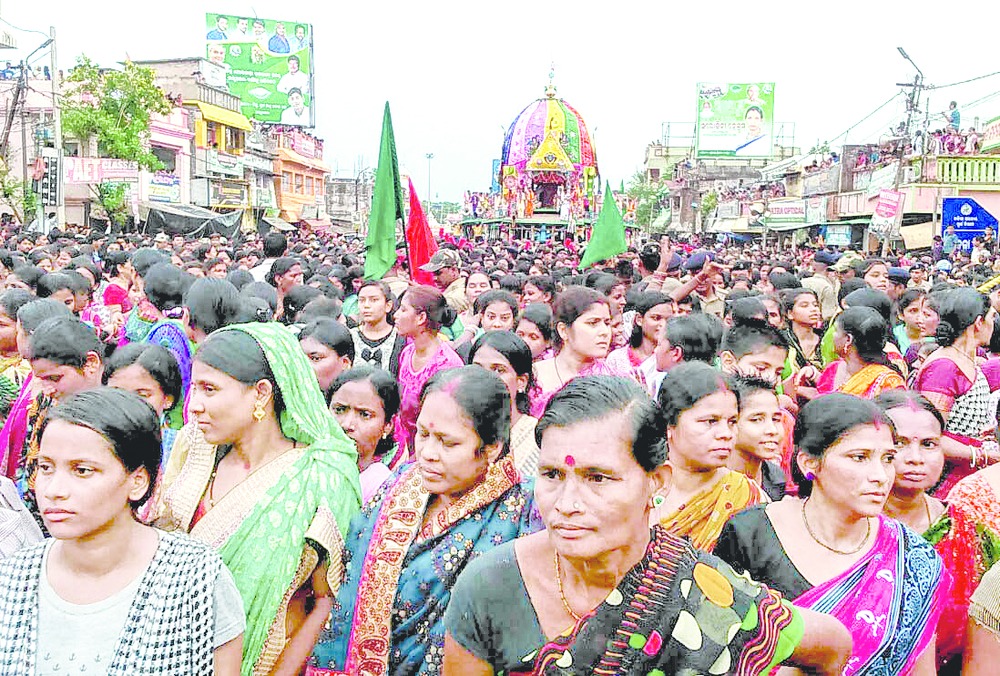
The other speciality is that only women devotees pull the chariot of Goddess Subhadra here.
Today, hundreds of devotees pulled Lord Balabhadra's chariot up to the Mausima (Gundicha) temple, and subsequently, the women devotees pulled the chariot of Goddess Subhadra half the way. Tomorrow, the chariot of Lord Jagannath would be pulled.
Rath yatra in Baripada began in 1575 on the initiative of the then ruler of Mayurbhanj estate, Maharaja Baidyanath Bhanja Deo. People from Jharkhand and Bengal gather here to witness the event, said octogenarian Sachindra Das.
"Earlier, sialilata (a type of wild creeper) was used as rope to pull the chariots. But nowadays, the coil rope is used. Besides, elephants used to pull the chariots in the past," he said.
The chariot-pulling of Goddess Subhadra, exclusively by the women devotes, began in 1975, the International Year of Women. At that time, only five women pulled the chariot in a symbolic manner. In the subsequent years, the experiment proved quite popular, and the same practice has been followed since then.
Elaborate security arrangements were made to ensure smooth conduct of the event. Twenty-two platoons of police were deployed and 19 closed-circuit television (CCTV) cameras were installed to keep tabs on the crowd.
For many women, the occasion stands for homecoming. Sarita Barik, 45, a native of Baripada, said: "This is an annual event, which I hardly afford to miss. I come here every year during car festival and take part in the pious job. I consider myself very fortunate and blessed to be a part of this event."
Another Baripada resident Bibhudtatta Das said: "Here, Nabakalebar (change of idols) is not conducted simultaneously with the event in Puri. It is performed here as and when required."
In Dharakote, too, devotees pulled the chariot today though the 20-year-old queen of the erstwhile Dharakote estate, Sulakhyana Gitanjali Devi, performed the chhera panhara (symbolic sweeping) of the chariot yesterday.
The delayed rath yatra in Dharakote facilitates the royalty to first take part in Puri car festival and come back to their kingdom in one day, sources in the royal family said.
More than 60,000 devotees assembled in Dharakote to take part in the festival.