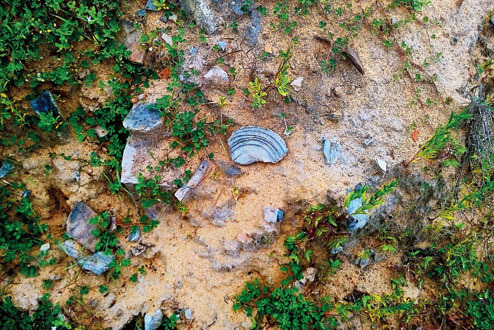

Artefacts discovered by the students at Garhabangara village in Puri district. Picture by Ashwinee Pati

The objects discovered by Utkal University students at the site. Picture by Ashwinee Pati
Bhubaneswar, Sept. 3: Utkal University students have discovered artefacts, which, experts say, belong to the period of Mauryan emperor Asoka, at Garhabangara village in Puri district.
Asoka had ruled most of the Indian subcontinent from 268 BC to 232 BC.
The excavated site is located 89km from Bhubaneswar and 17km from Konark.
Varsity students Ramakant Pradhan, Kailasha Bhoi, Purna Chandra Gohayata and Susanta Kumar Das, under the guidance of assistant professor Anam Behera of the department of ancient Indian history, culture and archaeology of Utkal University, conducted the excavation on August 26.
Findings of the exploration include stopper, terracotta dog handle that belongs to a pottery, red slip ware, bed ware, stamped pottery, net sinker, Maratona ware of Myanmar, Chinese porcelain and celadon, earthen hopscotch, ill-fired red ware and a fragmented terracotta wheel ring.
'The location of Dhauli and Sisupalgarh on the upper part of the Kushabhadra, Daya and Bhargavi rivers were well connected with Garhabangara village on the Kushabhadra river mouth and Manikapatans in the Chilika,' said Behera.
'Such proximity to the Daya and Bhargavi river mouth proves maritime importance of these rivers, for which material from Greece and other parts of the world reached to Sisupalgarh. These activities date back to the Asokan era. The discovery of a stopper among the excavated materials further confirms the period of the find,' he said.
'The excavated site is located between the Haraparvati temple at the village and the right bank of the Kushabhadra. These sites are 5km from the well-known port site Khalkatapatana on the same river bank near the sea coast,' said Behera.
More excavation will be conducted in the sites under guidance of the Archaeological Survey of India shortly.
Earlier, the varsity students had found 4,500-year-old artefacts at various locations in Khurda district and a 1,400-year-old Buddha idol.
The students had, in June, discovered rock shelters in the Khandapada forest range in Nayagarh district.
'We have been conducting a number of excavations in various parts of the state. We are in touch with the ASI and the state archaeology to carry forward research and find out the exact date of the findings,' said Behera.