
Shillong: The dredging of the Umïam reservoir in Meghalaya to remove silt deposits and enhance its storage capacity "does not appear to be an attractive plan", said Meghalaya power minister James K. Sangma in the Assembly here on Wednesday.
Raising the issue in the Assembly Mawphlang MLA Syntar Klas Sunn sought to know the measures taken by the government to reduce silt deposits and ensure that power generation is not affected.
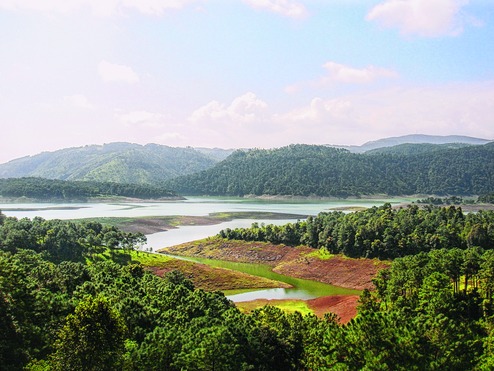
The Umïam dam was built in the early 1960s to store water for hydroelectric power generation. It is the mother reservoir for power generation of the entire state.
Earlier, Sunn questioned James for giving a negative reply to his query - whether the storage capacity of the Umïam lake has reduced considerably because of high siltation thereby adversely affecting power generation.
James admitted that increasing urbanisation of Shillong and its neighbouring areas has substantially increased the silt load in the two main tributaries of Umïam river - Umkhrah river and Umshyrpi - both of which flow through the heart of Shillong.
Preserving the live storage of the reservoir is of utmost importance as excessive silt load in the lake has lowered the storage.
Sharing the outcome of studies related to the assessment of siltation of the Umïam lake conducted in 1990 by Water and Power Consultancy Services (Wapcos) and by Tojo Vikas International Private Limited, New Delhi, in 2004, James said, the study by Wapcos indicated an average rate of siltation at 26.1 hectare metre per 100 square km per year, while the study carried out by Tojo Vikas was much more and elaborate.
Quoting the study by Tojo, he said the volume of sediment collected in the Umïam reservoir from 1965 to 2004 was 20.551 million cubic metres, which corresponds to a sedimentation rate of 23.79 hectare metre per 100 square km per year.
"The overall rate of sedimentation in 2004 in both the live and dead storages of the reservoir was 0.527 million cubic metre per year," James said. He also said the live storage of the reservoir in 2004 had reduced by 4.64 per cent and the dead storage had reduced by 36.33 per cent, adding when the Umïam reservoir turns 100 years old, the loss in live storage would be 15 per cent and the loss in dead storage would be 73 per cent.
James said according to the study, dredging of the reservoir to eliminate the silt deposits and enhance the storage capacity does not appear to be an attractive proposition as the dredging would be for 2.17 million cubic metres which is only 1.53 per cent of the live storage capacity of the reservoir.
He said the cost for dredging, even if it is just 1.53 per cent of the live storage, will cost about Rs 41 crore at the rate of Rs 189 per cubic metre, as in 2004, which is not economically viable.