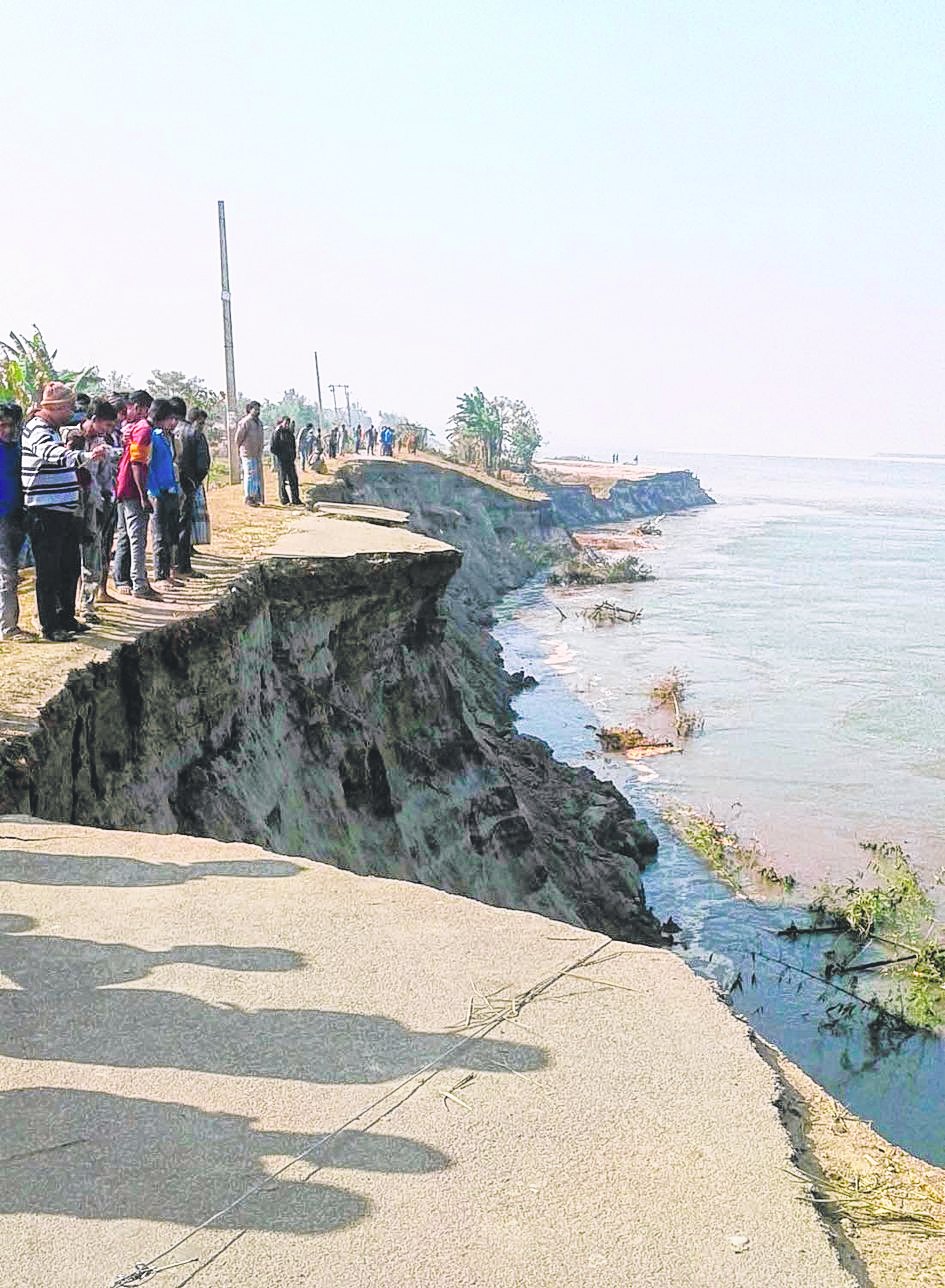

A portion of eroded land in Mankachar. Picture by UB Photos
Guwahati, Jan. 7: The National Jute Board is pushing for replacing synthetics by jute geotextiles (JGT) to prevent erosion in Assam.
The officials of the board today met engineers of the Brahmaputra Board, NF Railway and the Border Roads Organisation here and explained the potential of using jute geotextiles in various fields, including preventing erosion.
Jute geotextile's popularity has increased in different parts of the world and it has emerged as a strong alternative to synthetic geotextiles for many civil engineering applications.
Major applications of jute geotextiles are strengthening of roads, protection of river banks against erosion, control of surface soil detachment, slope management, stabilising embankments, prevention of railway track settlements and consolidation of soft soil.
The jute commissioner of the ministry of textile, Subrata Gupta, said eco-friendly jute geotextiles have proved its success in preventing erosion of the banks of about 40 rivers in states, including Bengal, Odisha and Himachal Pradesh. He said as the geotextiles have proved itself in Himachal Pradesh where the river current is very strong, it will succeed in Assam too as the nature of the rivers in both the states is similar.
'During our projects we used the jute geotextiles successfully to prevent river bank erosion. But lack of awareness among the engineers about its usefulness and durability has been the bottleneck in its extensive use. Today, we explained to the participants about its utility in different projects, including preventing erosion,' Gupta said.
In the nineties, the jute geotextiles was used to prevent erosion in parts of Majuli. A few years back, it was also used in the Sonapur area of Meghalaya to prevent erosion of hill slopes.
Officials of the National Jute Board said using jute geotextiles in preventing erosion will bring down expenditure by 50 per cent. While synthetic costs Rs 120 per square metre, it is around Rs 60 per square metre for jute geotextiles.
The officials of the jute board said NF Railway has also procured 80,000 square metres of the geotextiles to be used alongside the erosion-prone portion of railway tracks in the region, including Garo hills.
Next to Bengal, Assam is the largest producer of jute in the country although there are very few mills in the state producing simple bags and other materials and they are yet to start geotextiles production.
The officials of NJB said they have succeeded by using the material in implementation of about 190 different projects in different states, but barring Bengal, no state has shown much interest in promoting jute in a big way.