 |
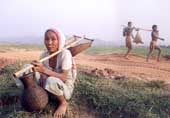
| ‘Practices and technologies of the traditional fishermen communities were also geared towards a sustainable harvest and conservation of fishery resources’. Picture by S.H. Patgiri |
Traditional societies have a vast wealth of knowledge about their environment and a movement to revive the system is of utmost importance
Biodiversity in various parts of the world, especially the Northeast, has been facing a threat as development encroaches on the land and traditions of the indigenous people. Traditional societies have a vast wealth of knowledge about their environment — built up over the centuries. Not only does this knowledge include information about different species of animals and plants, their behaviour and uses, but also about sustainable use and long-term conservation. Records in the form of written as well as unwritten traditional lores prove that traditional societies have a very rounded concept of ecosystem management — traditional but nonetheless scientific.
Indigenous societies — also known as ecosystem people — remain strongly dependent on natural biological resources gathered with their own labour from a relatively restricted resource pool surrounding their settlements. In the indigenous community system, resource use and conservation is integrated. No distinction is made between resources and habitat for conservation and those for use. There is usually no concept of wilderness. The only exception would be sacred landscapes, habitats and species which are out of bounds.
Take for example the Northeast tribal communities’ sacred groves, sacred ponds, sacred patches of grasslands, sacred animals and the like. These are all biological resources that have been preserved by tradition. Certain species of plants and animals have been preserved on account of sacred qualities attributed to them. The most common examples are those of ficas religiosa, neem, mango and woodapple. Plants and animals worshipped as totems also symbolise the kinship ties of humans and nature. The practice of certain taboos with regard to resource extraction can also be interpreted as conservation practices cast in religious idioms, since most of them allow for regeneration and perpetuation of species.
In addition to the belief systems, which condition relations between human beings and bio-diversity, the social, political and economic relation between human beings themselves influence or control resource use. These include structures for management of common property resources, customary tenure rights, customary laws and rules regarding resources, localised economics and so on. Traditional community-based management of common property resources typically imposes restrictions on the indiscriminate use of resources and ensures some form of distribution of benefits and livelihood opportunities. An example is the self-managed village commons — water bodies, forests and pastures.
On the other hand, people who have access to resources from far and wide, perhaps covering the entire biosphere — and known as biosphere people — are part of an extractive economy that has most rapidly expanded in the last two centuries. They have elaborated a science of management that claims to promote sustainable use of resources, but which are actually ineffective in ensuring it.
Therefore, preservation of traditions and other rights of the indigenous people is the ultimate path for conservation of biodiversity of a particular area. Indigenous communities of the Northeast have many age-old traditional practices in different fields like forestry, agriculture, animal husbandry and ethnomedicine, which have a great impact in conservation of biodiversity. For instance, Meghalaya is known to have one of the richest ethnomedicine traditions. The state’s traditional health care system serves more than 70 per cent of the population and is based on the rich diversity of medicinal plants and associated knowledge.
The practices and technologies of the traditional fishermen communities were also geared towards a sustainable harvest and conservation of fishery resources. As a matter of fact, only the traditional fishery management system can conserve the vast fish diversity of this region. Therefore, exploration of traditional fishery management techniques, which are on the verge of extinction, is the need of the hour.
With state and private corporations taking over common property resources like forests and wetlands, local people have been alienated and traditional management systems have broken down. Over-exploitation and diversion of resources from rural to urban sector, the physical displacement of communities by development projects and changes in lifestyle aspirations have also eroded the traditional systems.
Vast archives of knowledge and expertise are being thrown into oblivion, leaving humanity in danger of losing its past and perhaps jeopardising its future as well. Knowledge is also disappearing because the young have embraced the view that traditional ways are irrelevant.
Most of the ethnic groups of the Northeast maintain a holistic tradition of conserving plants and animals. They have plant, animal and water cults and as part of religious tradition preserve a large number of valuable plant and animal species of this region. There is also a strong heritage of preserving water bodies. Even though the tribal communities of the region were basically hunter-gatherers, yet they do not hunt all animals nor gather all varieties of plants. Many plant and animal species are worshipped, with most communities believing that definite plant and animal species are their forefathers. In this way, a large number of plants and animals are traditionally preserved in the region — which in turn has been responsible for this part of the world turning into a biodiversity hotspot.
There are many great examples of indigenous systems towards conservation of biodiversity. Most of the tribes of the region practice age-old water harvesting systems. Construction of dong for irrigation of valley fields, large tanks for irrigation and other purposes, traditional science for locating the water table underground, terrace cultivation in the hills, bamboo drip irrigation in the hill slopes are some of the examples of indigenous systems for biodiversity conservation.
The most elaborate and powerful ethno-medicinal system of the region can also play a vital role in conservation of biodiversity.
Exploration of various useful indigenous systems in the Northeast is thus the need of the hour. A strong peoples’ movement to fight against the encroachment on land and tradition of the indigenous communities and to revive the indigenous systems is of utmost importance to conserve the biodiversity of this region.